

- Updated: March 29, 2026
- 7 min read
A‑Evolve: Open‑Source Framework Automates Agentic AI State Mutation and Self‑Correction
A‑Evolve is a universal, open‑source framework that automates the entire lifecycle of autonomous AI agents, turning manual prompt‑tuning into a self‑correcting, five‑stage mutation loop.
What Is A‑Evolve and Why It Matters
Developed by a research team at Amazon, A‑Evolve promises a “PyTorch moment” for agentic AI. Just as PyTorch liberated deep‑learning practitioners from hand‑crafted gradient code, A‑Evolve liberates AI engineers from the tedious cycle of manually adjusting prompts, tools, and code when an autonomous agent fails a task. By treating an agent as a mutable collection of files—manifest, prompts, skills, tools, and memory—the framework enables agents to self‑evolve toward higher performance with zero human intervention.
The impact is immediate for tech‑savvy professionals, AI researchers, and developers who build autonomous agents for software engineering, data analysis, or customer support. Instead of spending hours debugging a failed GitHub issue resolution, the mutation engine rewrites the agent’s own configuration, validates the change, and redeploys the improved version automatically.
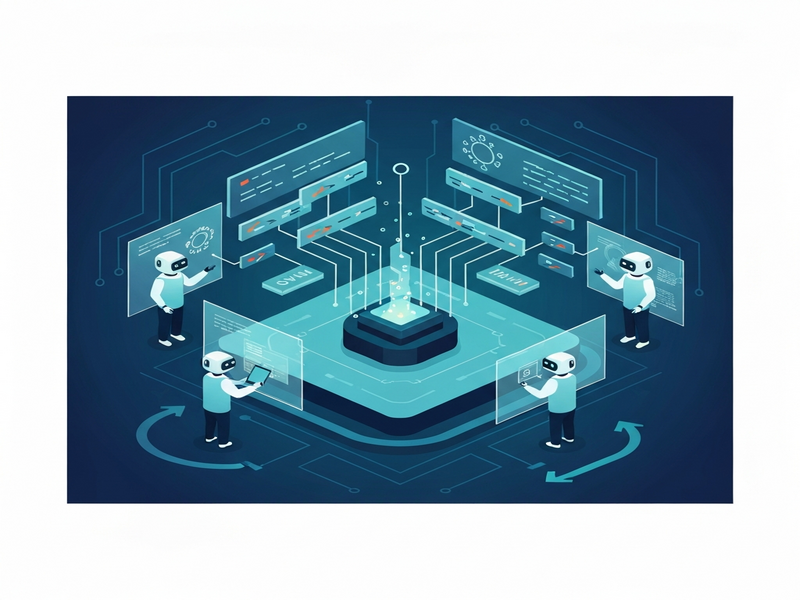
The Five‑Stage Mutation Loop That Powers Autonomous Improvement
A‑Evolve’s core engine follows a deterministic, closed‑loop process that guarantees stable progress. Each iteration consists of five distinct stages, each designed to be MECE (Mutually Exclusive, Collectively Exhaustive) and easily parsable by large language models.
1. Solve
In the Solve phase, the agent tackles a target task inside a user‑defined environment (the “Bring Your Own Environment” or BYOE). Whether it is fixing a bug on agentic AI platforms or generating a marketing copy, the agent runs with its current configuration.
2. Observe
During Observe, the framework captures structured logs, performance metrics, and benchmark feedback. This data is stored in the memory/ directory, providing a reproducible snapshot of the agent’s behavior.
3. Evolve
The Evolve stage is where the mutation engine analyses the observations, pinpoints failure points, and programmatically edits the files in the manifest.yaml, prompts/, skills/, or tools/ directories. For example, a missing tool call can be added as a new skill file, or a prompt can be refined based on error patterns.
4. Gate
Before committing the change, Gate runs a suite of fitness functions—regression tests, safety checks, and benchmark re‑evaluations. If the new mutation degrades any critical metric, the gate rejects it, preventing regressions.
5. Reload
Finally, Reload restarts the agent with the updated workspace, tagging the new version in Git (e.g., evo-3). The loop then repeats, driving continuous improvement.
Modular “Bring Your Own” Architecture and Seamless Git Integration
A‑Evolve is deliberately modular, allowing developers to plug in any component that fits their workflow:
- Bring Your Own Agent (BYOA): Supports ReAct loops, multi‑agent orchestration, or custom LLM pipelines.
- Bring Your Own Environment (BYOE): Works with Docker sandboxes, cloud CLIs, or on‑premise servers.
- Bring Your Own Algorithm (BYO‑Algo): Choose LLM‑driven mutation, reinforcement learning, or evolutionary strategies.
All changes are automatically committed to a Git repository. If a mutation fails the Gate stage, the system rolls back to the last stable tag, ensuring reproducibility and auditability—features that resonate with enterprise governance standards.
Benchmark Performance: From Baseline to State‑of‑the‑Art
The research team evaluated A‑Evolve on four high‑profile benchmarks using a base Claude‑series model. The results demonstrate that automated evolution can push agents into top‑tier rankings without any manual tuning.
| Benchmark | Score | Rank | Improvement |
|---|---|---|---|
| MCP‑Atlas | 79.4 % | #1 | +3.4 pp |
| SWE‑Bench Verified | 76.8 % | ≈#5 | +2.6 pp |
| Terminal‑Bench 2.0 | 76.5 % | ≈#7 | +13.0 pp |
| SkillsBench | 34.9 % | #2 | +15.2 pp |
Notably, on MCP‑Atlas the framework evolved a generic 20‑line prompt into an agent with five newly authored skills, propelling it to the leaderboard’s summit. These gains were achieved with zero manual harness engineering, underscoring the power of the mutation loop.
How A‑Evolve Beats Traditional Manual Tuning
Manual tuning typically follows a linear, human‑in‑the‑loop process:
- Run the agent on a task.
- Inspect logs and identify failure points.
- Rewrite prompts or add tools.
- Retest and repeat.
This approach suffers from three major drawbacks:
- Scalability bottleneck: Each iteration requires human time, limiting the number of tasks an engineer can optimize per week.
- Inconsistent quality: Human bias leads to uneven improvements across agents.
- Reproducibility risk: Manual edits are rarely version‑controlled, making rollback difficult.
In contrast, A‑Evolve’s automated loop delivers:
- Continuous, data‑driven refinements.
- Git‑tagged mutations for full audit trails.
- Parallel evolution across multiple environments, thanks to the BYOE design.
What Amazon Researchers Say
“A‑Evolve represents a paradigm shift. By automating the harness engineering process, we enable agents to self‑improve at a speed that would be impossible for a human team. The five‑stage loop provides both rigor and flexibility, making it suitable for any domain—from software debugging to creative content generation.” – Lead researcher, Amazon AI Labs
Take the Next Step with UBOS: Build, Deploy, and Scale Your Agentic AI
If you’re ready to experiment with autonomous agents or integrate A‑Evolve‑style automation into your products, UBOS offers a suite of tools that align perfectly with the framework’s philosophy.
UBOS homepage
Explore the full platform and discover how UBOS can host your evolving agents.
UBOS platform overview
Get a high‑level view of the modular architecture that mirrors A‑Evolve’s BYO approach.
AI marketing agents
Deploy self‑optimizing agents for campaign creation, copywriting, and performance analytics.
UBOS partner program
Join a community of innovators and get co‑marketing benefits.
Enterprise AI platform by UBOS
Scale agentic AI across large organizations with robust security and compliance.
Web app editor on UBOS
Visually design your agent workspace, mirroring the A‑Evolve file structure.
Workflow automation studio
Orchestrate multi‑step pipelines that can trigger the mutation loop on demand.
UBOS pricing plans
Choose a plan that fits startups, SMBs, or enterprises.
UBOS portfolio examples
See real‑world deployments of autonomous agents in action.
UBOS templates for quick start
Kick‑start your agent workspace with pre‑built templates like AI Article Copywriter or AI SEO Analyzer.
Whether you are a startup looking for rapid prototyping (UBOS for startups) or an SMB seeking operational efficiency (UBOS solutions for SMBs), the platform’s modularity aligns with A‑Evolve’s BYO philosophy.
Explore Related AI Integrations on UBOS
UBOS also offers a rich ecosystem of AI integrations that can be combined with A‑Evolve‑style agents:
- Telegram integration on UBOS – enable real‑time agent interaction via chat.
- ChatGPT and Telegram integration – bridge conversational AI with messaging.
- OpenAI ChatGPT integration – leverage the latest LLMs for mutation logic.
- Chroma DB integration – store vector embeddings for fast retrieval.
- ElevenLabs AI voice integration – give your agents a natural speaking voice.
Conclusion: A‑Evolve Sets a New Standard for Agentic AI
A‑Evolve’s systematic, five‑stage mutation loop, modular BYO design, and Git‑backed reproducibility collectively redefine how autonomous agents are built and refined. The benchmark results prove that automated self‑correction can achieve state‑of‑the‑art performance without the costly manual tuning cycle that has long hampered AI development.
For developers eager to experiment, the open‑source repository is ready to clone. For enterprises seeking production‑grade reliability, UBOS provides the infrastructure, templates, and integration ecosystem to bring A‑Evolve‑style agents into real‑world workflows.
Stay ahead of the AI curve—explore A‑Evolve, integrate with UBOS, and let your agents evolve themselves.
Read the original MarkTechPost story for more background: A‑Evolve: The PyTorch Moment for Agentic AI Systems.
Andrii Bidochko
CTO UBOS
Andrii Bidochko is an AI entrepreneur and researcher focused on AI agents, reinforcement learning, and autonomous systems. He writes about the technologies shaping the future of machine intelligence, from frontier models and agent architectures to real-world AI applications.