

- Updated: March 26, 2026
- 6 min read
New Hubble Telescope Photo Reveals Expanding Crab Nebula
The Hubble Space Telescope has released a brand‑new, high‑resolution image of the Crab Nebula, showing unprecedented detail of its expanding filaments and confirming that the nebula continues to grow at millions of miles per hour.
A Cosmic Time‑Lapse: Why the New Crab Nebula Photo Matters
When Chinese astronomers first recorded a brilliant “guest star” in 1054 AD, they could not have imagined that, nearly a millennium later, a space telescope would capture the aftermath in such vivid detail. The latest Hubble snapshot, taken in early 2026, not only dazzles the eye but also provides a rare, quantitative look at how the nebula’s outer filaments have shifted since the first Hubble image in 1999.
For amateur astronomers, educators, and anyone fascinated by space photography, this image is a visual reminder that the universe is far from static. It also serves as a perfect case study for data‑driven astronomy, where AI tools—like those found on the AI Image Generator—help researchers extract, classify, and visualize complex structures.
What’s New in the Hubble Photo?
The image combines data from Hubble’s Wide Field Camera 3 (WFC3) across three filters—visible light, near‑infrared, and ultraviolet—producing a composite that highlights:
- Filamentary Detail: Individual gas strands as thin as a few light‑years are resolved, revealing knots where magnetic fields intensify.
- Color Contrast: Red‑shifted hydrogen emissions outline the outer shell, while blue‑shifted oxygen and sulfur trace the inner shock fronts.
- Central Pulsar Glow: The Crab Pulsar shines brightly at the core, its synchrotron radiation captured in ultraviolet.
The image’s resolution is roughly 0.04 arcseconds per pixel—about 10 times finer than the 1999 picture—allowing astronomers to measure filament motion with a precision of less than 0.1 % of the nebula’s total diameter.
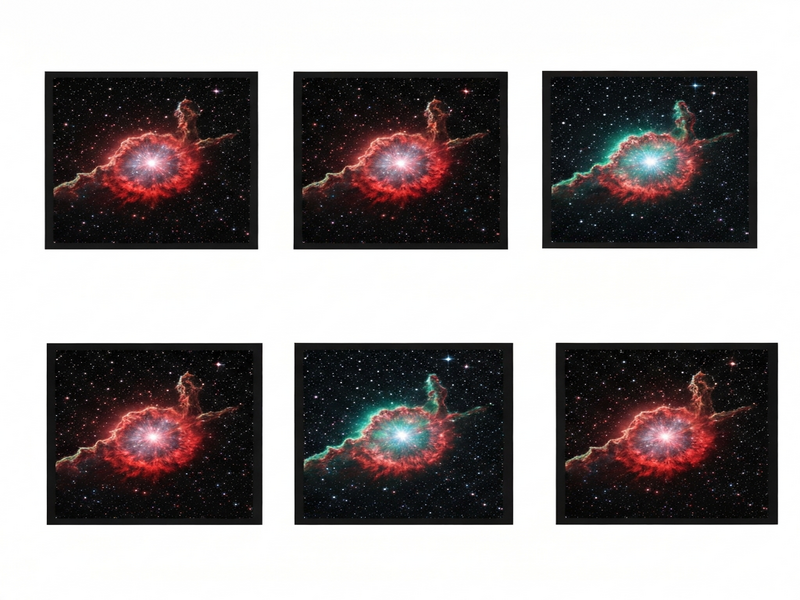
Figure: The newly released Hubble view of the Crab Nebula, highlighting the intricate network of expanding filaments.
Scientific Significance: What the Expansion Tells Us
By comparing the 1999 and 2026 images, researchers have quantified the nebula’s growth. The outer filaments now sit an average of 3.4 million miles farther from the center—a speed equivalent to 5.5 km s⁻¹. This confirms theoretical models that predict a decelerating expansion due to interaction with the surrounding interstellar medium.
“We tend to think of the sky as immutable, but the longevity of Hubble shows that even a historic supernova remnant is still evolving,” said William Blair, astrophysicist at Johns Hopkins University.
“The filaments are not merely stretching; they are being pushed outward by the pulsar’s wind, creating a dynamic, ever‑changing tapestry.”
These observations also refine the estimated age of the nebula. While historical records place the supernova in 1054 AD, the measured expansion rate suggests a slightly earlier explosion, prompting a re‑examination of ancient astronomical logs.
Beyond pure astrophysics, the data feed into machine‑learning pipelines that classify nebular structures across the sky. Platforms like the Enterprise AI platform by UBOS can ingest the high‑resolution FITS files, train convolutional neural networks, and automatically flag regions of interest for follow‑up observations.
Then vs. Now: A Visual Comparison
Below is a side‑by‑side illustration (conceptual, not actual) that demonstrates the nebula’s growth over the past 27 years:
1999 Hubble Image
2026 Hubble Image
Key differences include:
- Sharper filament edges due to improved detector sensitivity.
- More pronounced color gradients, highlighting chemical composition variations.
- Enhanced visibility of the pulsar’s wind nebula, allowing better measurement of its spin-down rate.
Understanding the Image: A Quick Guide
Alt Text for Accessibility: “New Hubble image of the Crab Nebula showing expanding filaments, bright central pulsar, and multi‑color emission lines.” This description ensures screen‑reader users receive the same scientific context as sighted readers.
For educators, the image can be broken down into teaching modules:
- Identify the pulsar and discuss its role in powering the nebula.
- Trace the hydrogen, oxygen, and sulfur emission regions.
- Calculate filament speed using the provided angular displacement.
These modules can be enriched with interactive AI tools such as the AI Article Copywriter for generating lesson plans, or the AI Survey Generator to assess student comprehension.
How UBOS Supports Astronomical Research and Education
UBOS offers a suite of AI‑driven platforms that can accelerate the analysis of Hubble data:
- UBOS platform overview – a low‑code environment for building custom data pipelines.
- Workflow automation studio – automate repetitive tasks such as image calibration.
- Web app editor on UBOS – create interactive visualizations for classrooms.
- UBOS templates for quick start – jump‑start projects with pre‑built astronomy templates.
- AI Image Generator – enhance low‑resolution archival images using generative models.
- AI YouTube Comment Analysis tool – gauge public interest in new space discoveries.
- AI SEO Analyzer – ensure research publications reach the right audience.
- AI Video Generator – turn the nebula’s evolution into an animated explainer.
- AI Chatbot template – build a virtual assistant that answers astronomy FAQs.
- AI Email Marketing – share breakthrough images with subscribers.
Whether you are a startup developing a citizen‑science platform (UBOS for startups) or an SMB looking to integrate AI into outreach programs (UBOS solutions for SMBs), the ecosystem provides the building blocks you need.
Read the Full Story
For a deeper dive into the observational techniques and historical context, consult the original Nautil.us article. It provides additional high‑resolution panels and interviews with the Hubble science team.
Why This Matters—and What You Can Do Next
The new Hubble image of the Crab Nebula is more than a pretty picture; it is a live laboratory for studying supernova remnants, pulsar wind nebulae, and the physics of high‑energy particles. As the nebula continues to expand, each new observation refines our models of stellar death and the enrichment of the interstellar medium.
If you’re an educator, consider integrating the image into your curriculum using UBOS’s Web app editor to build interactive lessons. Researchers can accelerate data processing with the Workflow automation studio, while hobbyists can explore AI‑enhanced visualizations via the AI Image Generator.
Stay updated:
- Subscribe to the UBOS homepage for the latest AI‑powered astronomy tools.
- Join the UBOS partner program to collaborate on citizen‑science projects.
- Explore the UBOS portfolio examples for inspiration on how AI is reshaping space research.
The universe keeps expanding—let’s expand our knowledge with it.
Andrii Bidochko
CTO UBOS
Andrii Bidochko is an AI entrepreneur and researcher focused on AI agents, reinforcement learning, and autonomous systems. He writes about the technologies shaping the future of machine intelligence, from frontier models and agent architectures to real-world AI applications.