

- Updated: March 16, 2026
- 5 min read
Python Type Checker Conformance Comparison: Insights and Rankings
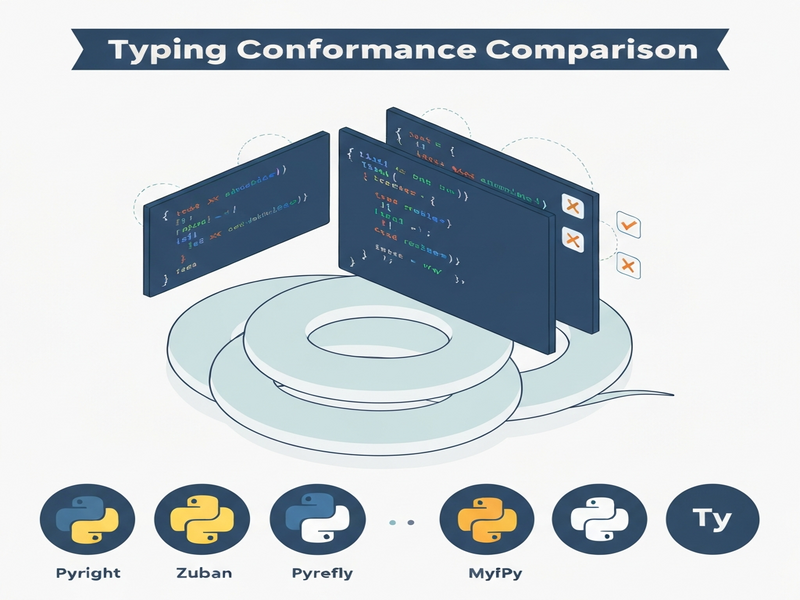
Python typing conformance comparison shows that Pyright leads with a 97.8% pass rate, followed by Zuban (96.4%), Pyrefly (87.8%), mypy (58.3%), and ty (53.2%).
Why Python Type Checkers Matter More Than Ever
Static analysis has become a non‑negotiable part of modern Python development. As codebases grow, the safety net provided by type hints and type checkers prevents costly runtime bugs and improves IDE assistance. Yet, not all type checkers follow the Python typing specification with the same rigor. Understanding the typing conformance of each tool is essential for teams that want reliable, future‑proof code.
In this article we dissect the latest conformance results, explain why they matter, and give you a practical roadmap for picking the right checker for your workflow.
What Is Typing Conformance?
Typing conformance measures how closely a type checker adheres to the PEP 484 and subsequent typing PEPs that define the semantics of typing constructs. The community maintains a conformance test suite with roughly 140 test files, each annotated with expected error locations. When a checker runs the suite, two outcomes are recorded:
- False positives – the checker flags an error where the spec says the code is valid.
- False negatives – the checker misses an error that the spec requires to be reported.
These metrics give developers a quantitative view of a tool’s “spec‑faithfulness.” The higher the pass rate, the fewer surprises you’ll encounter when you adopt advanced typing features like TypedDict extra items, TypeGuard, or ParamSpec.
Latest Test Suite Results (March 2026)
The table below reproduces the public dashboard numbers from the original conformance study. Results are expressed as fully passing tests / total tests, pass percentage, and counts of false positives/negatives.
| Type Checker | Fully Passing | Pass Rate | False Positives | False Negatives |
|---|---|---|---|---|
| Pyright | 136/139 | 97.8% | 15 | 4 |
| Zuban | 134/139 | 96.4% | 10 | 0 |
| Pyrefly | 122/139 | 87.8% | 52 | 21 |
| mypy | 81/139 | 58.3% | 231 | 76 |
| ty | 74/139 | 53.2% | 159 | 211 |
These numbers are a snapshot; many projects (including Pyrefly and ty) are in active beta and will likely improve in the coming weeks.
Why Conformance Matters – And When It Doesn’t
High conformance reduces the friction you feel when you adopt new typing features. Below are three concrete scenarios where a low‑conformance checker can become a blocker:
- Library integration headaches. A third‑party library may use
TypedDictwithextra_items=True. If your checker flags extra keys as errors (a false positive), you’ll spend time adding# type: ignorecomments or writing redundant casts. - Refactoring surprises. When you migrate a codebase to
ProtocolorParamSpec, a checker that fails to enforce the spec (false negatives) may silently accept invalid patterns, leading to runtime failures that are hard to debug. - Team onboarding. New hires rely on IDE diagnostics. Inconsistent error reporting erodes confidence in the type system and can cause developers to abandon type hints altogether.
However, conformance is not the whole story. The test suite focuses on edge‑case compliance, not on everyday developer experience. For example, type inference quality—how well a checker guesses types for unannotated variables—varies dramatically and is not captured by the conformance metrics. Likewise, performance on large monorepos, integration with Workflow automation studio, and the clarity of error messages are equally important.
Choosing the Right Type Checker for Your Project
When you decide which tool to adopt, weigh the following dimensions alongside raw conformance numbers:
1. Inference & Type Narrowing
Tools like OpenAI ChatGPT integration can be paired with a checker to provide AI‑driven suggestions for missing annotations. Pyright and Pyrefly both excel at narrowing via isinstance checks, while mypy’s inference can be more conservative.
2. Performance on Large Codebases
Pyright’s incremental mode processes millions of lines in seconds, making it ideal for monorepos. If you need a fast, cloud‑native solution, consider the Enterprise AI platform by UBOS, which can run Pyright as part of a CI pipeline.
3. IDE & LSP Support
All major editors support the Language Server Protocol (LSP), but the quality of diagnostics varies. Pyright’s VS Code extension provides real‑time underlines and quick‑fixes, while mypy often requires a separate plugin.
4. Ecosystem Compatibility
Frameworks such as Django, FastAPI, and Pydantic have custom stubs. Pyright and Pyrefly ship with up‑to‑date stubs for these libraries, whereas mypy may need manual --ignore-missing-imports flags.
5. Cost & Licensing
All the major checkers are open source, but enterprise support differs. If you need SLA‑backed assistance, the UBOS partner program offers consulting that can integrate any checker into your CI/CD workflow.
6. Extensibility with AI‑Powered Templates
UBOS’s templates for quick start include an AI SEO Analyzer and an AI Article Copywriter. Pairing these with a high‑conformance checker ensures your generated code respects the typing spec from day one.
In practice, many teams adopt a hybrid approach: use Pyright for fast local feedback, then run mypy in CI for a broader, more permissive check. The key is to align the toolset with your team’s priorities—speed, accuracy, or ecosystem coverage.
Conclusion & Next Steps
Typing conformance is a valuable benchmark, but it’s only one piece of the puzzle. By combining a high‑conformance checker like Pyright with UBOS’s low‑code Web app editor and AI marketing agents, you can build robust, type‑safe applications faster than ever.
Ready to experiment?
- Explore the UBOS for startups free tier and spin up a prototype that uses Telegram integration on UBOS for real‑time alerts.
- Try the GPT‑Powered Telegram Bot template to see how static typing improves bot reliability.
- Check out the UBOS pricing plans and pick a tier that includes CI integration for your chosen type checker.
Stay ahead of the curve—adopt a type checker with strong conformance, pair it with AI‑enhanced development tools, and let your codebase reap the benefits of safety, speed, and scalability.
“Choosing the right type checker is less about the highest pass rate and more about the synergy with your development workflow.” – About UBOS
Andrii Bidochko
CTO UBOS
Andrii Bidochko is an AI entrepreneur and researcher focused on AI agents, reinforcement learning, and autonomous systems. He writes about the technologies shaping the future of machine intelligence, from frontier models and agent architectures to real-world AI applications.