

- Updated: February 24, 2026
- 5 min read
Conduent Data Breach Affects Over 25 Million: Security Incident Details and Response
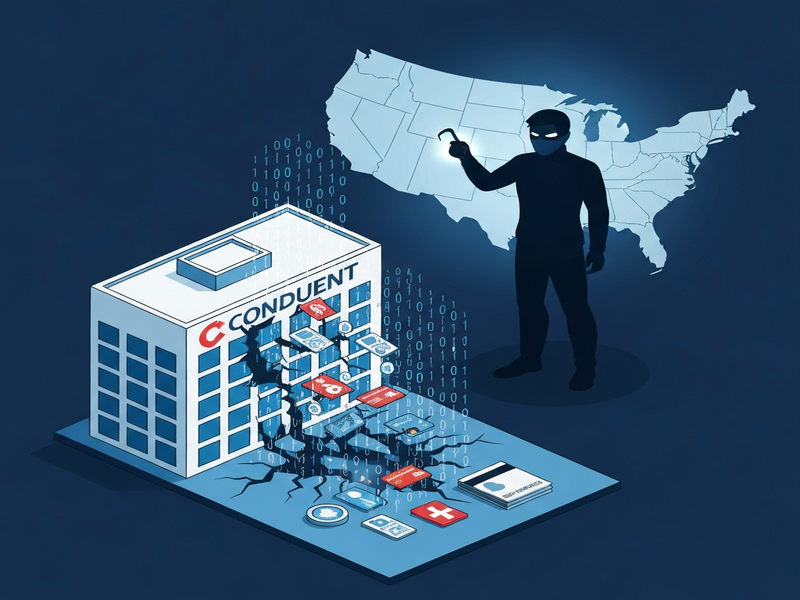
The Conduent data breach, first reported in January 2025, has now exposed the personal information of at least **25 million** individuals across the United States.
What happened? A concise overview
Conduent, a major provider of government‑contracted printing, mailroom, and payment‑processing services, suffered a ransomware‑driven security incident that has grown into one of the largest personal‑data leaks of the decade. The breach now affects more than 25 million people, including beneficiaries of state assistance programs, employees of large corporations, and private citizens whose data were processed through Conduent’s platforms.
Scale of the breach and who is affected
According to public breach‑notification letters compiled by TechCrunch, the compromised records span three states that account for the bulk of the exposure:
- Texas – roughly 15.4 million individuals
- Oregon – about 10.5 million individuals
- Additional notifications covering several hundred thousand residents in Massachusetts, New Hampshire, and Washington
The data set includes:
- Full legal names
- Dates of birth
- Residential addresses
- Social Security numbers (SSNs)
- Health‑insurance identifiers and medical‑record details
Because Conduent’s services touch more than 100 million people nationwide, the ripple effect of this breach could extend far beyond the states listed above.
Timeline of the incident
| Date | Event |
|---|---|
| January 2025 | Ransomware group claims initial intrusion; Conduent begins internal investigation. |
| October 2025 | First public “Incident Notice” posted on Conduent’s website (hidden from search engines via a noindex tag). |
| February 2026 | TechCrunch aggregates breach‑notification letters, confirming exposure of at least 25 million records. |
The staggered disclosure pattern has drawn criticism from privacy advocates, who argue that delayed transparency hampers timely mitigation.
Conduent’s response and public statements
Conduent’s official communications have been limited to brief breach‑notification letters sent to affected individuals and a terse “Incident Notice” page. In a recent interview, spokesperson Sean Collins declined to disclose the total number of notifications sent or the rationale behind the hidden web page.
Key elements of Conduent’s response include:
- Offering free credit‑monitoring services for a 12‑month period.
- Advising victims to monitor bank statements and file fraud alerts with credit bureaus.
- Stating that the company has engaged third‑party forensic experts to assess the breach.
Critics note that the company’s approach mirrors the “security‑by‑obscurity” tactics seen in earlier high‑profile incidents, such as the Change Healthcare hack of 2024.
Impact on consumers, businesses, and public agencies
Beyond the immediate risk of identity theft, the breach threatens the operational continuity of several state‑run assistance programs that rely on Conduent’s data pipelines. Potential consequences include:
- Increased fraud attempts on food‑stamp, unemployment, and Medicaid benefits.
- Disruption of payroll and benefits processing for large corporate clients.
- Regulatory scrutiny from the Federal Trade Commission (FTC) and state attorneys general.
For IT security professionals, the incident underscores the importance of multi‑factor authentication (MFA), zero‑trust network architecture, and continuous monitoring of third‑party vendors.
Expert commentary on data‑security implications
“When a contractor that processes government benefits is compromised, the fallout is not just personal—it can destabilize public‑service delivery at scale.” – Dr. Maya Patel, Chief Information Security Officer, CyberGuard Labs
Dr. Patel emphasizes three actionable takeaways for organizations that outsource critical data handling:
- Vendor risk assessments must be refreshed quarterly, with a focus on ransomware resilience.
- Data minimization – only store the fields absolutely required for service delivery.
- Incident‑response drills that include third‑party coordination scenarios.
These recommendations align with best‑practice guides found on the UBOS data security page and the UBOS breach‑response resources.
Further reading and UBOS resources for security‑focused teams
UBOS offers a suite of tools and educational content that can help security officers harden their environments and respond faster to incidents like the Conduent breach.
UBOS homepage
Explore the full platform and discover how AI‑driven automation can reduce manual data‑handling errors.
About UBOS
Learn about our mission to empower enterprises with secure, low‑code AI solutions.
UBOS platform overview
A deep dive into the architecture that isolates sensitive data and enforces role‑based access.
UBOS for startups
Startups can leverage built‑in security controls while scaling rapidly.
UBOS solutions for SMBs
Small‑ and medium‑size businesses get enterprise‑grade protection without the overhead.
Enterprise AI platform by UBOS
Integrate AI‑powered monitoring and anomaly detection across your data pipelines.
Web app editor on UBOS
Rapidly prototype secure front‑ends for internal tools without writing code.
Workflow automation studio
Automate breach‑response workflows, from ticket creation to stakeholder notification.
UBOS pricing plans
Transparent pricing models that scale with your security needs.
UBOS portfolio examples
Case studies showing how other organizations have fortified their data pipelines.
UBOS templates for quick start
Pre‑built templates such as the AI SEO Analyzer and AI Article Copywriter accelerate secure app development.
SEO meta description (max 160 characters)
Conduent data breach exposes 25 M records. Learn the timeline, impact, expert insights, and how UBOS can help secure your data.
Stay ahead of data‑security threats
If you’re an IT security professional or data‑privacy officer, don’t wait for the next headline. Explore UBOS’s AI marketing agents, partner program, and the full suite of security‑focused templates to build resilient, compliant solutions today.
Andrii Bidochko
CTO UBOS
Andrii Bidochko is an AI entrepreneur and researcher focused on AI agents, reinforcement learning, and autonomous systems. He writes about the technologies shaping the future of machine intelligence, from frontier models and agent architectures to real-world AI applications.