

- Updated: February 21, 2026
- 7 min read
Lexega Turns SQL into Deterministic Signal Pipelines – A New Era for Data Processing
Lexega’s SQL‑to‑signals technology instantly converts raw SQL scripts into deterministic, machine‑readable semantic signals, allowing data teams to enforce CI/CD policies, catch hidden bugs, and automate data‑pipeline governance.
Why SQL Needs a Guardrail Layer
Data engineers and AI developers know the pain: a pull request filled with a massive diff looks clean, tests pass, yet a single dangerous statement slips through because no human can read every line. As AI‑generated SQL proliferates, the risk of “invisible bugs” skyrockets. Lexega solves this by inserting a deterministic analysis step between code written and code deployed. The result is a set of signals—structured events that describe exactly what a statement does—followed by policy‑driven decisions (allow, warn, block).
Lexega’s SQL‑to‑Signals Pipeline in a Nutshell
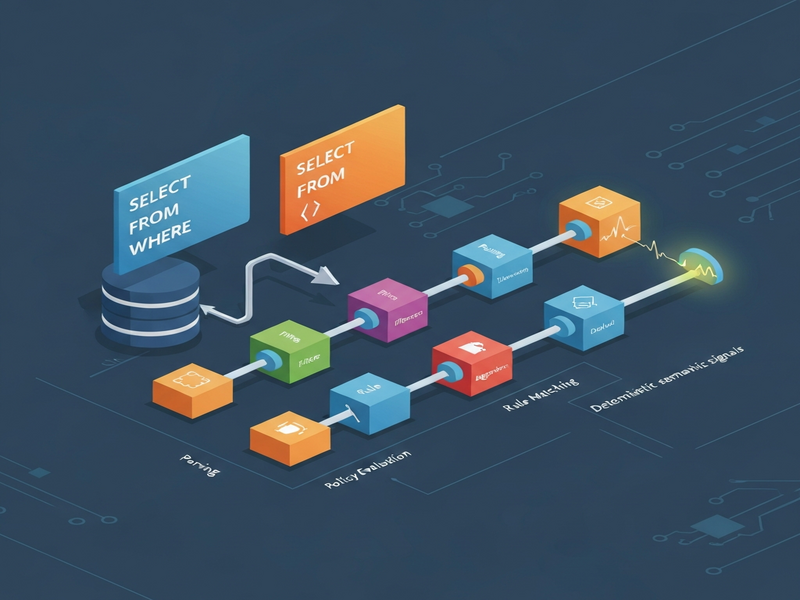
Lexega follows a clear, MECE‑structured pipeline:
- Tokenize & Parse – Handles multi‑statement scripts, Jinja, and dbt templates.
- Semantic Extraction – Walks the AST to surface facts such as tables read/written, grants, and policy changes.
- Signal Generation – Emits categorical signals (e.g.,
unbounded_write,join_nullable_filtered). - Rule Matching – Built‑in and custom YAML rules assign severity and human‑readable messages.
- Policy Evaluation – Environment‑aware policies decide whether to block, warn, or allow.
The entire flow is deterministic: the same input always yields the same signals, which is essential for auditability and repeatable CI/CD enforcement.
Key Features & Benefits for Data Teams
Deterministic Semantic Signals
Signals describe what a statement does, not how it looks. Examples include:
- Unbounded
DELETEorUPDATEwithoutWHERE - Policy removal (e.g., masking rules dropped)
- Security changes such as encryption disabled on external stages
Semantic Diff Engine
Beyond static patterns, Lexega compares before and after semantics. It can tell you if a join condition changed from INNER to LEFT, or if a column lineage was altered across CTE boundaries—information that a plain git diff cannot reveal.
Template‑Aware Analysis
Lexega renders Jinja/dbt templates using project context or supplied variables, ensuring that dynamic SQL is analyzed as it will run in production. When rendering fails, it gracefully falls back to raw‑template inspection.
Customizable Rule Engine
Built‑in rules cover hundreds of signal types, but teams can author declarative YAML rules without writing code. Tailor risk levels, messages, and severity thresholds to match your organization’s data‑governance model.
These capabilities translate into concrete business outcomes:
- Reduced Review Overhead – Engineers focus on high‑impact alerts instead of scrolling through massive diffs.
- Higher Data Quality – Hidden bugs like accidental inner‑join conversion are caught early.
- Compliance Automation – Policies enforce GDPR, PCI, or internal governance automatically in CI pipelines.
- Scalable AI‑Generated SQL – Deterministic guardrails make AI‑assisted code safe for production.
Real‑World Use Cases & Examples
Below are three scenarios where Lexega’s SQL‑to‑signals shines.
1. Detecting Dangerous Joins in Analytics Pipelines
A data team discovered that a LEFT JOIN inside a CTE was unintentionally turned into an INNER JOIN by a downstream WHERE filter. Lexega emitted the signal:
[CRITICAL] LEFT JOIN nullable side filtered in WHERE clause.
↳ data_integrity:join:nullable_table_filtered:table=customers,column=tier
This pinpointed the exact column lineage issue, allowing the team to fix the query before it hit production.
2. Enforcing Policy on Unbounded Writes in CI/CD
In a CI pipeline for a fintech startup, a developer accidentally introduced a DELETE FROM transactions; statement. Lexega’s signal engine flagged it as:
[CRITICAL] Unbounded write operation detected - no WHERE clause.The policy file for the prod environment was set to block, causing the pipeline to fail instantly. The same script passed in a dev environment where the policy was allow, demonstrating environment‑aware enforcement.
3. Auditing Schema‑Drop Operations in Zero‑Downtime Deploys
Many enterprises use “swap‑and‑drop” patterns that temporarily drop schemas. Lexega’s built‑in SCHEMA‑DROP rule would normally raise a Critical alert. By overriding the rule with a custom low‑severity rule, the team reduced noise while still logging the event for audit purposes.
These examples illustrate how deterministic signals turn vague “code smells” into actionable data points that can be automated, audited, and reported.
Seamless Integration with CI/CD and Policy Enforcement
Lexega is designed to be a first‑class citizen in modern DevOps workflows. A typical integration looks like this:
lexega-sql analyze migrations/*.sql \
  --policy .lexega/policy.yml \
  --env prod \
  --decision-out decisions/$GITHUB_RUN_ID/
The command produces a decision.json file that CI tools (GitHub Actions, GitLab CI, Azure Pipelines) can consume to gate deployments.
Policy Files Are Environment‑Aware
Policies map signal severity to actions:
- Prod:
blockon Critical,warnon High. - Staging:
warnon Critical,allowon High. - Dev:
allowfor all severities.
Exception Management
When a legitimate high‑risk change is needed, Lexega supports time‑boxed exceptions that are logged for compliance audits. This ensures that overrides are transparent and reversible.
Automation with UBOS Workflow Studio
UBOS’s Workflow automation studio can orchestrate the Lexega analysis step, store decisions, and trigger notifications to Slack or Teams. By chaining Lexega with UBOS’s Web app editor, teams can build custom dashboards that visualize signal trends over time.
Leveraging UBOS AI Platform for Extended Insights
Once signals are captured, they become valuable data for downstream AI models. The Enterprise AI platform by UBOS can ingest signal logs to power predictive risk scoring, while the AI marketing agents can automatically generate release notes based on detected changes.
How Lexega Fits Into the UBOS Ecosystem
UBOS provides a full‑stack environment for building, deploying, and governing AI‑enhanced applications. Lexega’s deterministic analysis complements several UBOS components:
- UBOS platform overview – Central hub for managing data pipelines, AI models, and policy artifacts.
- UBOS templates for quick start – Jump‑start a Lexega‑enabled CI pipeline with pre‑built YAML templates.
- UBOS pricing plans – Choose a tier that includes unlimited signal storage and policy versioning.
- UBOS partner program – Collaborate with Lexega to co‑deliver data‑governance solutions.
- UBOS portfolio examples – See real‑world deployments where Lexega prevented costly data breaches.
For startups looking for a lean solution, the UBOS for startups page highlights a bundled offering that includes Lexega analysis, CI integration, and a sandbox environment.
Getting Started in Minutes
Follow these three steps to bring deterministic SQL guardrails to your organization:
- Install Lexega – Run the official installer:
curl -fsSL https://lexega.com/install.sh | sh - Configure a Policy – Use the UBOS templates for quick start to generate a baseline
policy.ymlthat matches your environment. - Hook into CI – Add the Lexega command to your pipeline and watch
decision.jsongate your deployments.
After the first run, explore the AI SEO Analyzer template to see how signals can be repurposed for content quality checks—demonstrating the versatility of deterministic signals beyond pure data engineering.
Conclusion: Turn Uncertainty into Actionable Signals
Lexega’s SQL‑to‑signals technology gives data teams a reliable, deterministic safety net that scales with AI‑generated code. By converting raw SQL into structured events, it empowers automated policy enforcement, reduces manual review fatigue, and safeguards data integrity across environments.
Ready to future‑proof your data pipelines? Explore the UBOS homepage for a free trial, or dive straight into the Enterprise AI platform by UBOS to start integrating Lexega today.
For the original announcement and deeper technical details, see Lexega’s blog post: How Lexega Turns SQL Into Signals (Deterministically).