

- Updated: February 18, 2026
- 4 min read
Tesla Avoids California License Suspension by Dropping ‘Autopilot’ Term
Tesla avoided a 30‑day suspension by dropping the term “Autopilot” from its California marketing, satisfying the state DMV’s regulatory demands.
Tesla’s Autopilot Removal Controversy: How the California DMV Decision Reshaped Full‑Self Driving Pricing
Background – A Regulatory Standoff
In early 2026, the California Department of Motor Vehicles (DMV) threatened to suspend Tesla’s sales and manufacturing licenses for 30 days because the company continued to market its driver‑assistance suite under the “Autopilot” label. The DMV argued that the term misleads consumers about the true capabilities of the system, violating state consumer‑protection statutes. After months of legal wrangling, Tesla chose to comply by removing the “Autopilot” branding from all California‑specific advertising, thereby averting the suspension.
This decision reverberates across the electric‑vehicle (EV) market, influencing how manufacturers describe autonomous driving updates and reshaping consumer expectations for Full Self‑Driving (FSD) pricing.
The California DMV Case: Timeline and Key Findings
- November 2023: DMV files a formal complaint alleging deceptive marketing of “Autopilot” and “Full Self‑Driving” as fully autonomous features.
- December 2024: An administrative law judge recommends a 30‑day license suspension if Tesla does not cease the use of the contested terms.
- January 2025: Tesla rebrands “Full Self‑Driving Capability” to “Full Self‑Driving (Supervised)” to clarify driver‑monitoring requirements.
- February 2026: Tesla stops using “Autopilot” in California ads, prompting the DMV to withdraw the suspension order.
The DMV’s final statement emphasized that Tesla’s corrective action “demonstrates a willingness to comply with California consumer‑protection law and avoids a 30‑day suspension of dealer and manufacturer licenses.”
Impact on Full‑Self Driving Pricing and Market Sentiment
While the branding change was primarily a compliance move, it coincided with a major shift in Tesla’s pricing model for its FSD package:
- From One‑Time Fee to Subscription: The $8,000 lump‑sum price was replaced by a $99/month subscription, with hints of future price adjustments as the software matures.
- Consumer Backlash: Early adopters expressed frustration, fearing that the subscription model could increase the total cost of ownership over time.
- Investor Reaction: Tesla’s stock saw a modest dip immediately after the announcement, but analysts noted that regulatory clarity could stabilize long‑term growth.
Despite the controversy, many owners welcomed the clearer messaging around driver supervision, reducing the risk of misuse and potential accidents.
Key Takeaways from the Original TechCrunch article
“Tesla’s decision to drop the ‘Autopilot’ term in California effectively ends a three‑year legal battle and allows the company to continue selling its EVs without interruption.”
The TechCrunch piece highlighted three core points:
- The DMV’s enforcement action was the first major state‑level attempt to curb ambiguous autonomous‑driving terminology.
- Tesla’s shift to a subscription‑based FSD model aligns with broader industry trends toward software‑as‑a‑service (SaaS) revenue streams.
- Regulatory compliance may become a competitive differentiator as other automakers prepare for similar scrutiny.
What This Means for AI‑Powered Automotive Solutions
Regulatory clarity around driver‑assistance terminology opens new opportunities for AI platforms that help manufacturers stay compliant while delivering cutting‑edge features.
Explore how UBOS platform overview can streamline compliance workflows, or learn about the Workflow automation studio that automates documentation updates across global markets.
For startups looking to embed AI into vehicle telematics, the UBOS for startups program offers a sandbox environment to prototype safe, regulated AI models.
Enterprises can leverage the Enterprise AI platform by UBOS to monitor real‑time compliance metrics and generate audit‑ready reports.
Need a quick proof‑of‑concept? The UBOS templates for quick start include pre‑built modules for AI YouTube Comment Analysis tool and AI SEO Analyzer, which can be repurposed for automotive data analysis.
Visual Overview
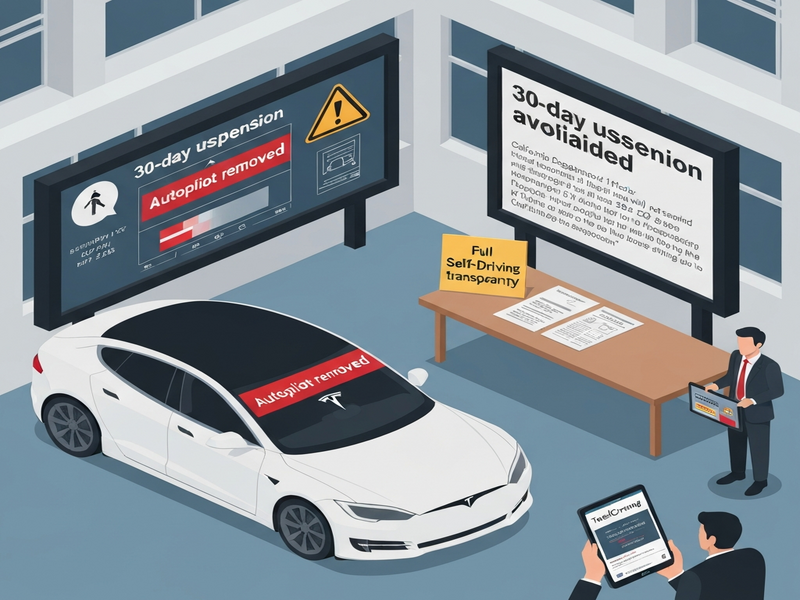
The illustration captures the regulatory crossroads where Tesla’s branding meets California’s consumer‑protection standards.
Future of Autonomous Driving Regulations
California’s decisive action may set a precedent for other states and countries. Key trends to watch:
- Standardized Terminology: Expect federal agencies to draft uniform definitions for “Level 2,” “Level 3,” and “Full Self‑Driving” to avoid brand‑specific confusion.
- Data Transparency: Regulators will likely demand real‑time telemetry logs to verify driver engagement, a task well‑suited for AI‑driven analytics platforms.
- Subscription Models: As more OEMs adopt SaaS pricing for advanced driver‑assistance features, compliance monitoring will become a recurring operational cost.
Companies that integrate AI compliance tools early will gain a competitive edge, reducing legal risk while accelerating feature rollouts.
Stay Ahead of the Curve
If you’re developing autonomous‑driving software or managing a fleet of EVs, ensure your branding and pricing strategies align with emerging regulations. Leverage AI‑powered solutions to automate compliance, monitor driver behavior, and adapt pricing in real time.
Ready to future‑proof your autonomous‑driving initiatives? Explore UBOS pricing plans today and start building compliant, intelligent vehicle experiences.