

- Updated: February 18, 2026
- 7 min read
Meta signs multiyear Nvidia deal for millions of AI chips, boosting data‑center power
Meta’s multiyear partnership with Nvidia will deliver millions of AI chips—including Grace CPUs, Vera CPUs, Blackwell GPUs, and Rubin GPUs—to super‑charge its AI data‑center expansion and accelerate its AI‑driven products.
Meta‑Nvidia Multiyear AI Hardware Deal: Millions of Chips, New Data‑Center Power‑Boost
In a landmark agreement announced in February 2026, Meta secured a multiyear supply of Nvidia’s latest AI processors. The deal covers the immediate delivery of thousands of Nvidia Grace CPUs and Blackwell GPUs, with a roadmap that adds the next‑generation Vera CPUs and Rubin GPUs by 2027. This partnership marks the first large‑scale “Grace‑only” deployment for any customer and signals Meta’s commitment to scaling its AI infrastructure despite ongoing challenges with its own in‑house chip program.
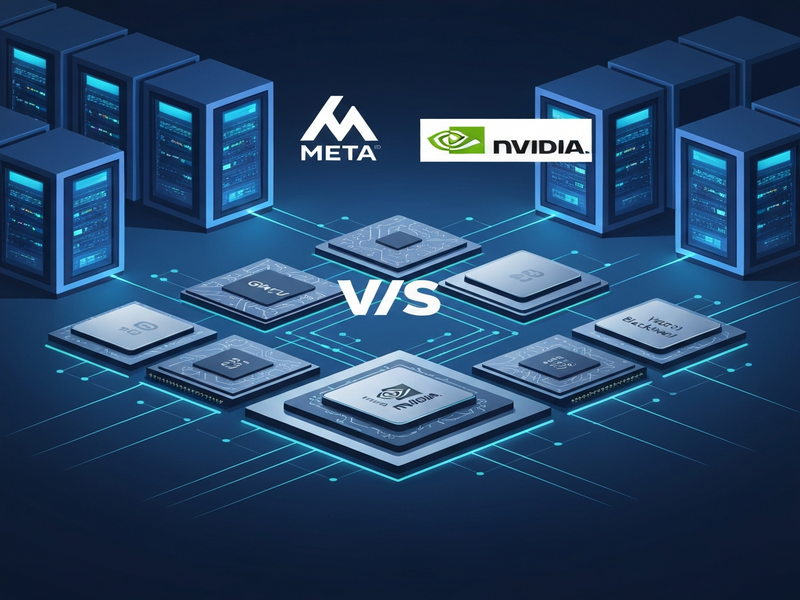
Grace CPU and Future Vera CPU Commitments
Meta’s order begins with the Nvidia Grace CPU, a data‑center‑grade ARM‑based processor optimized for AI workloads. The Grace architecture delivers up to 2.5× higher performance‑per‑watt compared to traditional x86 CPUs, a critical metric for the energy‑intensive training of large language models.
Key specifications of the Grace CPU include:
- Up to 64 cores per socket with integrated high‑bandwidth memory (HBM2e).
- Native support for Nvidia’s NVLink and PCIe 5.0, enabling seamless GPU‑CPU communication.
- Enhanced security features such as confidential compute for protecting model data.
Looking ahead, the agreement also locks in access to Nvidia’s upcoming Vera CPU, slated for deployment in Meta’s data centers starting in 2027. Vera promises a further 30% boost in compute density and introduces a new memory hierarchy designed for next‑generation transformer models.
GPU Powerhouse: Blackwell and Rubin
Complementing the CPU supply, Meta will receive Nvidia’s latest GPU families:
- Blackwell GPUs – Built on the Hopper architecture, Blackwell offers up to 4 × the tensor‑core performance of its predecessor, with a focus on mixed‑precision training and inference.
- Rubin GPUs – Targeted at inference workloads, Rubin delivers ultra‑low latency and high throughput for serving billions of daily user interactions.
Both GPU lines integrate Nvidia’s NVLink 4.0, allowing Meta to construct tightly coupled GPU clusters that minimize data movement—a crucial factor for reducing training time on massive models like LLaMA‑2 and beyond.
Why a Grace‑Only Deployment Matters
The “Grace‑only” deployment is significant for three reasons:
- Energy Efficiency: Grace’s superior performance‑per‑watt aligns with Meta’s sustainability goals, helping the company meet its 2030 carbon‑neutral target.
- Scalability: By standardizing on a single CPU architecture, Meta can streamline its software stack, reducing operational complexity across its global data‑center fleet.
- Strategic Leverage: Early access to Vera ensures Meta stays ahead of competitors that may still be reliant on older CPU generations.
When Vera arrives in 2027, Meta will be positioned to replace legacy CPUs without a disruptive migration, preserving performance continuity for its AI services such as AI hardware research platforms and next‑generation recommendation engines.
Meta’s Own Chip Efforts: Hurdles and Delays
While the Nvidia partnership accelerates Meta’s immediate needs, the company continues to invest in its own custom silicon. According to the Financial Times, Meta’s internal AI chip program has encountered “technical challenges and rollout delays,” particularly around achieving the desired power‑efficiency ratio for large‑scale inference.
These setbacks have prompted Meta to adopt a hybrid strategy: leveraging Nvidia’s proven hardware while iterating on its own designs. The dual‑track approach mitigates risk, ensuring that product roadmaps for Facebook, Instagram, and the emerging Metaverse remain on schedule.
AI Data‑Center Expansion and the Broader Hardware Landscape
Meta’s AI data‑center footprint is set to grow dramatically. The company plans to add over 30 new AI‑optimized facilities worldwide by 2028, each equipped with the newly acquired Nvidia chips. This expansion will:
- Increase total AI compute capacity by an estimated 5 exaflops.
- Enable real‑time personalization for billions of daily active users.
- Support advanced research in multimodal AI, including vision‑language models.
Industry analysts note that Meta’s deal also reshapes the competitive dynamics of AI hardware. Nvidia, which has traditionally sold CPUs only to its own customers, now opens a new revenue stream by supplying Grace CPUs at scale. This move could pressure rivals like AMD and Google’s Tensor chips, which have been courting large cloud providers.
What the Press Is Saying
For a detailed breakdown of the agreement, see the original coverage by The Verge. The article highlights the strategic importance of the partnership and provides context on how it fits into the broader AI arms race.
Leveraging UBOS for AI‑Driven Workloads
Enterprises looking to harness similar AI capabilities can benefit from the UBOS platform overview. UBOS offers a modular AI stack that integrates seamlessly with Nvidia hardware, allowing developers to prototype, deploy, and scale AI models without deep infrastructure expertise.
Key UBOS features that complement Meta’s hardware strategy include:
- AI marketing agents that automate campaign creation using large language models.
- Workflow automation studio for orchestrating data pipelines across GPU clusters.
- Web app editor on UBOS for building interactive AI‑powered dashboards.
Startups can accelerate time‑to‑value with UBOS templates for quick start, such as the AI SEO Analyzer or the AI Article Copywriter. These templates are pre‑wired to leverage high‑performance GPUs, making them ideal for content generation, SEO optimization, and data‑driven marketing.
Business Implications and Future Outlook
Meta’s partnership with Nvidia is more than a procurement contract; it’s a strategic signal to the market:
| Implication | Potential Impact |
|---|---|
| Competitive Edge | Faster model iteration cycles give Meta a lead in personalized content delivery. |
| Cost Efficiency | Grace’s performance‑per‑watt reduces electricity spend, aligning with sustainability targets. |
| Ecosystem Growth | Third‑party developers can build on Meta‑Nvidia hardware via platforms like UBOS, expanding the AI ecosystem. |
By 2027, when Vera CPUs become operational, Meta expects to double its AI inference capacity while cutting power consumption by roughly 20%. This efficiency gain will be crucial as the company scales generative AI services across its family of apps.
Explore More UBOS Resources
For organizations interested in replicating Meta’s AI hardware strategy, UBOS provides a suite of tools and programs:
- UBOS partner program – collaborate with UBOS experts to design custom AI solutions.
- Enterprise AI platform by UBOS – enterprise‑grade orchestration for large GPU farms.
- UBOS solutions for SMBs – affordable AI compute for small and medium businesses.
- UBOS for startups – fast‑track AI product launches with pre‑built pipelines.
- UBOS pricing plans – transparent, usage‑based pricing that scales with your compute needs.
UBOS Template Marketplace: Ready‑Made AI Apps
Developers can jump‑start projects using UBOS’s marketplace. Notable templates include:
- Talk with Claude AI app – conversational AI powered by Anthropic’s Claude.
- Your Speaking Avatar template – generate lifelike voice avatars with ElevenLabs AI voice integration.
- AI YouTube Comment Analysis tool – sentiment analysis at scale.
- Generative AI Text-to-Video – turn scripts into video content using Nvidia GPUs.
- AI Chatbot template – deploy a chatbot backed by OpenAI’s OpenAI ChatGPT integration.
Conclusion
Meta’s multiyear Nvidia AI hardware partnership is a decisive step toward scaling its AI ambitions. By securing Grace CPUs now and Vera CPUs later, alongside Blackwell and Rubin GPUs, Meta ensures a high‑performance, energy‑efficient foundation for the next generation of AI services. While internal chip development continues to face hurdles, the hybrid approach—combining external best‑in‑class silicon with proprietary designs—offers a resilient path forward.
For businesses eager to emulate this strategy, platforms like UBOS provide the tooling, templates, and partner ecosystem needed to harness the same hardware advantages without the massive upfront investment. As AI continues to reshape every sector, the Meta‑Nvidia deal stands as a benchmark for how strategic hardware alliances can accelerate innovation while managing cost and sustainability.