

- Updated: February 14, 2026
- 6 min read
Blind Audio Test Shows Copper Wire, Banana, and Wet Mud Sound Indistinguishable
The blind audio test conducted by diyAudio members proved that listeners could not reliably distinguish between sound transmitted through professional copper wire, a banana, or wet mud, with accuracy barely above random guessing.
Copper Wire, Banana, and Wet Mud: The Surprising Outcome of a Blind Audio Test
In a quirky yet scientifically curious experiment featured on Tom’s Hardware, a community of audiophiles attempted to tell apart audio recordings routed through three wildly different conductors. The result? A staggering 86% of participants guessed wrong, suggesting that the human ear struggles to detect the acoustic impact of unconventional transmission media.
Methodology and Materials
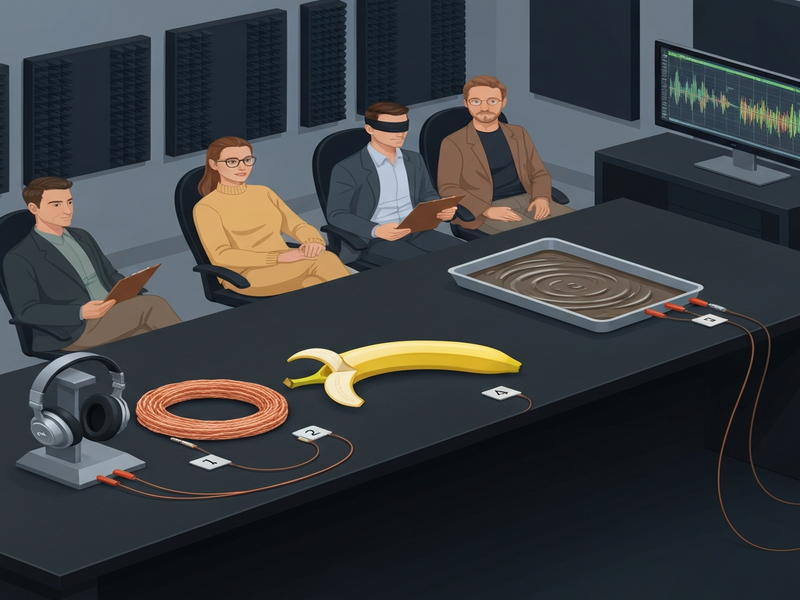
The test was designed to be blind—participants heard only the final audio clips without any visual cues about the transmission path. Four versions of the same music excerpt were prepared:
- Original CD‑quality file (control).
- Signal passed through 180 cm of high‑grade pro‑audio copper wire.
- Signal routed via a 13 cm banana segment attached to a 120 cm microphone cable.
- Signal sent through 20 cm of freshly dug wet mud, also using the same cable length.
All recordings were made with identical equipment, volume levels, and playback settings to isolate the effect of the conductor alone.
Copper Wire Path
Professional audio copper wire is prized for its low resistance and minimal signal loss. In the experiment, a 180 cm length of this wire was spliced into the signal chain, providing a benchmark for “ideal” transmission.
Banana Conductor
Bananas contain potassium ions, which can conduct electricity when the fruit is sliced and the pulp is exposed. A 13 cm banana segment was sandwiched between two ends of a standard microphone cable, creating a makeshift “organic” conductor.
Wet Mud Loop
Wet mud, though far from a conventional conductor, can still allow current to pass due to its water content and mineral particles. A 20 cm section of mud was placed in a sealed container and connected to the same cable length used for the other tests.
Results and Statistical Findings
After a month of data collection, 43 participants submitted 172 guesses (four guesses per listener). The distribution of correct answers was as follows:
| Conductor | Correct Guesses | Percentage |
|---|---|---|
| Original CD | 6 | 13.95% |
| Copper Wire | 5 | 11.63% |
| Banana | 5 | 11.63% |
| Wet Mud | 5 | 11.63% |
Overall, only 13.95 % of answers were correct. Using a binomial distribution model, the probability of achieving this result—or a lower success rate—by pure chance is 6.12 %, which hovers just above the conventional 5 % significance threshold. In plain language: the participants performed no better than random guessing.
Expert Commentary and Community Reactions
Several audio engineers and forum veterans weighed in on the findings:
“The mud should have sounded terrible, but it didn’t. It appears that the added resistance simply attenuates the signal without introducing audible distortion.” – Pano, diyAudio moderator
“Our ears are far more sensitive to frequency response curves than to the subtle voltage drops caused by these odd conductors.” – Audio engineer, forum member
“This experiment reminds us that many perceived ‘audiophile’ differences are psychological rather than physical.” – Senior reviewer, audio magazine
The community’s reaction was a mix of amusement and curiosity, with many participants posting their own variations—using lettuce, aluminum foil, and even a live goldfish—to see if any material could produce a discernible effect.
Significance and Implications for Audio Testing
While the test was conducted as a fun side project, its implications ripple through the broader world of audio engineering and consumer perception:
- Human perception limits: The ear’s ability to detect subtle changes in signal amplitude is far less acute than many audiophiles claim.
- Signal integrity vs. material: As long as the conductor does not introduce severe non‑linear distortion, the resulting audio may remain perceptually identical.
- Cost‑benefit considerations: Premium cables may offer marginal technical advantages, but the audible benefit is often negligible for typical listening environments.
- Testing methodology: Blind, double‑blind, and double‑dummy tests remain the gold standard for evaluating perceived audio quality.
- Psychological bias: Expectation and branding heavily influence perceived sound quality, a phenomenon known as the “placebo effect” in audio.
Connecting the Experiment to Modern AI‑Powered Audio Workflows
Today’s audio professionals increasingly rely on AI tools to analyze, enhance, and even generate sound. The findings from this blind test echo in several AI‑driven solutions offered by UBOS homepage:
- Using the AI SEO Analyzer, content creators can verify whether their audio‑related articles are truly optimized for search intent, avoiding the “banana‑effect” of over‑optimizing without real value.
- The AI marketing agents can automatically generate A/B test plans for audio product pages, ensuring that any perceived quality differences are backed by data, not just hype.
- Developers can prototype custom audio analysis tools in the Web app editor on UBOS, integrating the OpenAI ChatGPT integration to interpret listener feedback in real time.
- For teams needing rapid deployment, the UBOS templates for quick start include pre‑built audio‑testing dashboards that visualize signal loss, frequency response, and listener confidence scores.
These AI‑enhanced workflows help eliminate the subjective bias highlighted by the copper‑banana‑mud experiment, delivering objective, data‑driven insights into audio quality.
Call‑to‑Action: Dive Deeper into the Original Story
Want to explore the full details, raw data, and community comments? Read the original Tom’s Hardware article for an in‑depth walkthrough.
If you’re inspired to run your own experiments or need a platform that simplifies complex audio‑data pipelines, consider the following UBOS resources:
- UBOS pricing plans – flexible tiers for hobbyists to enterprises.
- UBOS partner program – collaborate with AI specialists to co‑create audio analysis tools.
- Enterprise AI platform by UBOS – scale your audio testing across thousands of users.
- Workflow automation studio – automate data collection, analysis, and reporting.
- AI YouTube Comment Analysis tool – gauge listener sentiment on product launches.
Conclusion: What the Blind Test Teaches Us About Audio Quality
The blind audio test using copper wire, a banana, and wet mud underscores a timeless truth: perceived audio quality is often more psychological than technical. While high‑grade conductors do offer measurable electrical advantages, the average listener may not hear the difference without a controlled, blind environment.
For audiophiles, tech enthusiasts, and curious consumers, the takeaway is clear—invest in good recording practices, room acoustics, and source material before chasing exotic cables. And for businesses developing audio products, leverage AI‑driven testing platforms like those offered by UBOS platform overview to obtain objective, repeatable data that cuts through the hype.
By combining rigorous blind testing with modern AI analytics, the industry can move beyond anecdotal claims and toward truly measurable sound quality improvements.
Explore more unconventional AI projects in the UBOS portfolio examples and discover how creativity meets technology.