

- Updated: January 28, 2026
- 6 min read
IPv6 Security Without NAT: Why IPv6 Is Not Insecure
IPv6 is not insecure because it lacks NAT; its security is provided by built‑in firewall rules, stateful inspection, and modern networking best practices.
Why IPv6 Security Doesn’t Depend on NAT
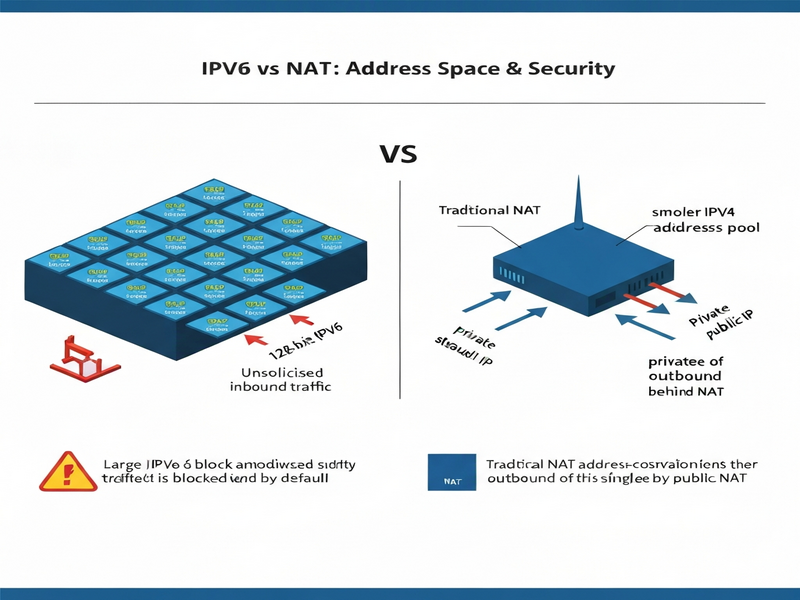
Recent debates on networking forums often claim that IPv4’s NAT‑by‑default makes it inherently safer than IPv6. This notion conflates address translation with true security controls. In reality, NAT is an address‑conservation mechanism, not a firewall. Modern IPv6 deployments rely on explicit, default‑deny firewall policies that protect devices without the need for NAT.
Understanding NAT: Not a Security Feature
NAT (Network Address Translation) was introduced to stretch the dwindling IPv4 address pool. It works by mapping many private IP addresses to a single public address, rewriting packet headers as traffic passes through a router. While NAT unintentionally hides internal addresses, its primary purpose is not to block attacks.
- It enables multiple devices to share one public IP.
- It rewrites source or destination ports based on static or dynamic mappings.
- It does not inspect packet payloads or enforce connection state.
The perceived “security” of NAT actually stems from the stateful firewalls that are bundled with most consumer routers. Those firewalls, not NAT itself, drop unsolicited inbound traffic by default.
IPv6’s Built‑In Security Model
IPv6 was designed with security in mind from the ground up. Every IPv6‑enabled router can enforce a set of default firewall rules that follow a default‑deny posture. For example, popular UniFi routers ship with the following IPv6 firewall policy:
| Rule | Action |
|---|---|
| Allow Established/Related Traffic | Accept outbound return traffic |
| Block Invalid Traffic | Drop malformed packets |
| Block All Other Traffic | Deny any unsolicited inbound traffic |
These rules mean that, unless you explicitly create an allow rule, no external host can initiate a connection to an IPv6 device on your network. The same security posture can be achieved on any IPv6‑capable platform, regardless of whether NAT is used.
IPv4 NAT vs. IPv6 Native Security: A Side‑by‑Side Comparison
IPv4 with NAT
- Relies on address translation to hide internal hosts.
- Security depends on the router’s stateful firewall configuration.
- Port forwarding is required for any inbound service.
- Complexity grows with multiple sub‑nets and overlapping address spaces.
IPv6 Native
- Each device has a globally routable address.
- Default‑deny firewall rules block unsolicited inbound traffic.
- No need for port‑forwarding unless you deliberately open a service.
- Simpler routing tables and easier network segmentation.
In short, IPv6 removes the illusion that NAT is a security shield and replaces it with transparent, policy‑driven firewalling that is easier to audit and manage.
Benefits of IPv6 Adoption for Modern Networks
Beyond security, IPv6 brings a host of advantages that align with today’s cloud‑first, AI‑driven enterprises.
- Vast Address Space: 2128 addresses eliminate the need for address‑sharing tricks.
- Simplified Network Management: No more NAT translation tables, fewer ACLs, and cleaner routing.
- Built‑In IPsec Support: End‑to‑end encryption is a native option, not an add‑on.
- Improved Multicast & Mobility: Efficient group communication and seamless device movement across subnets.
- Future‑Proofing: Aligns with emerging technologies such as IoT, edge computing, and AI‑enhanced services.
For organizations that already leverage AI platforms, IPv6’s clean addressing model simplifies integration with services like the Enterprise AI platform by UBOS, where each micro‑service can be addressed directly without NAT‑induced ambiguity.
How UBOS Helps You Transition to IPv6 Securely
UBOS provides a suite of tools that make IPv6 adoption painless while reinforcing security best practices.
- UBOS homepage offers a quick start guide for enabling IPv6 on virtualized environments.
- Learn the company’s mission at About UBOS, where the focus on secure, AI‑driven infrastructure is highlighted.
- The UBOS platform overview details native support for IPv6 firewalls and routing.
- Startups can accelerate their IPv6 rollout with UBOS for startups, which includes pre‑configured security policies.
- SMBs benefit from UBOS solutions for SMBs, offering managed IPv6 address allocation and monitoring.
- Leverage AI marketing agents to automatically generate security‑aware marketing copy that educates customers about IPv6 benefits.
- Automate firewall rule provisioning with the Workflow automation studio, ensuring every new service inherits the default‑deny posture.
- Build custom IPv6‑enabled web interfaces using the Web app editor on UBOS, which includes built‑in validation for IPv6 address fields.
- Explore transparent pricing for IPv6‑centric plans at UBOS pricing plans.
- See real‑world deployments in the UBOS portfolio examples, many of which showcase IPv6‑first architectures.
- Kick‑start projects with ready‑made UBOS templates for quick start, including an “IPv6 Secure Gateway” template.
AI‑Powered Tools That Complement IPv6 Security
Integrating AI services can further harden your IPv6 environment. UBOS’s marketplace offers several templates that work seamlessly with IPv6 addresses.
- AI SEO Analyzer – scans your public IPv6 endpoints for exposure.
- AI Article Copywriter – helps you produce security documentation for IPv6 policies.
- AI Video Generator – create training videos on IPv6 firewall configuration.
- AI Chatbot template – deploy a help‑desk bot that can answer IPv6‑related queries 24/7.
- AI Email Marketing – automate outreach to inform clients about IPv6 migration benefits.
Visual Overview
Practical Steps to Harden Your IPv6 Network Today
Implementing IPv6 securely is straightforward when you follow a disciplined checklist.
- Enable IPv6 on all routers and switches. Verify that the default firewall policy matches the “allow established/related, block invalid, block all else” model.
- Audit existing IPv4 NAT rules. Translate any necessary port forwards into explicit IPv6 allow rules.
- Deploy stateful inspection. Use UBOS’s Workflow automation studio to push consistent policies across devices.
- Enable IPsec where appropriate. IPv6 natively supports IPsec; configure it for sensitive traffic.
- Monitor logs with AI. Leverage the AI SEO Analyzer or custom scripts to detect anomalous inbound attempts.
- Document address allocations. Use the Web app editor on UBOS to maintain an up‑to‑date IP address inventory.
- Educate staff. Deploy the AI Chatbot template as an internal knowledge base for IPv6 best practices.
Conclusion & Call‑to‑Action
IPv6 does not inherit insecurity from the absence of NAT; instead, it offers a cleaner, more transparent security model that aligns perfectly with modern AI‑driven infrastructure. By adopting IPv6 and leveraging UBOS’s suite of tools—ranging from the Enterprise AI platform to ready‑made templates—you can future‑proof your network while maintaining a robust security posture.
Ready to modernize your network? Visit the UBOS homepage to explore IPv6‑ready solutions, request a demo, or start a free trial today.