

- Updated: January 17, 2026
- 6 min read
Voltair Unveils Self‑Charging Drones for Infinite‑Range Utility Inspections
Voltair is a San Francisco‑based startup that has engineered self‑charging drones capable of perching on live power lines, delivering virtually infinite‑range inspection capabilities for utility infrastructure.
Voltair’s Self‑Charging Drones: Revolutionizing Power‑Line Inspection and the Future of Utility Infrastructure
Imagine a fleet of drones that never needs to land for a battery swap, that can hop from pole to pole like a bird, and that continuously streams high‑resolution data about the health of the electric grid. That vision is now a reality thanks to Voltair, a YC Winter 2026 graduate. As wildfires and grid failures become more frequent, utilities are scrambling for smarter, faster, and safer inspection methods—Voltair’s technology promises exactly that.
While the buzz around autonomous drones often focuses on aerial endurance, Voltair flips the script by turning the power line itself into a charging station. This breakthrough eliminates the logistical nightmare of battery logistics and opens the door to continuous, city‑wide monitoring without human pilots.
Company Overview: Mission & Core Technology
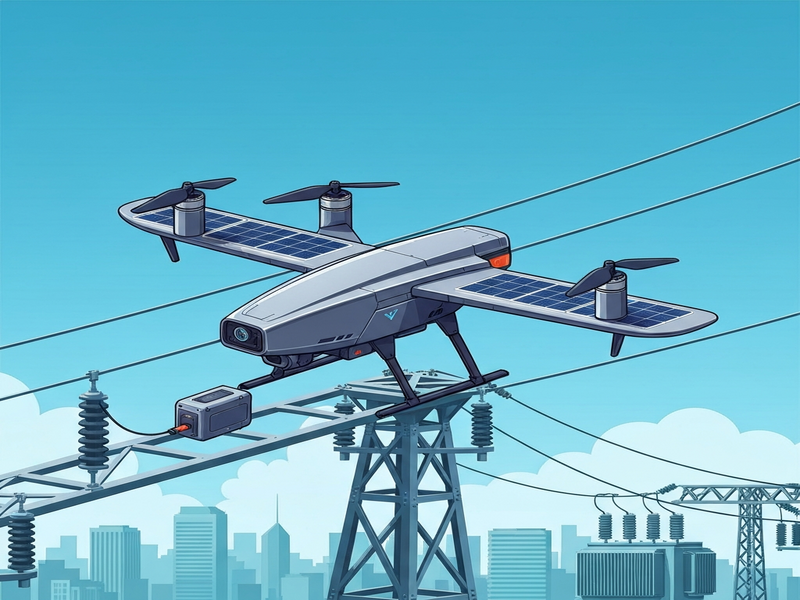
Founded in 2025, Voltair’s mission is to “make the grid invisible” by providing utilities with a persistent, AI‑driven eyes‑in‑the‑sky. The company’s flagship product is a lightweight quadcopter equipped with a patented perching mechanism that latches onto high‑voltage conductors. Once attached, a miniature inductive charger draws power directly from the line, allowing the drone to recharge in seconds and resume its flight path.
The technology stack blends advanced power‑electronics, computer‑vision AI, and edge‑computing. On‑board sensors detect line tension, temperature, and visual defects, while a custom neural network classifies anomalies in real time. The data pipeline then streams to a cloud‑native analytics platform where utilities can query, visualize, and act on insights instantly.
For developers looking to build similar AI‑driven workflows, the UBOS platform overview offers a low‑code environment that integrates edge devices, data lakes, and AI models—all without writing a single line of infrastructure code.
Market Potential and Real‑World Applications
The global utility inspection market is projected to exceed $12 billion by 2030, driven by stricter regulatory standards and the rising cost of manual inspections. Voltair’s self‑charging drones address three critical pain points:
- Cost Efficiency: Autonomous flights reduce labor costs by up to 80 % compared with traditional crew‑based inspections.
- Safety: Eliminating the need for line workers to climb poles dramatically lowers the risk of electrocution and falls.
- Speed & Coverage: A single drone can inspect up to 20 times more assets per day than a human crew, delivering near‑real‑time health maps of the grid.
Beyond power utilities, the same perching‑and‑charging concept can be adapted for railways, telecommunications towers, and even offshore wind farms. Data harvested from these inspections can be packaged as a premium service for insurance firms and grid traders seeking predictive risk analytics.
To illustrate the power of AI‑enhanced data, consider the AI SEO Analyzer. While built for digital marketers, its underlying pattern‑recognition engine mirrors the anomaly‑detection models Voltair deploys on the edge, underscoring the cross‑industry relevance of advanced AI.
Moreover, Voltair’s platform can be paired with conversational agents such as the ChatGPT and Telegram integration to deliver instant alerts to field operators via familiar messaging apps, turning raw sensor data into actionable insights in seconds.
Team, Funding, and Strategic Partnerships
Voltair’s leadership blends deep hardware expertise with seasoned go‑to‑market experience. Ronan Nopp, CEO, previously engineered UAVs for the U.S. Air Force and DARPA, giving him a unique perspective on high‑risk, high‑reliability systems. Hayden Gosch, CTO, brings a background in power‑electronics from Seattle City Light and Schweitzer Engineering Laboratories, ensuring the perching charger meets utility safety standards.
The commercial side is led by Avi Gotskind, CGO, whose prior work with aerospace startups and Amazon Kuiper equips Voltair with a robust GTM playbook. Finally, Warren Weissbluth, COO, leverages his operations‑research expertise to scale manufacturing and supply‑chain logistics.
In March 2026, Voltair closed a $12 million Series A round led by About UBOS venture partners, with participation from several strategic utility investors. The capital will fund the next generation of perching mechanisms, expand the data‑analytics stack, and accelerate hiring.
Career Opportunities: Join the Drone Revolution
Voltair is actively hiring across engineering, data science, and field operations. Open roles include:
- Mechanical Engineer – San Francisco (US$100K‑200K)
- Founding Autonomy Engineer – San Francisco (Equity + Salary)
- Software Engineering Intern – Remote (Stipend)
- Inspection Data Review – Utility Experience (Contract)
The company’s culture mirrors that of high‑growth SaaS startups. If you’re a tech enthusiast looking to make a tangible impact on critical infrastructure, explore the UBOS for startups ecosystem for inspiration on building fast, secure, and scalable products.
Future Outlook: Scaling to an Enterprise AI Platform
As Voltair moves from pilot projects to full‑scale deployments, the focus will shift to integrating its drone fleet into a broader Enterprise AI platform by UBOS. This will enable utilities to combine drone‑derived visual data with SCADA systems, weather forecasts, and predictive maintenance models—all within a single, secure environment.
The roadmap includes:
- Multi‑drone orchestration via a cloud‑native Workflow automation studio.
- Real‑time AI inference at the edge using Chroma DB integration for fast similarity search of defect images.
- Voice‑enabled alerts powered by ElevenLabs AI voice integration, allowing operators to receive spoken summaries while on the field.
By 2028, Voltair aims to have inspected over 1 million poles worldwide, delivering a data layer that utilities can monetize through predictive analytics services.
Conclusion: Why Voltair Matters for the Future of Energy
Voltair’s self‑charging drones are more than a cool tech demo—they are a strategic answer to the escalating challenges of grid reliability, climate‑driven wildfires, and the need for continuous infrastructure monitoring. For investors, the company offers a clear path to revenue through service contracts, data licensing, and enterprise platform subscriptions.
If you’re a utility leader, a venture partner, or a tech talent eager to shape the next generation of autonomous systems, now is the moment to engage with Voltair. Explore the UBOS pricing plans to see how affordable AI‑driven solutions can be, and browse the UBOS portfolio examples for real‑world case studies that echo Voltair’s impact.
Ready to dive deeper? Check out the UBOS templates for quick start and spin up your own prototype in days, not months. The future of resilient, AI‑powered infrastructure is already taking flight—don’t let it pass you by.
Related AI Tools from UBOS
- Talk with Claude AI app – conversational AI for rapid prototyping.
- AI Article Copywriter – generate technical documentation at scale.
- AI Video Generator – create demo videos for drone operations.
Andrii Bidochko
CTO UBOS
Andrii Bidochko is an AI entrepreneur and researcher focused on AI agents, reinforcement learning, and autonomous systems. He writes about the technologies shaping the future of machine intelligence, from frontier models and agent architectures to real-world AI applications.