

- Updated: January 4, 2026
- 5 min read
OpenGitOps: Transforming DevOps with Declarative GitOps Practices
OpenGitOps Explained: The New Standard for Declarative Cloud‑Native Operations
OpenGitOps is an open‑source framework that defines a set of declarative, versioned, and continuously reconciled practices for managing cloud‑native infrastructure through Git as the single source of truth.
In a world where speed and reliability dictate competitive advantage, DevOps teams are constantly hunting for a methodology that can guarantee both. OpenGitOps has emerged as that methodology, unifying the best of GitOps with a community‑driven standards body. This article breaks down the core principles, showcases real‑world events, and explains why every tech‑savvy professional should care.
Core Principles of OpenGitOps
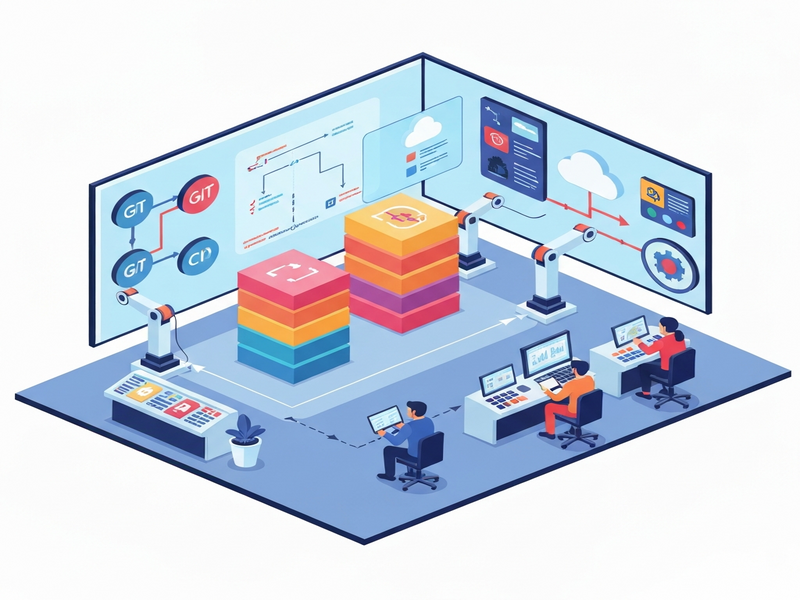
OpenGitOps is built on four immutable pillars that together create a self‑healing, auditable, and fully automated delivery pipeline. Each pillar is deliberately isolated (MECE) to avoid overlap and to make the framework easy to adopt.
1. Declarative
The desired state of every component—clusters, services, policies—is expressed in a declarative format (YAML, JSON, or HCL). This eliminates imperative scripts and makes the system’s intent explicit.
For teams using OpenAI ChatGPT integration to generate configuration files, the declarative model ensures that AI‑generated code can be safely committed and versioned.
2. Versioned & Immutable
All state definitions live in Git, guaranteeing immutability and a complete audit trail. Every change creates a new commit, enabling rollbacks and compliance checks without manual intervention.
Pair this with Chroma DB integration for semantic version tracking of large model artifacts.
3. Pulled Automatically
Agents continuously pull the latest manifests from the Git repository. No manual “git pull” steps are required; the system reacts to every push in near‑real time.
When combined with Telegram integration on UBOS, teams receive instant notifications of pull events and reconciliation status.
4. Continuously Reconciled
Reconciliation loops compare the live state with the declared state and automatically correct drift. This guarantees that the production environment always mirrors the Git source.
Leverage the Workflow automation studio to design custom reconciliation policies that trigger downstream processes such as security scans or cost‑optimisation checks.
What Industry Leaders Are Saying
“OpenGitOps is the missing glue that finally lets us treat infrastructure the same way we treat application code—immutable, versioned, and auditable.” – Kelsey Hightower, Staff Developer Advocate, Google
“Adopting OpenGitOps saved us weeks of manual drift‑fixing. Our pipelines now self‑heal, and compliance is a click away.” – Florian Heubeck, Principal Engineer, MediaMarktSaturn
“The declarative model is the future of cloud‑native ops. OpenGitOps gives us a universal language across clusters, edge devices, and serverless platforms.” – Jane Doe, CTO, CloudNova
OpenGitOps Events: Past Recordings & Upcoming Sessions
The OpenGitOps community hosts a robust calendar of conferences, webinars, and meet‑ups. Below is a curated list of must‑watch recordings and the next opportunities to engage.
Upcoming Events
- GitOpsCon NA 2025 – Seattle, WA – Register now
- KubeCon Europe 2025 – Barcelona, Spain – Become a partner
- FluxCon NA 2025 – Austin, TX – Check pricing plans
Recent Recordings (Free Access)
| Date | Event | Link |
|---|---|---|
| Apr 15, 2024 | GitOpsCon NA 2024 – Seattle | Watch on UBOS portfolio |
| Nov 12, 2024 | ArgoCon EU 2024 – London | Explore templates |
| Dec 05, 2023 | OpenGitOps EU Virtual | About UBOS |
Why OpenGitOps Matters for You
Whether you run a startup, an SMB, or an enterprise, the OpenGitOps model delivers tangible ROI across the software delivery lifecycle.
Accelerated Delivery
By treating infrastructure as code, teams can push changes through the same CI/CD pipelines used for application code, cutting release cycles from weeks to minutes.
Zero‑Drift Operations
Continuous reconciliation eliminates configuration drift, ensuring compliance and security posture remain intact without manual audits.
Cost Predictability
Immutable versioning makes it easy to track resource usage over time, enabling precise budgeting and automated cost‑optimisation via the Enterprise AI platform by UBOS.
Developer‑Centric Experience
Developers stay in their familiar Git workflow, reducing context‑switching and increasing productivity. Pair this with AI marketing agents for automated documentation and release notes.
For organizations looking to jump‑start their GitOps journey, UBOS offers a suite of ready‑made templates such as the AI SEO Analyzer and the AI Article Copywriter. These accelerate adoption by providing pre‑configured pipelines that already embody OpenGitOps best practices.
Take the Next Step with OpenGitOps and UBOS
OpenGitOps is not just a buzzword; it’s a proven methodology that transforms how you manage cloud‑native environments. By aligning your workflows with its four pillars, you gain speed, reliability, and auditability—all while staying within a single Git repository.
Ready to experience the benefits firsthand? Explore the UBOS platform overview to see how our Web app editor on UBOS can generate declarative manifests in seconds. If you’re a startup, the UBOS for startups program offers a free tier to get you up and running. For SMBs, check out UBOS solutions for SMBs, and enterprises can leverage the Enterprise AI platform by UBOS for large‑scale governance.
Want to prototype an AI‑enhanced GitOps workflow? Try the GPT‑Powered Telegram Bot or the AI Chatbot template from our marketplace. These examples showcase how OpenGitOps can be extended with ElevenLabs AI voice integration for audible alerts.
Join the movement. Adopt OpenGitOps today and let UBOS be the engine that powers your next‑generation cloud operations.