

- Updated: November 26, 2025
- 6 min read
Stanford CS234 Reinforcement Learning Course Overview – Insights and Resources
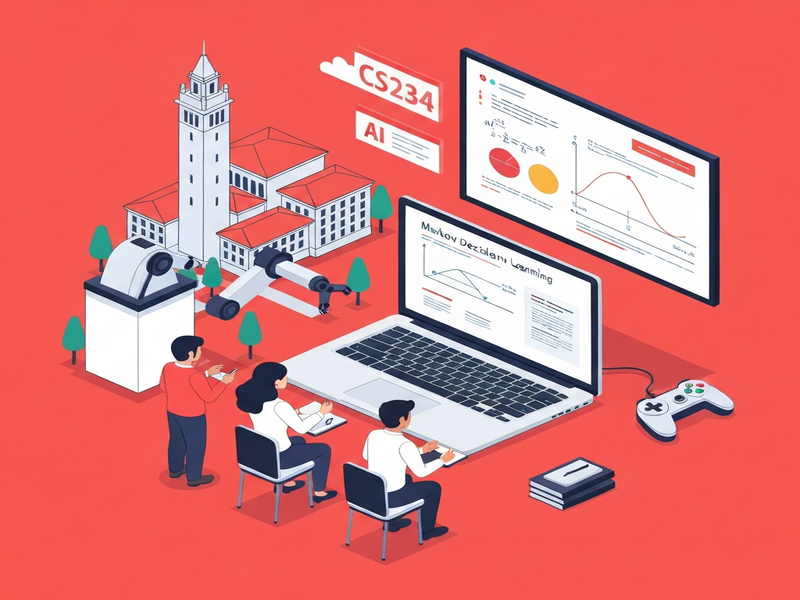
Stanford’s CS234 Reinforcement Learning (Winter 2025) is a graduate‑level course that equips students with the theory, algorithms, and hands‑on experience needed to build autonomous decision‑making systems across robotics, gaming, healthcare, and more.
Why CS234 Matters in 2025
Reinforcement learning (RL) has moved from academic curiosities to the backbone of real‑world AI systems—think autonomous drones, personalized recommendation engines, and intelligent game agents. Stanford’s CS234 Winter 2025 course page provides a comprehensive, research‑driven curriculum that bridges foundational theory with modern deep RL techniques.
For anyone aiming to stay ahead in the AI race, understanding CS234’s structure and expectations is essential. Whether you’re a graduate student, a professional upskilling, or a researcher scouting new collaborations, this guide gives you a clear roadmap.
Explore more AI innovations at the UBOS homepage, where cutting‑edge tools help you apply RL concepts to real projects.
Course Overview
Title: CS234 – Reinforcement Learning (Winter 2025)
Instructor: Emma Brunskill, Professor of Computer Science, Stanford University
Teaching Assistants: Chethan Bhateja (Head TA), Aishwarya Mandyam, HyunJi (Alex), Nam Hengyuan Hu, Lansong (Ryan), Li Shiyu Zhao, Keenon Werling
The course blends live lectures (Tue/Thu, 1:30 – 2:50 PM), interactive labs, and a semester‑long project. All materials—including slides, video recordings, and assignment specs—are hosted on the UBOS platform overview, ensuring seamless access for remote learners.
Key themes covered:
- Markov Decision Processes (MDPs) and dynamic programming
- Model‑free methods: Q‑learning, SARSA, policy gradients
- Deep RL: DQN, PPO, and offline RL
- Exploration‑exploitation trade‑offs and safety
- Real‑world case studies in robotics, finance, and healthcare
Prerequisites and Learning Outcomes
Prerequisites
To thrive in CS234, students should be comfortable with:
- Python programming (including NumPy, PyTorch/TensorFlow)
- Calculus, linear algebra, and probability (e.g., MATH 51, CME 100)
- Fundamentals of machine learning (CS 221 or CS 229)
- Basic optimization concepts (gradient descent, convex analysis)
For those needing a quick refresher, the UBOS AI courses library offers targeted modules on Python, linear algebra, and ML fundamentals.
Learning Outcomes
By the end of the quarter, participants will be able to:
- Formulate real‑world problems as MDPs and select appropriate RL algorithms.
- Implement tabular and deep RL methods from scratch, using the AI marketing agents framework as a testbed.
- Analyze algorithmic performance using regret, sample complexity, and convergence metrics.
- Design and execute a semester‑long RL project, delivering a reproducible research report.
- Critically evaluate ethical considerations and AI tool usage in academic work.
These outcomes align with the capabilities of the Enterprise AI platform by UBOS, which supports end‑to‑end RL pipelines.
Weekly Schedule & Key Assignments
The 11‑week winter quarter follows a tight, MECE‑structured agenda. Below is a snapshot of the core topics and deliverables.
| Week | Topic | Key Assignment |
|---|---|---|
| 1 | Intro to RL & Tabular MDPs | Assignment 1 – Simple Gridworld (released Jan 7) |
| 2 | Policy Evaluation & Q‑Learning | Assignment 1 due Jan 13; Assignment 2 – Q‑Learning (released Jan 14) |
| 3‑4 | Policy Search & Function Approximation | Assignment 2 due Jan 31 |
| 5‑6 | Offline RL & Imitation Learning | Midterm (in‑class) + Assignment 3 – Offline RL (released Feb 5) |
| 7‑8 | Exploration Strategies | Assignment 3 due Feb 22 |
| 9 | Monte‑Carlo Tree Search & AlphaGo | In‑class Quiz |
| 10‑11 | Project Development & Final Presentations | Final project poster & write‑up |
All coding tasks are submitted via Workflow automation studio, which integrates with Gradescope for automated grading and feedback.
Grading Policy and Exam Details
The course uses a weighted grading scheme designed to reward consistent effort and deep understanding.
- Assignments (1‑3): 46 % total (10 % + 18 % + 18 %)
- Midterm Exam: 25 %
- In‑class Quiz: 5 %
- Project Milestones & Poster: 24 % (proposal, milestone, final poster, paper)
Students receive five “late days” (each adds 24 hours) across assignments and project milestones. No late days are allowed for the final poster or paper.
For detailed pricing of additional resources (e.g., cloud GPU time), consult the UBOS pricing plans.
Exam Logistics
The midterm is held in‑class on Week 5. Students may bring a single‑sided handwritten cheat sheet (letter‑size). No electronic devices are permitted. The quiz in Week 9 follows the same policy, but a double‑sided sheet is allowed.
Accommodations for medical or travel conflicts are arranged on a case‑by‑case basis; students should contact the staff email promptly.
Academic Integrity and AI Tool Usage Guidelines
Upholding the Stanford Honor Code is non‑negotiable. All written solutions must be authored individually, and code submissions must not be publicly posted.
Generative AI tools (e.g., Gemini, GPT‑4, Claude) are permitted for brainstorming and debugging, provided students:
- Do not request full solutions or copy‑paste generated code verbatim.
- Document any AI‑assisted snippets in comments.
- Acknowledge AI usage in the project write‑up.
For a concrete example of responsible AI integration, see the ChatGPT and Telegram integration, which demonstrates how to log AI interactions for transparency.
How CS234 Fits Into the Wider AI Education Landscape
Reinforcement learning is now a cornerstone of enterprise AI strategies. Companies leverage RL for supply‑chain optimization, dynamic pricing, and autonomous systems. The AI SEO Analyzer showcases how RL‑based bandit algorithms can continuously improve search rankings.
Moreover, the rise of low‑code AI platforms—like the Web app editor on UBOS—allows developers to prototype RL agents without deep infrastructure knowledge. This democratization mirrors Stanford’s pedagogical shift toward project‑centric learning, preparing graduates for immediate impact in industry.
For hands‑on practice, explore the AI Article Copywriter template, which uses RL to optimize content generation based on engagement metrics.
Take the Next Step
If you’re ready to dive deep into reinforcement learning, enroll via Stanford’s registration portal and complement your studies with UBOS resources. Our UBOS templates for quick start include pre‑built RL environments that integrate directly with the course assignments.
Browse the UBOS portfolio examples to see how alumni have turned CS234 projects into production‑grade AI products. Whether you’re a startup founder, an SMB looking to adopt AI, or an enterprise architect, the UBOS solutions for SMBs can accelerate your path from research to deployment.
Stay updated on future AI courses, workshops, and community events by visiting the About UBOS page.
Enroll in CS234, experiment with UBOS tools, and become a leader in the next generation of intelligent systems.