

- Updated: June 12, 2026
- 7 min read
ZipRL: Adaptive Multi‑Turn Context Compression with Hindsight Response Replay
Direct Answer
ZipRL introduces an adaptive, multi‑granularity context‑compression framework that lets large language model (LLM) agents retain the most task‑relevant information across long, multi‑turn interactions while staying token‑efficient. By pairing a hierarchical compression engine with Hindsight Response Replay (HRR), ZipRL dramatically improves performance on complex agent benchmarks, making it a practical solution for scaling LLM‑driven assistants.
Background: Why This Problem Is Hard
LLMs excel when they can attend to the full conversation history, but the attention window is bounded by a fixed token limit. In real‑world deployments—customer‑support bots, autonomous planning agents, or workflow orchestrators—conversations can easily exceed thousands of tokens. When the context overflows, developers resort to one of two strategies:
- Rule‑based truncation. Simple heuristics (e.g., keep the last N turns) discard older turns indiscriminately, often erasing crucial state information such as goals, constraints, or intermediate results.
- Uniform compression. Techniques that uniformly summarize every turn (e.g., extractive summarization) preserve length but dilute fine‑grained details, leading to ambiguous or sub‑optimal decisions later in the episode.
Both approaches suffer from a fundamental trade‑off: information retention vs. token efficiency. Reinforcement learning (RL) offers a way to learn this trade‑off, yet traditional RL for context compression faces two additional hurdles:
- Sparse rewards. Agent success is typically measured only at the end of a long horizon (e.g., task completion), providing little feedback about which compression choices were beneficial.
- Credit assignment. When a mistake occurs after many compression steps, it is difficult for the optimizer to pinpoint which earlier reduction caused the failure.
These challenges become acute as enterprises push LLM agents into multi‑turn, high‑stakes workflows—think automated contract negotiation or multi‑step data‑pipeline orchestration—where losing a single constraint can cascade into costly errors.
What the Researchers Propose
The ZipRL framework tackles the above bottlenecks with two complementary ideas:
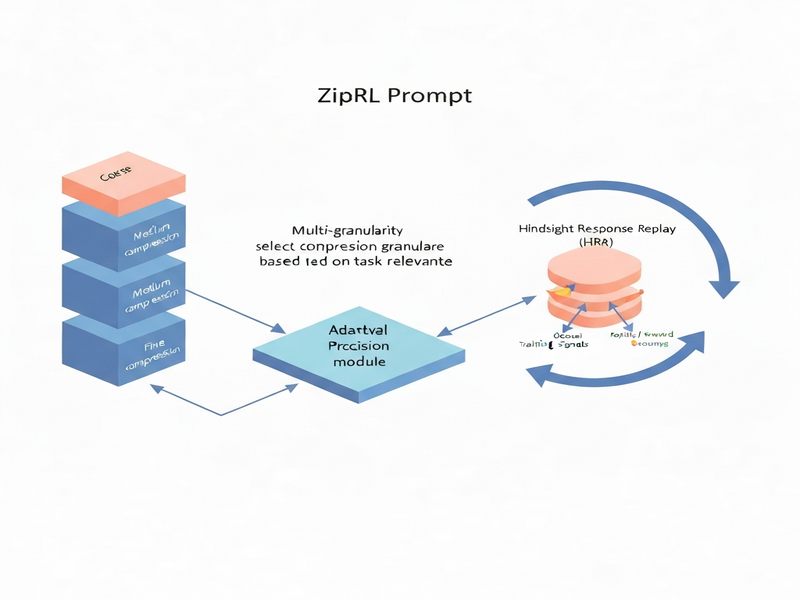
- Multi‑granularity compression. Instead of applying a single, uniform summarization rule, ZipRL dynamically selects compression granularity per turn. Coarse‑grained prompts generate macro‑summaries for older, less volatile dialogue, while fine‑grained prompts preserve detailed context for recent, decision‑critical exchanges.
- Hindsight Response Replay (HRR). HRR enriches the RL signal by replaying past responses under a “what‑if” lens. After an episode finishes, the system re‑evaluates earlier compressed states using the final reward, reshaping advantages so that the optimizer receives dense, informative gradients.
In essence, ZipRL acts as a two‑stage agent:
- A compressor that decides, at each turn, how much of the history to retain and at what level of abstraction.
- A policy learner that uses Generalized Reward‑Based Policy Optimization (GRPO) enhanced with HRR to align compression decisions with downstream task success.
How It Works in Practice
The operational flow of ZipRL can be broken down into four logical stages, each of which maps cleanly onto existing LLM‑orchestration pipelines:
1. Turn Ingestion
When a new user or system message arrives, the agent appends it to the current context buffer. The buffer now contains a mixture of raw turns and previously compressed summaries.
2. Granularity Selection
ZipRL evaluates a lightweight policy network that scores each segment of the buffer on two axes: relevance (how likely the segment influences the next decision) and staleness (how far back it is in the conversation). Based on these scores, the system chooses one of three actions:
- Keep as‑is. High‑relevance, recent turns stay untouched.
- Fine‑compress. Medium‑relevance turns are summarized with a prompt that preserves key entities and logical relations.
- Coarse‑compress. Low‑relevance, older turns are collapsed into a high‑level narrative (e.g., “The user initially requested a price quote for product X”).
3. Compression Execution
Selected segments are fed to the underlying LLM using specially crafted prompts that guide the model toward the desired granularity. For example, a coarse‑compression prompt might read:
“Summarize the following exchange in one sentence, preserving only the original goal and any constraints.”
The LLM returns a concise summary that replaces the original segment in the buffer, freeing up tokens for future turns.
4. Hindsight Response Replay (HRR)
After the episode terminates (e.g., the agent completes the task or reaches a maximum turn limit), ZipRL re‑plays the trajectory. It re‑injects the final reward into each compression decision, recomputes advantages, and updates the policy via GRPO. This hindsight step turns a sparse, end‑of‑episode reward into a dense learning signal, allowing the compressor to quickly discover which granularity choices were beneficial.
What sets ZipRL apart from prior work is the non‑uniform, context‑aware compression coupled with a replay mechanism that directly ties compression quality to downstream success, rather than relying on proxy metrics like BLEU or ROUGE.
Evaluation & Results
To validate ZipRL, the authors conducted extensive experiments across five representative multi‑turn agent tasks:
- Goal‑driven planning. An LLM must devise a multi‑step plan to achieve a user‑specified objective.
- Customer‑support ticket resolution. The agent handles a sequence of clarifying questions before delivering a solution.
- Data‑pipeline orchestration. The model coordinates a series of API calls and data transformations.
- Negotiation dialogue. Two agents exchange offers and counter‑offers over many turns.
- Interactive code debugging. The system iteratively refines code snippets based on user feedback.
Each task was evaluated with two model families—Qwen3‑4B and Qwen3‑8B—under identical hardware and token budgets. ZipRL was compared against three baselines:
- Simple truncation (keep last N turns).
- Uniform extractive summarization.
- A prior RL‑based compressor that lacks hindsight replay.
The results were striking:
- ZipRL achieved a 27.9 % average improvement in task success rate over the best baseline for the 4‑billion‑parameter model.
- For the 8‑billion‑parameter model, the gain rose to 34.7 %**, demonstrating scalability.
- Token consumption dropped by roughly 40 %** compared to full‑context baselines, confirming the framework’s efficiency.
- In a stress test that forced agents to operate over **256 turns**, ZipRL maintained stable performance while the baselines collapsed due to context overflow.
These findings indicate that ZipRL not only preserves critical information but also learns to allocate token budget where it matters most, a capability that traditional methods lack.
Why This Matters for AI Systems and Agents
For practitioners building production‑grade LLM agents, ZipRL offers three immediate benefits:
- Extended conversation horizons. By compressing intelligently, agents can handle hundreds of turns without hitting model limits, unlocking use‑cases such as long‑form tutoring or multi‑stage contract drafting.
- Cost reduction. Fewer tokens per request translate directly into lower inference spend, a crucial factor for SaaS platforms that bill per‑token usage.
- Robustness to context drift. The hierarchical compression preserves high‑level goals while discarding noise, reducing the likelihood of “hallucinations” caused by stale information.
Enterprises can integrate ZipRL into existing orchestration layers with minimal friction. For example, the UBOS platform overview already supports plug‑in style agents; ZipRL can be added as a middleware that preprocesses the context before each LLM call. Similarly, teams building conversational bots can pair ZipRL with the ChatGPT and Telegram integration to keep long‑running chats responsive and cost‑effective.
What Comes Next
While ZipRL marks a significant step forward, several avenues remain open for exploration:
- Cross‑modal compression. Extending the granularity logic to multimodal inputs (images, audio) could enable agents that reason over rich media streams without exploding token counts.
- Meta‑learning of granularity policies. Current policies are trained per‑task; a meta‑learner could generalize compression strategies across domains, reducing the need for task‑specific fine‑tuning.
- Human‑in‑the‑loop feedback. Incorporating explicit user signals (e.g., “this part was helpful”) could further align compression decisions with real‑world utility.
- Safety and compliance. Adaptive compression must respect data‑privacy constraints; future work should investigate provable guarantees that sensitive information is never inadvertently dropped.
Developers interested in experimenting with ZipRL can start by exploring the Enterprise AI platform by UBOS, which offers a sandbox for custom policy integration. Start‑ups may also find the UBOS for startups program useful for rapid prototyping, while larger organizations can leverage the UBOS partner program for co‑development and support.
For a deeper dive into the original methodology, see the ZipRL paper. The authors also release code and model checkpoints, enabling the community to benchmark against the reported 27.9 % and 34.7 % gains.
Andrii Bidochko
CTO UBOS
Andrii Bidochko is an AI entrepreneur and researcher focused on AI agents, reinforcement learning, and autonomous systems. He writes about the technologies shaping the future of machine intelligence, from frontier models and agent architectures to real-world AI applications.