

- Updated: June 11, 2026
- 7 min read
Zipping the Thought: When and How Compressed Reasoning Data Works in LLM Post-Training
Direct Answer
The paper “Zipping the Thought: When and How Compressed Reasoning Data Works in LLM Post‑Training” introduces a systematic taxonomy of chain‑of‑thought (CoT) formats—Explicit, Composed, and Implicit—and empirically shows how the granularity of these compressed reasoning traces influences supervised fine‑tuning (SFT) and subsequent reinforcement‑learning‑with‑verifiable‑rewards (RLVR). Its findings help practitioners decide how much reasoning detail to retain when scaling limited training data, directly impacting the cost‑performance trade‑off of large language model (LLM) agents.
Background: Why This Problem Is Hard
LLMs have become proficient at solving multi‑step problems when they are prompted to generate a chain‑of‑thought. However, each reasoning step consumes tokens, and long CoT sequences dramatically increase inference latency and API costs. The industry response has been to compress reasoning traces—either by merging steps or by omitting intermediates—before using them for supervised fine‑tuning. Yet three fundamental questions remain unanswered:
- Performance vs. Compression: Does a coarser trace inevitably sacrifice accuracy, or can scaling data compensate?
- Generalization: How does the shape of the compressed trace affect a model’s ability to handle longer, unseen problems?
- Interaction with RL: Can reinforcement learning recover the lost granularity, or does it simply reinforce the compressed pattern?
Existing studies treat CoT as a monolithic training signal, providing little guidance on how to balance token efficiency with reasoning fidelity. This gap is especially acute for enterprises that must fine‑tune proprietary models on modest datasets while still demanding high‑quality reasoning.
What the Researchers Propose
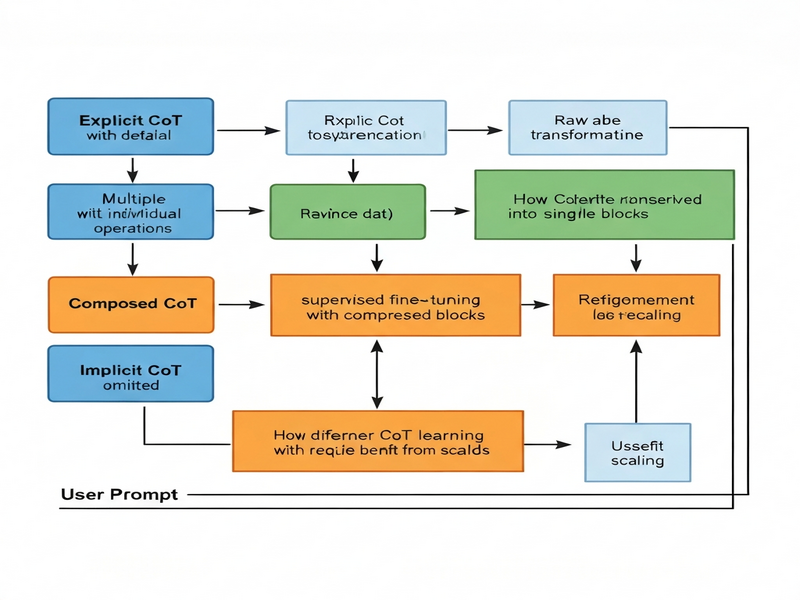
The authors present a three‑tier taxonomy that categorizes CoT traces by their level of aggregation:
Explicit CoT
Every elementary operation—arithmetic, logical comparison, variable assignment—is emitted as a separate token line. No aggregation occurs, making the trace maximally transparent.
Composed CoT
Multiple elementary operations that logically belong together are merged into a single, higher‑level step (e.g., “compute the sum of the first three numbers”). This reduces token count while preserving a clear causal chain.
Implicit CoT
Intermediate steps are omitted entirely; the model jumps from the problem statement to the final answer, relying on internal inference to fill the gaps.
The taxonomy is illustrated in the diagram below, which maps each style to its token footprint and typical use‑case.
Beyond the taxonomy, the paper proposes a controlled synthetic compositional reasoning benchmark. The benchmark lets researchers vary three axes independently:
- Task difficulty: Number of nested operations.
- Compression granularity: Choice of Explicit, Composed, or Implicit trace.
- Data size: Number of training examples per granularity.
This design isolates the effect of each factor, enabling a clean analysis of how compressed reasoning data behaves during post‑training.
How It Works in Practice
From an engineering standpoint, the workflow can be broken into three stages:
- Data Generation & Compression – A base LLM solves a set of synthetic problems and emits full Explicit CoT. A deterministic post‑processor then rewrites each trace into either Composed or Implicit form according to predefined rules.
- Supervised Fine‑Tuning (SFT) – The compressed dataset is fed to the target model using standard cross‑entropy loss. The authors experiment with three model families (7B, 13B, 34B) to assess size‑dependent effects.
- Reinforcement Learning with Verifiable Rewards (RLVR) – After SFT, the model undergoes RL where a verifier checks each step against a ground‑truth program. Rewards are granted only when the verifier can decompose a compressed step into valid sub‑operations.
Key differentiators of this pipeline include:
- Controlled granularity: The same underlying problem set is presented in three distinct reasoning styles, eliminating confounding variables.
- Verification‑driven RL: Unlike generic RLHF, RLVR explicitly forces the model to expose hidden sub‑steps, providing a unique lens on how compressed knowledge can be “unzipped.”
- Unidirectional ordering experiments: The authors test whether presenting steps in forward order (problem → answer) versus reverse order influences generalization to longer sequences.
Evaluation & Results
The experimental suite covers four major dimensions:
1. Data Scaling vs. Compression Granularity
When the training set is small (≈5 K examples), Explicit CoT outperforms both Composed and Implicit formats by a margin of 7–9 % on exact‑answer accuracy. As the dataset grows to 100 K examples, the gap narrows, and Composed CoT actually surpasses Explicit by ~3 % because the model learns to reuse higher‑level abstractions.
2. Effect of Repetition
Repeating the same Composed examples multiple times (data augmentation) yields a consistent boost (≈4 % absolute) in downstream performance, suggesting that the model benefits from reinforced pattern exposure. Implicit traces, however, show diminishing returns and eventually plateau, indicating a tendency toward memorization rather than reasoning.
3. RLVR Decompression
RLVR applied after SFT on Composed data successfully decomposes many merged steps back into their elementary operations, improving test‑time accuracy on longer chains by up to 6 %. For Implicit data, RLVR struggles to recover hidden steps, leading to marginal gains (<1 %). This demonstrates that RLVR can “unzip” certain compressed formats but not all.
4. Unidirectional Ordering
Training with forward‑ordered CoT (problem → step 1 → … → answer) yields better extrapolation to tasks with twice the original length, compared to reverse‑ordered training. The effect is most pronounced for Composed CoT, where forward ordering adds ~5 % robustness.
Overall, the results paint a nuanced picture: coarser reasoning can be viable—but only when paired with sufficient data, strategic repetition, and a verification‑aware RL phase.
Why This Matters for AI Systems and Agents
For practitioners building production‑grade agents, the paper offers concrete guidance on how to allocate limited annotation budgets:
- Choose the right granularity. If you can afford a medium‑sized dataset (≈50 K examples), favor Composed CoT to reap abstraction benefits while keeping token costs low.
- Leverage data repetition. Simple oversampling of Composed traces can substitute for additional unique examples, accelerating convergence.
- Integrate verification‑based RL. Adding an RLVR stage can recover hidden reasoning steps, especially for models that were fine‑tuned on compressed data.
- Design forward‑ordered prompts. Align your prompt engineering pipeline with the forward ordering that the study shows to improve generalization.
These insights translate directly into cost savings for enterprises that bill per token. By compressing reasoning traces without sacrificing downstream performance, companies can reduce inference latency for chat‑based assistants, autonomous planning agents, and decision‑support bots.
UBOS customers can immediately apply these principles using the platform’s Workflow automation studio to generate, compress, and fine‑tune reasoning data at scale. The OpenAI ChatGPT integration also lets you test RLVR‑style verification loops without building a custom reward model from scratch.
What Comes Next
While the study makes significant strides, several open challenges remain:
- Real‑world benchmarks. The synthetic task isolates variables but may not capture the messiness of natural language reasoning. Future work should validate the taxonomy on code generation, legal reasoning, and scientific literature synthesis.
- Hybrid CoT formats. A mixed strategy that dynamically switches between Explicit, Composed, and Implicit steps based on problem complexity could further optimize token usage.
- Scalable verification. RLVR relies on a perfect verifier; building approximate yet efficient verifiers for open‑domain tasks is an active research frontier.
- Cross‑model transfer. Investigating whether a model fine‑tuned on Composed CoT can teach a smaller student model to emulate the same abstraction hierarchy.
UBOS is already exploring a template library that embeds the taxonomy logic into reusable fine‑tuning pipelines, enabling rapid experimentation for startups and SMBs. The UBOS partner program also offers co‑development opportunities for organizations that want to contribute verification modules or custom CoT compressors.
References
- Matsutani, K., Minegishi, G., Kojima, T., Iwasawa, Y., & Matsuo, Y. (2026). Zipping the Thought: When and How Compressed Reasoning Data Works in LLM Post‑Training. arXiv preprint arXiv:2605.28008.
- Additional background on chain‑of‑thought prompting: Wei, J. et al., “Chain of Thought Prompting Elicits Reasoning in Large Language Models,” 2022.
Andrii Bidochko
CTO UBOS
Andrii Bidochko is an AI entrepreneur and researcher focused on AI agents, reinforcement learning, and autonomous systems. He writes about the technologies shaping the future of machine intelligence, from frontier models and agent architectures to real-world AI applications.