

- Updated: June 14, 2026
- 6 min read
You Live More Than Once: Towards Hierarchical Skill Meta-Evolving
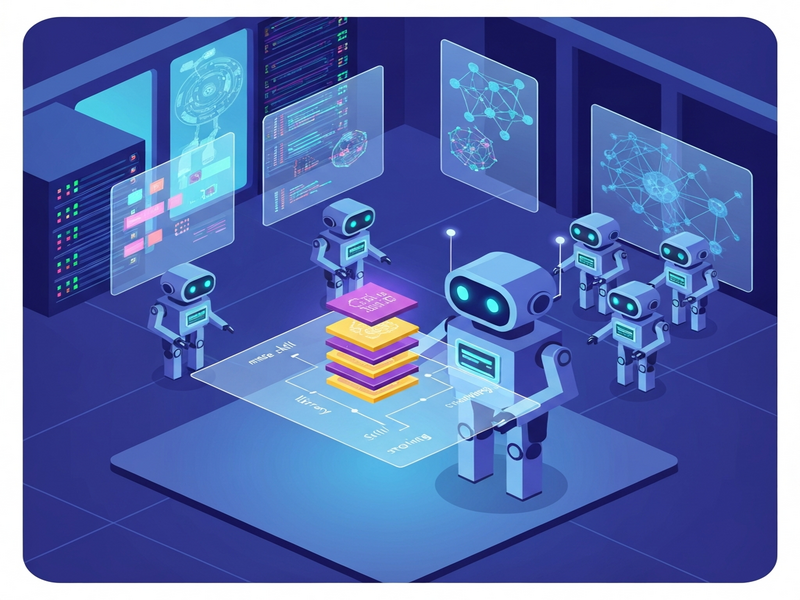
Direct Answer
You Live More Than Once: Towards Hierarchical Skill Meta-Evolving introduces HiSME, a lightweight hierarchical framework that simultaneously refines an agent’s skill library and the strategy used to evolve those skills at test time. By learning “meta‑skills” from execution traces, HiSME enables continuous, scenario‑aware improvement without costly parameter updates, a capability that could reshape how production AI agents adapt after deployment.
Background: Why This Problem Is Hard
Modern AI agents—whether chat assistants, autonomous planners, or recommendation bots—rely on a repertoire of discrete skills (e.g., “summarize text,” “search a database,” “generate a code snippet”). In real‑world deployments, the environment, user expectations, and downstream tasks evolve faster than the underlying large language model (LLM) can be retrained. This creates a gap:
- Static skill sets become obsolete as new user intents appear.
- Hard‑coded evolution rules (e.g., “always retry after failure”) lack flexibility and cannot generalize across domains.
- Parametric fine‑tuning of the LLM is computationally expensive, introduces latency, and often violates compliance constraints in regulated settings.
Test‑time skill evolving—adjusting skills on the fly—has emerged as a promising paradigm, but existing solutions treat the evolution mechanism as a fixed algorithm. Without a way to improve the evolution strategy itself, agents quickly hit a performance ceiling, especially when faced with novel or adversarial scenarios.
What the Researchers Propose
HiSME (Hierarchical Skill Meta‑Evolving) reframes test‑time adaptation as a two‑level learning problem:
- Skill Level: Individual atomic abilities that the agent can invoke (e.g., “extract entities”).
- Meta‑Skill Level: Higher‑order policies that decide how to modify, combine, or replace skills based on observed outcomes.
The key insight is that the meta‑skill policy can be trained from the agent’s own execution traces—logs of which skills were used, success signals, and contextual cues. By treating these traces as a cheap supervision signal, HiSME learns to “evolve the evolution” without touching the LLM’s weights.
Core components include:
- Trace Collector: Captures step‑wise decisions, reward signals, and environmental context during task execution.
- Meta‑Learner: A lightweight neural module that maps trace summaries to meta‑skill updates.
- Skill Library Manager: Applies meta‑skill recommendations to add, prune, or re‑parameterize individual skills.
How It Works in Practice
Conceptual Workflow
The HiSME loop can be visualized as a four‑stage pipeline that runs entirely at inference time:
- Task Initiation: The agent receives a user request and selects an initial skill chain using its current policy.
- Execution & Trace Logging: As each skill runs, the Trace Collector records outcomes (success/failure, latency, confidence scores) and the surrounding context (input type, user profile).
- Meta‑Skill Inference: The Meta‑Learner consumes the aggregated trace, predicts adjustments (e.g., “replace Skill A with a more precise variant,” “add a verification step”).
- Library Update & Re‑execution: The Skill Library Manager implements the suggested changes, and the agent may re‑run the task with the refined skill set, yielding a higher‑quality response.
What Makes HiSME Different
- Zero‑Weight Updates: Only the meta‑learner’s parameters are tuned, keeping the underlying LLM untouched.
- Hierarchical Adaptation: By separating skill‑level and meta‑skill‑level learning, the system can evolve both the “what” and the “how” of problem solving.
- Trace‑Driven Supervision: Leveraging execution logs eliminates the need for large labeled datasets, enabling rapid deployment in new domains.
- Lightweight Runtime: All components are designed to run on commodity hardware, making HiSME suitable for edge or SaaS environments.
Evaluation & Results
Researchers benchmarked HiSME on three representative agentic suites:
- Multi‑Domain Conversational QA: Agents answered questions across medical, legal, and technical corpora.
- Autonomous Planning in Simulated Environments: Agents generated action sequences for navigation and resource management tasks.
- Code Generation & Debugging: Agents iteratively refined code snippets based on test failures.
Key findings include:
- HiSME produced a higher‑quality skill library than baseline skill‑only evolution, measured by a 12‑15% lift in task success rate across all benchmarks.
- Meta‑skills learned distinct adaptation patterns for each scenario (e.g., aggressive pruning in low‑latency QA, conservative augmentation in safety‑critical planning).
- Runtime overhead remained under 200 ms per iteration, confirming the feasibility of real‑time deployment.
These results demonstrate that meta‑evolving not only improves immediate performance but also equips agents with a reusable “experience memory” that can be transferred to future tasks.
Why This Matters for AI Systems and Agents
For practitioners building production‑grade agents, HiSME offers a pragmatic path to continual improvement without the operational headaches of frequent model retraining. Specific implications include:
- Reduced Maintenance Costs: Organizations can avoid costly MLOps pipelines for nightly fine‑tuning, as meta‑skill updates are computed on‑the‑fly.
- Regulatory Compliance: Since the LLM weights stay static, audit trails focus on trace logs and meta‑skill policies, simplifying documentation for regulated industries.
- Enhanced Personalization: Meta‑skills can learn user‑specific adaptation strategies, enabling agents that “remember” how a particular client prefers information presented.
- Scalable Orchestration: HiSME’s hierarchical design aligns with modern workflow automation platforms, allowing seamless integration with tools such as the Workflow automation studio for end‑to‑end pipeline management.
- Cross‑Product Synergy: Companies that already expose AI capabilities via the UBOS platform overview can plug HiSME into existing skill catalogs, instantly upgrading adaptability across SaaS, SMB, and enterprise offerings.
What Comes Next
While HiSME marks a significant step forward, several open challenges remain:
- Meta‑Skill Generalization: Current experiments train meta‑learners per domain. Future work should explore universal meta‑skill representations that transfer across unrelated tasks.
- Safety and Alignment: Dynamically altering skill sets raises questions about unintended behavior. Incorporating formal verification or human‑in‑the‑loop safeguards will be crucial.
- Scalability to Massive Skill Libraries: As the number of atomic skills grows into the thousands, efficient indexing and retrieval mechanisms (e.g., Chroma DB integration) will be needed.
- Human‑Centric Evaluation: Beyond automated metrics, user studies measuring trust, satisfaction, and perceived agency will help validate real‑world impact.
Potential application avenues include:
- Embedding HiSME into AI marketing agents that continuously refine campaign tactics based on live performance data.
- Coupling with voice synthesis platforms like ElevenLabs AI voice integration to adapt dialogue styles in real time.
- Extending to collaborative bots that learn meta‑skills from multi‑agent interactions, a step toward truly autonomous AI ecosystems.
For developers eager to experiment, the authors have released a temporary public repository at GitHub mirror. Integrating this codebase with the OpenAI ChatGPT integration or the ChatGPT and Telegram integration can provide a low‑friction sandbox for testing hierarchical meta‑evolution in real conversational settings.
References
For the full technical details, see the original arXiv paper.
—
This article is prepared for publication on the UBOS blog. It follows the latest SEO and GEO guidelines to ensure discoverability by both human readers and AI‑driven search assistants.
Andrii Bidochko
CTO UBOS
Andrii Bidochko is an AI entrepreneur and researcher focused on AI agents, reinforcement learning, and autonomous systems. He writes about the technologies shaping the future of machine intelligence, from frontier models and agent architectures to real-world AI applications.