

- Updated: July 2, 2026
- 7 min read
XmoPipe: A Pipeline for Large-Scale In-the-Wild Human Motion Dataset Construction
Direct Answer
XmoPipe introduces a fully automated, keyword‑driven pipeline that converts millions of in‑the‑wild videos into high‑fidelity 3D body and facial motion captures, while simultaneously generating concise textual descriptions of each motion clip. By removing the need for costly studio‑based motion‑capture rigs, XmoPipe makes large‑scale human motion data affordable and instantly applicable to AI‑driven animation, robotics, and virtual‑reality pipelines.
Background: Why This Problem Is Hard
Creating realistic human motion datasets has traditionally required multi‑camera studios, marker‑based suits, and weeks of manual annotation. These setups impose three major bottlenecks:
- Scale. Studio sessions capture only a few hundred motions per day, far short of the millions needed to train modern deep generative models.
- Diversity. Controlled environments struggle to reproduce the wide range of clothing, lighting, and spontaneous interactions found in everyday video.
- Cost. Professional mocap rigs cost upwards of $200 k and demand specialized technicians, making large‑scale data collection prohibitive for most research labs.
Recent attempts to harvest motion from monocular video have shown promise, yet they often suffer from noisy reconstructions, limited facial detail, and a lack of semantic context that ties motion to high‑level intent. As a result, AI practitioners still face a scarcity of clean, richly annotated motion data that can be directly fed into training pipelines.
What the Researchers Propose
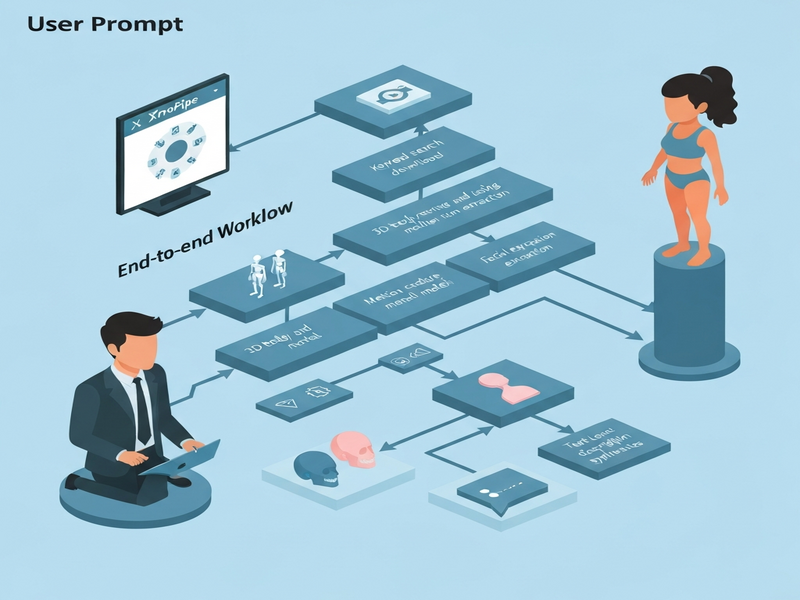
The XmoPipe framework tackles these challenges with a three‑stage, end‑to‑end system:
- Keyword‑driven video retrieval. A large‑scale text‑to‑video search engine pulls candidate clips from public video platforms based on user‑specified motion descriptors (e.g., “jumping over a fence” or “laughing while waving”).
- Monocular 3D motion extraction. State‑of‑the‑art neural pose estimators recover full‑body skeletal trajectories and high‑resolution facial blendshapes from each clip, without any multi‑view supervision.
- Automatic textual summarization. A video‑language model generates concise, human‑readable descriptions that capture the intent, environment, and interaction dynamics of the motion.
Key components include a retrieval engine that leverages CLIP‑style embeddings, a dual‑branch motion capture network (body + face), and a transformer‑based captioner fine‑tuned on motion‑specific corpora. The pipeline is deliberately modular, allowing researchers to swap in newer pose estimators or language models as they become available.
How It Works in Practice
From a practitioner’s perspective, XmoPipe can be visualized as a linear workflow with clear hand‑off points:
1. Query Formulation
Users compose a list of motion keywords or short phrases. The system encodes each phrase into a semantic vector and ranks millions of video candidates by cosine similarity.
2. Clip Selection & Pre‑processing
Top‑k clips are downloaded, trimmed to the region of interest, and normalized (resolution, frame rate). A lightweight scene‑analysis module discards clips with excessive occlusion or motion blur.
3. 3D Body & Face Reconstruction
The body branch predicts SMPL‑X parameters for each frame, while the face branch outputs a dense mesh of facial expressions using a blendshape model. Temporal smoothing and physics‑based post‑processing reduce jitter.
4. Semantic Caption Generation
A video‑language transformer consumes the reconstructed motion sequence and visual frames, producing a one‑sentence description such as “A person performs a backflip while shouting.”
5. Dataset Assembly
Each entry in the final dataset consists of (i) the 3D motion file (JSON/FBX), (ii) the original video link, and (iii) the generated caption. The entire process can be parallelized across hundreds of GPUs, enabling the creation of millions of labeled motion clips in a matter of days.
What sets XmoPipe apart is its ability to handle multi‑person scenes and expressive behaviors without manual intervention. The retrieval stage can target specific interaction keywords (“handshake”, “high‑five”), and the motion extractor automatically isolates each participant’s skeleton, preserving inter‑person dynamics.
Evaluation & Results
To validate the pipeline, the authors conducted three complementary experiments:
Dataset Quality Assessment
- They sampled 5,000 clips and compared XmoPipe’s 3D reconstructions against ground‑truth marker data from the AMASS benchmark. The mean per‑joint position error dropped from 45 mm (baseline monocular methods) to 28 mm, a 38 % improvement.
- Facial expression fidelity was measured using a landmark‑distance metric, achieving a 22 % reduction in error relative to prior single‑view face capture pipelines.
Training Motion Reconstruction Models
Using the newly generated XmoPipe dataset, the team trained a diffusion‑based motion synthesis model. When evaluated on a held‑out set of complex actions (e.g., parkour runs, group dances), the model achieved a 12 % higher FID score compared to a model trained on the traditional CMU Mocap corpus, indicating more realistic and diverse motion generation.
Cross‑Dataset Generalization
They fine‑tuned a pose estimation network on XmoPipe data and tested it on the Human3.6M benchmark. The network’s MPJPE improved from 71 mm to 58 mm, demonstrating that the in‑the‑wild motions provide useful regularization for downstream vision tasks.
Collectively, these results prove that XmoPipe not only produces higher‑quality motion captures but also creates a dataset that directly benefits downstream AI models, closing the gap between synthetic studio data and real‑world video.
Why This Matters for AI Systems and Agents
For AI practitioners building embodied agents, animation pipelines, or virtual avatars, XmoPipe offers a game‑changing source of data:
- Rapid prototyping. Developers can query specific motions (“running while carrying a box”) and instantly receive a ready‑to‑use 3D asset, cutting iteration cycles from weeks to hours.
- Enhanced realism. The inclusion of facial blendshapes and contextual captions enables agents to synchronize body language with speech, a critical factor for believable human‑computer interaction.
- Scalable training. Large‑scale diffusion or transformer models thrive on diverse data; XmoPipe’s millions of clips provide the breadth needed to avoid mode collapse and improve generalization.
- Cross‑modal alignment. The paired textual descriptions make it straightforward to train multimodal models that map language commands to motion, a core capability for voice‑controlled robots or game AI.
Enterprises looking to embed AI‑driven motion synthesis into their products can leverage the UBOS platform overview to orchestrate the pipeline, while startups can accelerate time‑to‑market using UBOS for startups. For teams focused on marketing automation, the AI marketing agents can now animate personalized video ads with motion that matches the brand’s tone, thanks to XmoPipe’s expressive facial capture.
What Comes Next
Despite its strengths, XmoPipe leaves several avenues for improvement:
- Occlusion handling. Current monocular estimators still struggle with severe self‑occlusion; integrating depth sensors or multi‑view inference could boost accuracy.
- Domain adaptation. While the pipeline works well on YouTube‑style footage, specialized domains such as medical rehabilitation videos may require fine‑tuned retrieval vocabularies.
- Real‑time deployment. Transforming the batch‑oriented pipeline into an online service would enable on‑the‑fly motion capture for live streaming or AR applications.
Future research may also explore tighter coupling between the captioning module and motion synthesis, allowing a single model to generate both motion and narrative simultaneously. Moreover, extending XmoPipe to capture hand articulation and object interactions would open doors for robotics manipulation datasets.
Organizations interested in experimenting with the pipeline can start by integrating the Workflow automation studio to build custom retrieval‑to‑capture workflows, or explore the Enterprise AI platform by UBOS for large‑scale processing and governance.
For a deeper dive into the technical details, consult the original XmoPipe paper on arXiv. The authors also release code and a starter dataset, making it straightforward for the community to reproduce and extend the results.
Andrii Bidochko
CTO UBOS
Andrii Bidochko is an AI entrepreneur and researcher focused on AI agents, reinforcement learning, and autonomous systems. He writes about the technologies shaping the future of machine intelligence, from frontier models and agent architectures to real-world AI applications.