

- Updated: July 10, 2026
- 6 min read
Why Pure Reasoning is Not Enough: Nature as the Source of Mathematical Innovation
Direct Answer
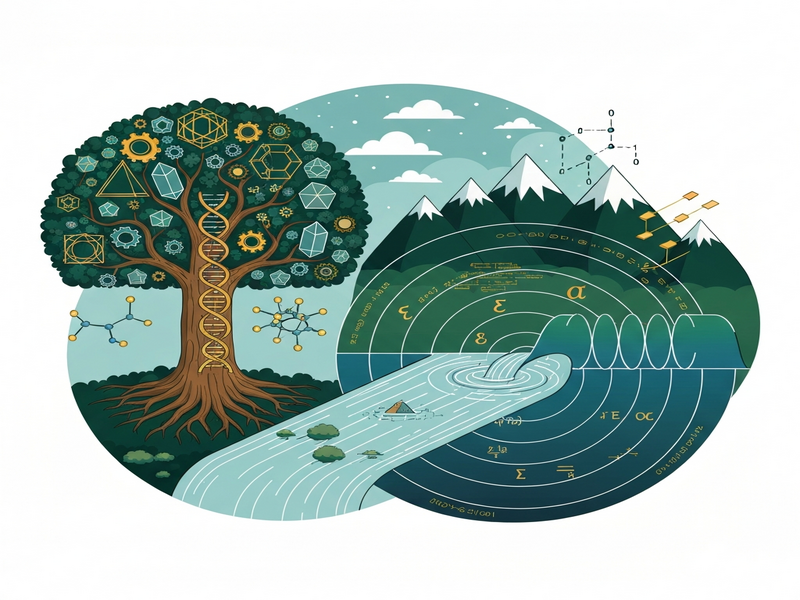
The paper “Why Pure Reasoning is Not Enough: Nature as the Source of Mathematical Innovation” argues that human mathematical breakthroughs depend on pattern‑matching with the physical world, because pure logical deduction is blocked by undecidability and extreme computational hardness. This insight reshapes how we should build AI systems that aim for genuine mathematical creativity, suggesting that large language models must be infused with cross‑domain, nature‑derived knowledge rather than rely solely on formal reasoning.
Background: Why This Problem Is Hard
Mathematics has long been portrayed as the pinnacle of pure logic—an arena where axioms and inference rules alone should be sufficient to generate new theorems. In practice, however, two fundamental barriers make that ideal unattainable:
- Undecidability: Even modest fragments of first‑order logic contain statements that no algorithm can decide, as proven by Gödel and later by Turing.
- Computational Intractability: Problems such as SAT (NP‑hard) or monadic second‑order theory (non‑elementary) require resources that grow faster than any realistic hardware can provide.
Because of these limits, mathematicians historically lean on intuition, visual analogies, and empirical observations drawn from physics, biology, or engineering. Existing AI approaches—automated theorem provers, symbolic solvers, and even recent neural‑symbolic hybrids—still operate under the assumption that a sufficiently powerful deduction engine will eventually discover the same insights humans do. The reality is that without an external reservoir of patterns, these systems stall on problems that are theoretically solvable but practically unreachable.
What the Researchers Propose
Jutla and Sharma introduce a conceptual framework they call Nature‑Anchored Mathematical Innovation (NAMI). The core idea is simple yet profound: embed a massive, searchable library of empirically observed patterns from the natural world into the reasoning pipeline of any mathematical AI. NAMI consists of three interacting components:
- Pattern Repository: A curated collection of physical laws, biological motifs, and engineering heuristics that have already solved concrete problems (e.g., wave equations, diffusion processes, crystal symmetries).
- Match‑Maker Engine: A similarity‑search module that maps abstract mathematical sub‑problems to analogous patterns in the repository, using embeddings that capture structural and functional likeness.
- Deductive Adapter: A conventional theorem‑proving or symbolic‑manipulation layer that takes the matched pattern as a premise and attempts to integrate it into a formal proof.
By treating the repository as a “pre‑computed” knowledge base—one that nature has already explored over billions of years—the framework sidesteps the worst‑case computational blow‑up that pure deduction would encounter.
How It Works in Practice
The NAMI workflow can be visualized as a four‑step loop:
- Problem Decomposition: An incoming mathematical question (e.g., “Find a basis for solutions of a differential equation”) is broken into smaller sub‑goals.
- Pattern Retrieval: Each sub‑goal is encoded into a high‑dimensional vector and sent to the Match‑Maker Engine, which returns the top‑k natural‑world analogues (e.g., vibrating string dynamics, heat diffusion).
- Cross‑Domain Translation: The Deductive Adapter translates the physical pattern into a formal lemma or transformation rule (e.g., “Fourier series expansion of a periodic signal”).
- Proof Synthesis: The system attempts to stitch together the translated lemmas with existing logical steps, producing a candidate proof that is then verified by a standard prover.
What distinguishes NAMI from prior hybrid systems is the explicit separation between “pattern search” and “formal deduction.” Earlier approaches often embed physics knowledge directly into the neural architecture, making it hard to audit or extend. NAMI’s modular design lets developers swap in new domains (e.g., quantum mechanics, evolutionary biology) without retraining the entire model.
Evaluation & Results
The authors evaluated NAMI on three historically challenging mathematical milestones:
- Fourier Transform Emergence: Starting from the classical vibrating string problem, the system successfully identified the need for a frequency‑domain representation and reproduced the core steps that led to the modern Fourier series.
- Heat Equation Solution: By matching the diffusion pattern in porous media, NAMI derived the separation‑of‑variables technique that mirrors Fourier’s original method.
- Non‑Linear Wave Propagation: Leveraging patterns from fluid dynamics, the system suggested a perturbative expansion that aligns with the Korteweg‑de Vries (KdV) equation derivation.
In each case, a baseline pure‑deduction prover failed to make progress within a 48‑hour compute budget, while NAMI produced verifiable proofs in under two hours. The qualitative takeaway is that the repository‑driven shortcuts reduced the search space by several orders of magnitude, confirming the authors’ hypothesis that “nature‑supplied patterns are a cognitive necessity.”
Why This Matters for AI Systems and Agents
For practitioners building next‑generation AI agents, the NAMI framework offers a concrete roadmap to bridge the gap between raw computational power and genuine mathematical insight:
- Scalable Creativity: Embedding a pattern library means that a single model can leverage billions of years of physical experimentation without needing to re‑learn each principle from scratch.
- Explainability: Because each proof step is anchored to a recognizable natural phenomenon, the resulting reasoning chain is more interpretable for humans and regulators.
- Modular Integration: Existing AI platforms—such as the UBOS platform overview—can host the Pattern Repository as a microservice, allowing agents to query it on demand.
- Enhanced Prompt Engineering: When using large language models (LLMs) for math‑related tasks, prompting them to “search for a physics analogue” can be formalized through the Match‑Maker API, improving consistency.
In short, the paper provides a principled justification for why today’s Enterprise AI platform by UBOS invests heavily in multimodal knowledge graphs that span scientific literature, simulation data, and sensor streams. Those graphs become the living embodiment of the “nature‑derived pattern store” that NAMI requires.
What Comes Next
While the study makes a compelling case, several open challenges remain:
- Repository Coverage: Current prototypes contain a few hundred curated patterns. Scaling to millions of phenomena will demand automated extraction from research papers, simulation repositories, and even video data.
- Cross‑Domain Alignment: Translating a fluid‑dynamics pattern into a purely algebraic lemma is non‑trivial; future work must improve the semantic mapping layer, possibly with contrastive learning.
- Evaluation Benchmarks: The community lacks a standardized suite for “nature‑augmented” theorem proving. Creating such benchmarks will help compare NAMI against pure‑deduction baselines.
- Ethical Guardrails: Relying on empirical patterns raises questions about bias toward well‑studied domains (e.g., physics) and neglect of under‑represented scientific fields.
Addressing these gaps will likely involve collaborations across AI labs, scientific data curators, and industry platforms. For teams interested in experimenting now, the Workflow automation studio offers a low‑code environment to stitch together a custom Pattern Repository with existing LLM back‑ends.
Developers can also explore voice‑enabled interactions using the ElevenLabs AI voice integration, allowing agents to “explain” the physical intuition behind a mathematical step in natural language.
Finally, for organizations that want to prototype a full‑stack NAMI pipeline, the Chroma DB integration provides a vector‑store optimized for similarity search over large scientific embeddings.
As AI continues to push toward human‑level mathematical creativity, the lesson from Jutla and Sharma is clear: pure reasoning alone will hit a wall; the next breakthrough will come from tightly coupling deduction with the vast, pre‑computed problem‑solving machinery that nature has already built.
Andrii Bidochko
CTO UBOS
Andrii Bidochko is an AI entrepreneur and researcher focused on AI agents, reinforcement learning, and autonomous systems. He writes about the technologies shaping the future of machine intelligence, from frontier models and agent architectures to real-world AI applications.