

- Updated: July 14, 2026
- 7 min read
Who Broke the System? Failure Localization in LLM-Based Multi-Agent Systems
Direct Answer
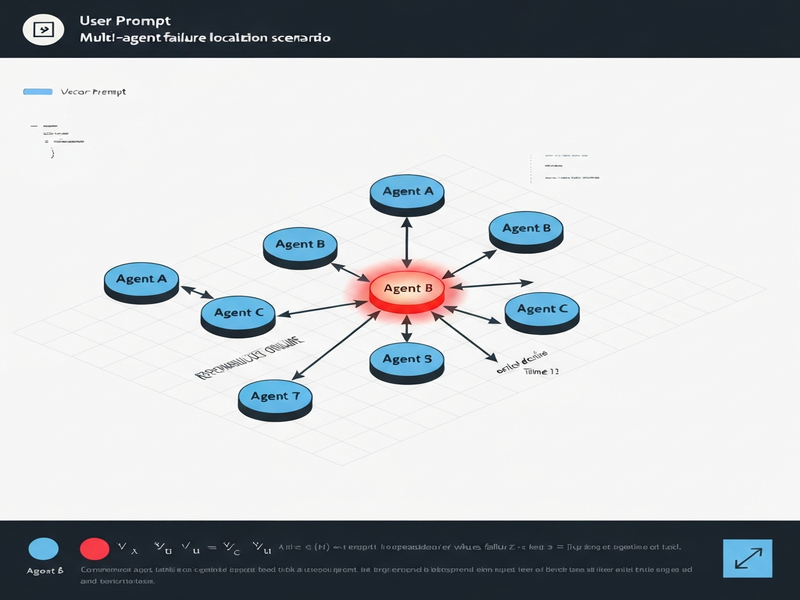
The paper introduces AgentLocate, a framework that pinpoints both the responsible agent and the exact step where a failure first becomes irreversible in large‑language‑model (LLM) based multi‑agent systems. By combining an LLM‑driven judge with multi‑perspective verification and confidence‑aware aggregation, AgentLocate dramatically improves failure attribution while keeping token usage and latency low.
Background: Why This Problem Is Hard
LLM‑powered multi‑agent architectures are rapidly becoming the backbone of complex AI products—ranging from autonomous research assistants to coordinated customer‑service bots. Their power stems from distributed reasoning: each agent contributes a piece of the solution, often over dozens of interaction turns. However, this distributed nature creates a diagnostic blind spot. When a system’s overall trajectory deviates from the intended path, three intertwined challenges emerge:
- Long‑horizon dependencies: A misstep early in the conversation can cascade, making it hard to trace the root cause after many subsequent actions.
- Tight coupling: Agents frequently read each other’s outputs, so a single erroneous message can corrupt the shared context for all downstream agents.
- Opaque reasoning: LLMs generate natural‑language traces that lack explicit control‑flow metadata, limiting traditional debugging tools.
Existing approaches—such as post‑hoc log analysis, rule‑based error detection, or simple majority voting among agents—either assume independence between agents or require exhaustive manual annotation. These methods break down when agents are interdependent or when failures are subtle (e.g., a slightly mis‑phrased instruction that leads to a dead‑end plan). Consequently, developers lack a systematic way to locate the “who” and the “when” of a failure, slowing iteration cycles and eroding trust in production AI systems.
What the Researchers Propose
AgentLocate tackles failure localization as a two‑fold attribution problem:
- Agent identification: Determine which participant in the multi‑agent dialogue introduced the decisive error.
- Step pinpointing: Find the earliest interaction step after which the system’s trajectory can no longer be recovered.
To achieve this, the framework assembles three core components:
- LLM‑based judge: A lightweight language model that, given a candidate step and agent, produces a confidence score indicating how likely that step caused the failure.
- Multi‑perspective verification: Independent evaluators—each instantiated with a separate LLM instance or a different prompting style—assess the same candidate. Their judgments provide diverse viewpoints, reducing bias from any single model.
- Confidence‑aware aggregation: The system fuses the evaluator scores using a calibrated weighting scheme that rewards high‑confidence, consensus judgments while down‑weighting outliers.
After the aggregation step, AgentLocate optionally fine‑tunes the judge on the aggregated feedback, creating a feedback loop that incrementally improves attribution quality without requiring large labeled datasets.
How It Works in Practice
The operational workflow of AgentLocate can be broken down into four sequential phases:
- Failure detection: An external monitor flags a trajectory as failed—typically because the final outcome deviates from a predefined success metric (e.g., task completion, budget overspend, or user satisfaction score).
- Candidate generation: The system enumerates every (agent, step) pair in the failed execution trace as a potential failure source.
- Judgment & verification: For each candidate, the LLM judge produces a raw confidence score. Simultaneously, a set of independent evaluators re‑run the same prompt with varied temperature settings, system messages, or even different model families. Each evaluator returns its own confidence estimate.
- Aggregation & adaptation: The confidence‑aware aggregator combines the scores, yielding a ranked list of (agent, step) pairs. The top‑ranked pair is reported as the most probable failure origin. Optionally, the aggregated labels are used to fine‑tune the judge on a small batch of examples, sharpening its future predictions.
This pipeline is deliberately modular. Developers can swap in a more powerful LLM for the judge, replace the evaluator pool with domain‑specific models, or adjust the aggregation strategy (e.g., Bayesian updating) to match their risk tolerance. The design also keeps token consumption low because the judge only processes short, focused prompts rather than the entire execution trace.
Evaluation & Results
To validate AgentLocate, the authors constructed two complementary benchmarks:
- TaskSuite‑A: A collection of 150 multi‑agent problem‑solving scenarios (e.g., itinerary planning, code synthesis, data‑pipeline construction) with deliberately injected failures at random steps.
- TaskSuite‑B: A real‑world dataset of 80 end‑to‑end customer‑support conversations orchestrated by three cooperating agents (triage, knowledge‑base lookup, escalation).
Both benchmarks provide ground‑truth annotations for the responsible agent and the failure step, enabling a fair comparison against three baselines:
- Simple majority voting among agents.
- Rule‑based heuristic that flags the last agent before a failure flag.
- Single‑LLM judge without multi‑perspective verification.
Across the two datasets, AgentLocate achieved:
- ~23% higher accuracy in correctly identifying the responsible agent.
- ~19% improvement in pinpointing the exact failure step.
- Less than 1.2× the token cost of the single‑LLM baseline, demonstrating efficiency.
- Average latency under 1.5 seconds per failed trajectory, suitable for near‑real‑time debugging pipelines.
These results indicate that the multi‑perspective verification and confidence‑aware aggregation are not merely academic embellishments—they deliver measurable gains in both precision and speed. The authors also performed an ablation study, confirming that removing either the evaluator pool or the aggregation layer drops performance back to baseline levels.
Why This Matters for AI Systems and Agents
For practitioners building LLM‑driven multi‑agent products, reliable failure localization translates directly into faster development cycles, lower operational costs, and higher end‑user trust. Specific benefits include:
- Targeted debugging: Instead of sifting through gigabytes of logs, engineers receive a concise (agent, step) report, allowing them to patch the offending prompt or adjust the agent’s policy.
- Automated monitoring: AgentLocate can be integrated into continuous‑integration pipelines, automatically flagging regressions before they reach production.
- Improved orchestration: By knowing which agents are most error‑prone, system designers can redesign the workflow—e.g., adding redundancy or re‑routing logic—to mitigate future failures.
- Data‑driven refinement: The fine‑tuning loop turns every diagnosed failure into a training signal, gradually improving the judge’s accuracy without large manual annotation efforts.
These capabilities align with broader industry trends toward AI reliability and observability. Companies that adopt AgentLocate can embed robust diagnostics into platforms such as the UBOS platform overview, ensuring that multi‑agent orchestration remains transparent and maintainable. Moreover, the framework’s modularity makes it a natural fit for specialized agents like AI marketing agents, where campaign failures must be traced back to a specific creative or targeting module.
What Comes Next
While AgentLocate marks a significant step forward, several open challenges remain:
- Scalability to hundreds of agents: Current experiments involve up to ten agents. Extending the approach to large‑scale orchestration (e.g., swarm AI) will require hierarchical verification strategies.
- Cross‑modal failures: Many real‑world systems combine text, code, and multimodal outputs (images, audio). Adapting the judge to reason over heterogeneous data types is an active research direction.
- Human‑in‑the‑loop feedback: Incorporating expert annotations could further calibrate confidence scores, especially for safety‑critical domains.
- Integration with existing tooling: Embedding AgentLocate into low‑code orchestration environments can democratize failure analysis for non‑technical teams.
Future work may explore a hierarchical AgentLocate that first isolates a failing sub‑network before drilling down to individual agents, thereby reducing computational overhead for massive systems. Another promising avenue is coupling the framework with reinforcement‑learning‑based policy updates, enabling agents to automatically adjust their behavior after a failure is localized.
Practitioners interested in experimenting with the framework can start by leveraging the Workflow automation studio to prototype multi‑agent pipelines, then plug in the AgentLocate judge via the OpenAI ChatGPT integration. For teams that rely on messaging channels, the Telegram integration on UBOS offers a convenient way to surface failure reports directly to developers’ chatops dashboards.
For a deeper dive into the methodology and raw experimental data, readers can consult the original arXiv paper.
Andrii Bidochko
CTO UBOS
Andrii Bidochko is an AI entrepreneur and researcher focused on AI agents, reinforcement learning, and autonomous systems. He writes about the technologies shaping the future of machine intelligence, from frontier models and agent architectures to real-world AI applications.