

- Updated: June 24, 2026
- 6 min read
When Web Agents Finish but Still Fail: Reproducible Triggers and Trace Diagnostics for Parallel Web Exploration
Direct Answer
The paper introduces Parallel WebBench, a reproducible benchmark for diagnosing failures in long‑horizon web agents, and a training regime called GRPO that dramatically improves agents’ ability to retrieve and synthesize evidence across parallel web‑exploration tasks. This matters because it exposes hidden error modes—search loops, premature termination, and synthesis collapse—that standard end‑to‑end evaluations miss, paving the way for more reliable AI assistants that can browse the web at scale.
Background: Why This Problem Is Hard
Web‑enabled AI agents are expected to navigate complex, multi‑page workflows—think price‑comparison, legal research, or real‑time data aggregation. Unlike single‑turn question answering, these tasks require long‑horizon planning, dynamic context updates, and the ability to verify that every required field has been satisfied before delivering a final answer.
Current evaluation pipelines typically rely on a binary “correct/incorrect” label derived from the final answer. This approach hides three critical shortcomings:
- Partial correctness: An agent may retrieve most of the needed information but omit a field, yet still be marked correct if the answer appears plausible.
- Stale or unsupported evidence: Agents sometimes cite outdated pages or fabricate citations, which a binary check cannot detect.
- Over‑inclusion: Adding extra, unrelated items can inflate confidence without improving utility.
These hidden failures are especially problematic for enterprise deployments where compliance, data freshness, and auditability are non‑negotiable. Existing benchmarks such as WebArena or MiniWoB focus on single‑agent trajectories and lack systematic, parallelized failure triggers, making it difficult to reproduce and study error patterns at scale.
What the Researchers Propose
The authors present two intertwined contributions:
- Parallel WebBench: A benchmark comprising 1,679 verified records, split into 350 manually curated parallel tasks and 1,329 reconstructed records with URL‑based trajectories. Each record includes a ground‑truth trace of pages visited, evidence extracted, and the final structured answer.
- GRPO (Goal‑oriented Retrieval‑Prompt Optimization): A training recipe that mixes human‑generated demonstrations with synthetic trajectories. By balancing human‑only, human‑synthetic, and synthetic‑heavy data mixtures, GRPO teaches agents to recognize when they have sufficient evidence and when to keep searching.
Key components of the framework are:
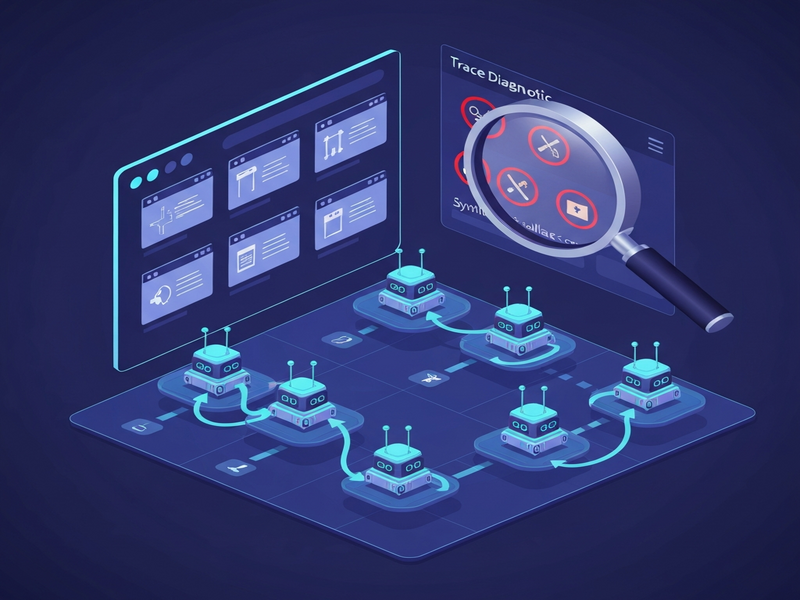
- Trace diagnostics: Automated tools that compare an agent’s execution trace against the benchmark’s verified trace, flagging loops, early exits, and synthesis mismatches.
- Reproducible triggers: Minimal perturbations (e.g., swapping a link order or injecting a stale page) that reliably induce each failure mode, enabling systematic stress‑testing.
- Balanced data mixtures: A curriculum that gradually introduces synthetic noise while preserving high‑quality human examples, reducing the model’s tendency to abstain.
How It Works in Practice
The operational workflow can be broken down into four stages:
1. Task Specification
A user submits a structured query (e.g., “Find the top three renewable‑energy ETFs, list their expense ratios, and provide the latest 30‑day performance”). The system translates this into a goal graph that enumerates required fields and permissible evidence sources.
2. Parallel Exploration Engine
The agent spawns multiple “search threads” that navigate the web concurrently. Each thread maintains its own context window (up to 16 k tokens) and reports back discovered snippets, URLs, and confidence scores.
3. Evidence Aggregation & Synthesis
Collected snippets are fed into a synthesis module that attempts to fill the goal graph. GRPO‑trained policies decide whether the current evidence set satisfies completeness thresholds or whether additional rounds of exploration are needed.
4. Trace Diagnostics & Feedback Loop
Before emitting the final answer, a diagnostic pass checks for three failure signatures:
- Context‑bound search loops: Re‑visiting the same set of pages without new information.
- Premature termination: The synthesis module signals completion despite missing fields.
- Synthesis collapse: The model overwrites previously verified evidence with hallucinated content.
If any signature is detected, the system either re‑initiates exploration or flags the answer for human review. This loop makes the agent’s behavior transparent and auditable—critical for compliance‑heavy sectors.
Evaluation & Results
The authors evaluated three model families (WebExplorer‑8B, GPT‑4.1‑mini, and a custom GRPO‑enhanced model) across the Parallel WebBench suite using two metrics:
- Completion rate: Percentage of tasks where the agent produced a well‑formed answer.
- Element‑wise F1 (GPT‑4.1‑mini‑judged): Fine‑grained correctness of each field, accounting for evidence support.
Key findings:
- The GRPO model raised completion from 50.7 % (WebExplorer‑8B) to 96.0 % while boosting element‑wise F1 from 0.2489 to 0.4529.
- Binary accuracy (all fields correct) remained substantially lower than completion, confirming a persistent “completion‑correctness gap.”
- Trace‑level analysis revealed that even the best model still fell prey to the three failure modes, though at reduced frequencies.
These results demonstrate that synthetic‑heavy training can dramatically reduce abstention and improve partial correctness, yet true end‑to‑end reliability demands additional mechanisms for evidence‑grounded coverage and synthesis diagnostics.
Why This Matters for AI Systems and Agents
For practitioners building production‑grade web agents, the paper offers a concrete roadmap to move beyond “answer‑only” metrics:
- Diagnostic tooling: The trace‑level diagnostics can be integrated into existing orchestration pipelines to automatically flag risky outputs before they reach end users.
- Data‑centric training: By blending human and synthetic demonstrations, teams can scale training data without sacrificing the nuanced reasoning that only human annotators provide.
- Parallelism as a safety net: Running multiple exploration threads in parallel reduces the chance that a single dead‑end path will cause premature termination.
Enterprises that require audit trails—such as financial services, legal tech, or regulated healthcare—can leverage these insights to build agents that not only answer questions but also produce verifiable evidence chains. For example, the Enterprise AI platform by UBOS can incorporate Parallel WebBench diagnostics to enhance its compliance reporting features.
What Comes Next
Despite the progress, several open challenges remain:
- Evidence‑grounded synthesis: Current models still collapse when merging multiple sources; future work should explore retrieval‑augmented generation (RAG) with stricter grounding constraints.
- Dynamic web environments: The benchmark assumes relatively static URLs; handling frequent site redesigns or JavaScript‑heavy pages will require more robust crawlers.
- Human‑in‑the‑loop verification: Integrating real‑time human feedback could further shrink the completion‑correctness gap.
- Scalable diagnostics: Automating the detection of subtle synthesis errors at web‑scale remains an unsolved problem.
Potential research directions include:
- Developing a meta‑learning layer that predicts when a trace is likely to enter a loop and proactively redirects exploration.
- Extending GRPO to multimodal inputs (e.g., images, PDFs) to broaden the scope of web‑based tasks.
- Coupling the diagnostic engine with a Workflow automation studio to automatically trigger remediation workflows when failures are detected.
Addressing these gaps will bring us closer to truly trustworthy autonomous agents that can operate on the open web without constant human supervision.
References
- Sogani, A., Rui, B., Vaidyanathan, S., Agarwal, R., Yan, M., & Venkataraman, S. (2026). When Web Agents Finish but Still Fail: Reproducible Triggers and Trace Diagnostics for Parallel Web Exploration. arXiv preprint arXiv:2606.20724.
- Related work on web‑agent benchmarks: WebArena, MiniWoB, and recent RAG literature.
Andrii Bidochko
CTO UBOS
Andrii Bidochko is an AI entrepreneur and researcher focused on AI agents, reinforcement learning, and autonomous systems. He writes about the technologies shaping the future of machine intelligence, from frontier models and agent architectures to real-world AI applications.