

- Updated: June 13, 2026
- 8 min read
When Does Memory Help Multi-Trajectory Inference for Tool-Use LLM Agents?
Direct Answer
The paper introduces a unified framework for evaluating how different memory‑sharing strategies affect multi‑trajectory inference in tool‑use LLM agents, and it shows that the choice of inference algorithm (best‑of‑N, beam search, or Monte‑Carlo Tree Search) can completely overturn the perceived benefit of a memory method. This matters because developers of autonomous agents often assume that “more memory” automatically yields better performance, yet the study reveals that memory must be paired with the right search strategy to be effective.
Background: Why This Problem Is Hard
Tool‑use LLM agents—large language models that can call external APIs, query databases, or execute shell commands—must reason over a sequence of actions (a trajectory) to achieve a goal. In practice, a single reasoning pass frequently fails due to ambiguous prompts, hidden constraints, or noisy tool responses. Multi‑trajectory inference mitigates this by generating several candidate trajectories and selecting the best one, but each attempt is typically isolated, discarding valuable lessons learned from earlier failures.
Existing approaches try to “remember” across attempts in three ways:
- Trajectory‑level reflection: after a candidate finishes, the system extracts high‑level insights (e.g., “the SQL query missed a join”).
- Atomic fact extraction: low‑level pieces of information (e.g., column names, file paths) are stored for reuse.
- Raw observation injection: the raw output of previous attempts is concatenated to the prompt of the next candidate.
These methods have been evaluated in isolation, usually with a single inference strategy on a single benchmark. Consequently, it remains unclear whether observed gains stem from the memory abstraction itself or from an interaction with the underlying search algorithm. As enterprises begin to deploy verifier‑free agents—systems that must act correctly without a post‑hoc correctness check—understanding this interaction becomes critical.
What the Researchers Propose
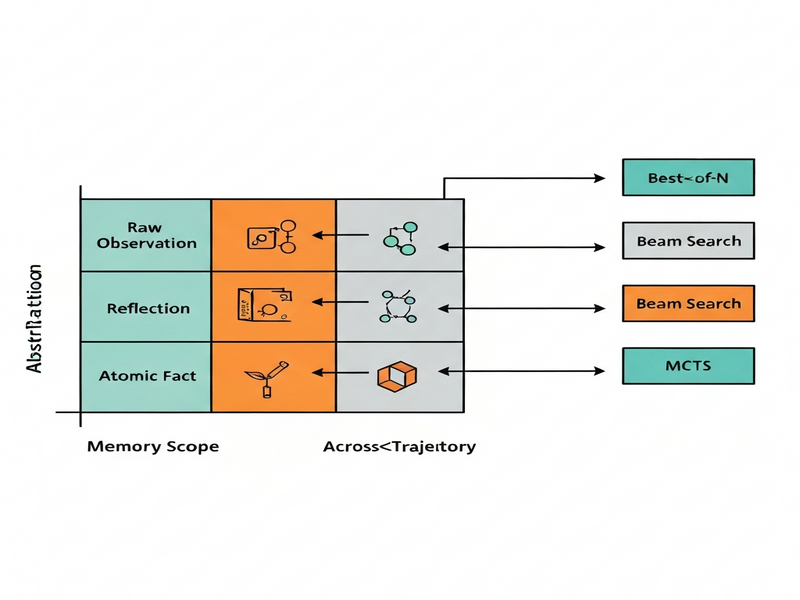
Li and Tao propose a unified memory framework that decomposes cross‑trajectory knowledge transfer along two orthogonal axes:
- Scope of transfer:
- Within‑expansion – information is shared only among sibling candidates generated from the same partial trajectory (i.e., during a single expansion step).
- Across‑trajectory – knowledge persists across completely separate candidate trees, influencing future expansions even after a full trajectory terminates.
- Abstraction level:
- Reflection – high‑level, human‑readable summaries of what went right or wrong.
- Atomic facts – discrete, reusable pieces such as schema elements or command flags.
- Raw observations – verbatim tool outputs or intermediate prompts.
By crossing these dimensions, the authors generate four concrete memory methods:
- Reflection (across‑trajectory, high‑level)
- Atomic fact extraction (across‑trajectory, low‑level)
- Within‑expansion raw observation injection (within‑expansion, raw)
- Baseline (no memory)
The framework is deliberately agnostic to the underlying inference engine, allowing the same memory method to be plugged into best‑of‑N sampling, beam search, or Monte‑Carlo Tree Search (MCTS). This design isolates the true contribution of memory from the confounding influence of the search strategy.
How It Works in Practice
The operational pipeline can be visualized as a three‑stage loop:
- Candidate Generation: The LLM receives the original user request plus any currently available memory context and produces a set of next‑step actions (e.g., a SQL query, a graph traversal command, or a CLI instruction).
- Execution & Observation: Each action is sent to the appropriate tool. The tool returns an observation (result set, error message, or confirmation).
- Memory Update: Depending on the chosen memory method, the observation is transformed:
- Reflection: a short natural‑language note summarizing the outcome.
- Atomic facts: a structured key‑value pair (e.g.,
{"table":"orders","columns":["id","date"]}). - Raw injection: the full text of the observation.
The transformed data is then either attached to sibling candidates (within‑expansion) or persisted globally (across‑trajectory) before the next generation round.
What distinguishes this approach from prior work is the explicit separation of when information is shared (same expansion step vs. later generations) and what is shared (high‑level insight vs. low‑level fact). This separation enables a clean factorial experiment: the same memory method can be evaluated under three distinct inference strategies without re‑engineering the agent.
{{IMAGE}}
Evaluation & Results
The authors benchmarked the four memory methods across three inference strategies on four tool‑use environments:
- SQL Suite – relational database queries with varying schema complexity.
- Knowledge‑Graph Explorer – SPARQL‑style traversals over a semi‑structured graph.
- CLI Sandbox – Unix‑like command execution with file‑system state.
- Hybrid Mix – tasks that require switching between SQL and CLI tools.
Key findings:
- Inference strategy dominates memory impact. The same memory method produced statistically different success rates when paired with best‑of‑N, beam search, or MCTS on identical examples.
- Reflection only shines under MCTS. When the search explores a tree of possibilities (as MCTS does), high‑level reflections guide pruning and lead to a modest but significant accuracy boost. Under best‑of‑N, reflection offered no measurable gain.
- Within‑expansion injection helps only when beam search suffers from low diversity. By conditioning each sibling on its peers’ raw outcomes, beam search recovered some of the lost exploration, but the effect vanished for best‑of‑N and MCTS.
- Atomic fact extraction is accuracy‑neutral but shortens trajectories. Across all three inference methods, agents that stored reusable facts completed tasks 19‑26 % faster (fewer steps) on environments with repeatable structure (e.g., the same table appears in multiple queries).
Statistical analysis (paired t‑tests with Bonferroni correction) confirmed that only the MCTS‑reflection combination achieved significance at p < 0.01, while other differences were either non‑significant or marginal.
Why This Matters for AI Systems and Agents
For practitioners building production‑grade agents, the study delivers three actionable insights:
- Match memory to search. If your deployment relies on simple sampling (best‑of‑N), investing in sophisticated reflection mechanisms yields little return. Instead, focus on lightweight fact extraction to reduce latency.
- Leverage MCTS for complex, multi‑step tasks. When agents must navigate deep decision trees (e.g., multi‑stage data pipelines), pairing MCTS with high‑level reflection can improve both correctness and interpretability.
- Prioritize reusable facts for efficiency. Even when accuracy does not improve, shorter trajectories translate to lower API costs and faster response times—critical metrics for SaaS offerings.
These findings align with the broader trend of “verifier‑free” deployment, where agents must act correctly on the first try because a downstream human or automated verifier is unavailable. By selecting the appropriate memory‑inference pairing, developers can build agents that are both reliable and cost‑effective.
For teams already using the UBOS platform overview to orchestrate LLM workflows, the paper suggests a concrete integration point: expose a “memory module” that can be toggled between reflection, fact extraction, or raw injection, and let the orchestration engine choose the inference strategy dynamically based on task complexity.
What Comes Next
While the unified framework clarifies many ambiguities, several limitations remain:
- Verifier‑free assumption. The experiments deliberately omitted any post‑hoc verification step. Real‑world systems often combine generation with a verifier (e.g., a sandbox or a test harness). Future work should explore how memory interacts with verification loops.
- Scalability of MCTS. Monte‑Carlo Tree Search provides strong guidance but can be computationally expensive for high‑dimensional tool spaces. Hybrid approaches that blend beam search’s speed with MCTS’s depth may be worth investigating.
- Generalization across domains. The benchmarks focus on structured data tools. Extending the analysis to unstructured modalities (e.g., image generation tools, code compilers) could reveal new memory abstractions.
Potential research directions include:
- Designing adaptive memory policies that switch abstraction levels on‑the‑fly based on observed tool feedback.
- Integrating learned memory encoders that compress raw observations into latent vectors, enabling richer within‑expansion sharing without exploding prompt length.
- Evaluating memory‑inference pairings in multi‑agent ecosystems where several LLMs collaborate on a shared task.
Practitioners interested in rapid prototyping can experiment with the Workflow automation studio to build custom pipelines that toggle between the three inference strategies and inject memory modules as described. Early adopters may also benefit from the Enterprise AI platform by UBOS, which offers built‑in support for MCTS‑style search and structured fact storage.
Finally, the community should consider open‑source benchmarks that capture verifier‑free, multi‑tool environments, enabling reproducible comparisons of memory‑inference pairings across research groups.
For a deeper dive into the original methodology and statistical analysis, consult the arXiv paper. To explore how these concepts can be turned into production‑ready agents, check out our AI marketing agents and the UBOS templates for quick start.
Ready to experiment with memory‑aware agents? Visit the UBOS homepage and start building smarter, faster LLM workflows today.
Andrii Bidochko
CTO UBOS
Andrii Bidochko is an AI entrepreneur and researcher focused on AI agents, reinforcement learning, and autonomous systems. He writes about the technologies shaping the future of machine intelligence, from frontier models and agent architectures to real-world AI applications.