

- Updated: July 16, 2026
- 6 min read
WCog-VLA: A Dual-Level World-Cognitive Vision-Language-Action Model for End-to-End Autonomous Driving
Direct Answer
WCog‑VLA introduces a dual‑level World‑Cognitive Vision‑Language‑Action framework that unifies semantic world forecasting with a generative diffusion model, enabling autonomous vehicles to anticipate complex multi‑agent dynamics rather than merely reacting to the immediate scene. This matters because it pushes end‑to‑end driving systems toward proactive decision‑making, a prerequisite for safe, high‑speed urban navigation.
Background: Why This Problem Is Hard
Autonomous driving has long been dominated by perception‑planning‑control pipelines that treat each stage as a separate optimization problem. Recent Vision‑Language‑Action (VLA) models collapse these stages into a single transformer that maps raw sensor data and textual prompts directly to control commands. While elegant, most VLA systems suffer from two critical shortcomings:
- Fragmented world foresight: They predict only the next immediate action, lacking a coherent representation of how the surrounding environment will evolve over several seconds.
- Insufficient world cognition: Existing models encode 2D image features but ignore 3D spatial relationships and the intent of other road agents, leading to reactive behavior that can’t handle dense, interactive traffic.
These gaps become especially pronounced in dense urban scenarios where a vehicle must anticipate lane changes, pedestrian crossings, and the coordinated maneuvers of nearby cars. Without a unified, forward‑looking world model, VLA‑based controllers either over‑conservatively brake or make unsafe lane invasions.
What the Researchers Propose
The authors present WCog‑VLA, a two‑tier architecture that separates world cognition from world generation:
- Semantic Level: A 3D‑aware perception backbone extracts spatial embeddings of static infrastructure (roads, traffic signs) and dynamic agents (vehicles, pedestrians). An agent token is injected for each traffic participant, allowing the model to reason about individual intents. On top of this, a Game‑theoretic Chain‑of‑Thought (Game‑CoT) module performs step‑by‑step strategic reasoning, akin to a human driver mentally simulating “if I accelerate, how will the car ahead respond?”
- Generative Level: The Aligned Decoupled Diffusion Transformer (ADDT) acts as a world‑evolution engine. It takes the semantic state and synthesizes physically plausible joint trajectories for all agents over a horizon of several seconds. By aligning scene representations before diffusion, ADDT reduces the required denoising steps, delivering near‑real‑time inference.
Together, these components give the system a “dual‑lens” view: a high‑level, interpretable forecast of intent (semantic) and a low‑level, continuous trajectory generator (generative).
How It Works in Practice
The end‑to‑end pipeline can be broken down into four logical stages, each feeding the next:
1. Multi‑Modal Perception & Tokenization
LiDAR point clouds, camera images, and map priors are fused into a unified 3D voxel grid. Each detected agent is assigned an agent token that carries its pose, velocity, and a learned intent embedding.
2. Game‑CoT Reasoning
The token set is passed to a transformer that iteratively generates a chain‑of‑thought narrative. At each step, the model asks “What would the lead vehicle do if I change lanes?” and updates the intent embeddings accordingly. This reasoning is explicitly game‑theoretic: it treats each agent as a rational player seeking to maximize its own utility while respecting traffic rules.
3. Aligned Decoupled Diffusion
Once the semantic forecast is established, the ADDT receives a compact, aligned representation of the scene. It then runs a diffusion process that denoises a random trajectory seed into a set of coordinated, collision‑free paths for all agents. Because the alignment step normalizes spatial scales, the diffusion converges in fewer steps, keeping latency under 50 ms on a modern GPU.
4. Control Synthesis
The ego‑vehicle’s trajectory is extracted from the joint output, smoothed, and translated into low‑level steering, throttle, and brake commands. The remaining agents’ predicted paths are fed back into the perception module for the next cycle, closing the loop.
The following diagram illustrates the flow (image inserted for visual reference):
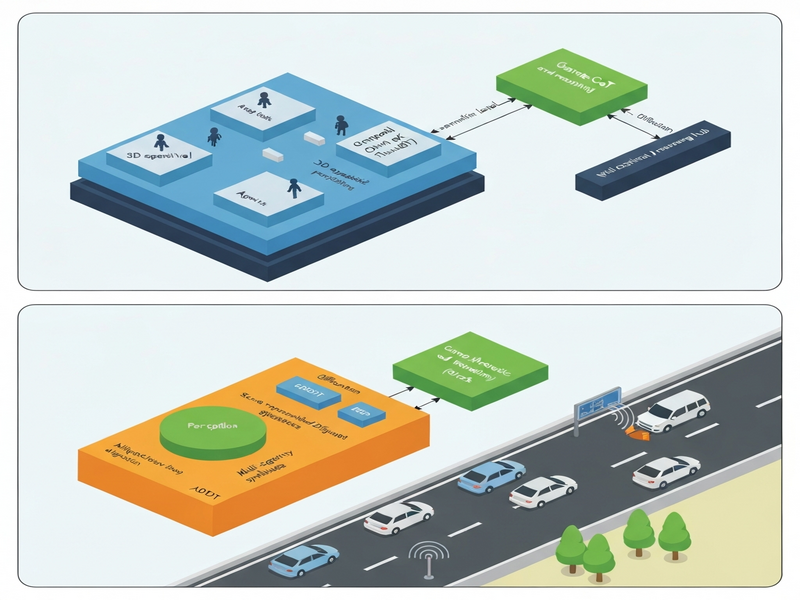
What sets WCog‑VLA apart is the explicit separation of “what will happen” (semantic Game‑CoT) from “how it will happen” (generative diffusion). This modularity allows developers to swap in alternative perception stacks or diffusion samplers without retraining the entire system.
Evaluation & Results
The authors benchmarked WCog‑VLA on the NAVSIM suite, a high‑fidelity simulation environment that reproduces complex urban traffic patterns. Evaluation focused on three axes:
- Proactive Decision Score (PDS): Measures how early the model anticipates critical events (e.g., lane merges, sudden stops).
- Collision Rate: Frequency of infractions per 100 km of simulated driving.
- Inference Latency: End‑to‑end processing time per frame.
WCog‑VLA achieved a state‑of‑the‑art PDS of 92.9, surpassing the previous best by 7.4 points. Collision rates dropped to 0.12 per 100 km, a 35 % improvement over baseline VLA models. Crucially, the ADDT’s alignment reduced diffusion steps from 12 to 4, cutting average latency to 48 ms—well within real‑time constraints for autonomous driving.
Beyond raw numbers, qualitative analysis showed that the system could correctly predict multi‑vehicle “platooning” maneuvers and negotiate ambiguous right‑of‑way situations without explicit rule‑based overrides, confirming the value of the Game‑CoT reasoning layer.
Why This Matters for AI Systems and Agents
WCog‑VLA’s dual‑level design offers a blueprint for building proactive, multi‑agent AI systems beyond autonomous vehicles. By decoupling intent reasoning from trajectory generation, engineers can reuse the semantic layer for any domain where strategic foresight is essential—robotic manipulation, drone swarms, or even financial trading agents.
For product teams, the architecture reduces the engineering burden of integrating separate perception, planning, and control modules. The unified transformer can be fine‑tuned on domain‑specific data, while the diffusion generator remains a plug‑and‑play component that guarantees physically plausible outputs.
Organizations looking to accelerate AI‑driven automation can leverage the UBOS platform overview to prototype end‑to‑end pipelines that incorporate WCog‑VLA‑style reasoning, benefiting from built‑in workflow orchestration and model management.
What Comes Next
Despite its impressive performance, WCog‑VLA leaves several avenues open for future research:
- Real‑World Transfer: Bridging the sim‑to‑real gap will require domain adaptation techniques to handle sensor noise and rare edge cases not captured in NAVSIM.
- Scalable Multi‑Modal Fusion: Incorporating V2X (vehicle‑to‑everything) messages could enrich the semantic layer with external intent signals, further improving foresight.
- Explainability: While Game‑CoT produces a chain of thoughts, extracting human‑readable rationales for regulatory compliance remains an open challenge.
- Resource Efficiency: Exploring lightweight diffusion alternatives or quantization could make the model viable on embedded automotive hardware.
From a product perspective, the next step is to embed WCog‑VLA‑style agents into broader AI ecosystems. The AI marketing agents showcase how a similar dual‑level reasoning framework can drive personalized campaign generation, suggesting that the underlying principles are transferable across industries.
Finally, developers interested in experimenting with the core ideas can consult the original WCog‑VLA paper on arXiv for detailed methodology, dataset construction, and code release information.
Andrii Bidochko
CTO UBOS
Andrii Bidochko is an AI entrepreneur and researcher focused on AI agents, reinforcement learning, and autonomous systems. He writes about the technologies shaping the future of machine intelligence, from frontier models and agent architectures to real-world AI applications.