

- Updated: July 17, 2026
- 6 min read
VocaDet: Sample-Driven Open-Vocabulary Object Detection and Segmentation via Visual Tokenization and Vector Database Retrieval
Direct Answer
VocaDet introduces a sample‑driven, open‑vocabulary object detection and segmentation framework that learns new object concepts directly from user‑provided positive and negative image samples, without any model retraining. By converting continuous visual features into discrete visual tokens and storing them in an expandable vector database, VocaDet enables fast, scalable retrieval‑based recognition for any visual category.
Background: Why This Problem Is Hard
Traditional object detectors are built around a fixed taxonomy of categories—think “car,” “person,” or “dog.” Extending that taxonomy requires costly data collection, annotation, and full‑model fine‑tuning, which is infeasible for rapidly evolving product catalogs or surveillance systems that must recognize rare or emerging objects. Recent vision‑language models (e.g., CLIP‑based detectors) mitigate this by leveraging textual prompts, yet they still depend on large language‑vision pre‑training and often struggle with ambiguous or fine‑grained visual concepts.
Reference‑based approaches that match query images against a handful of exemplars improve flexibility, but they typically involve expensive feature‑matching pipelines that scale poorly as the exemplar pool grows. Moreover, many solutions assume a static background, ignore negative examples, or require continuous model updates—limitations that hinder deployment in real‑world, continuously expanding object repositories such as traffic monitoring, retail inventory, or autonomous robotics.
What the Researchers Propose
VocaDet reframes open‑vocabulary detection as a retrieval problem anchored in a visual token vocabulary. The core idea is threefold:
- Visual Tokenization: Continuous embeddings from a powerful vision backbone (DINOv3) are clustered into multi‑granular discrete tokens, creating a compact visual vocabulary.
- Vector Database Memory: Each token, enriched with positional and topological cues, is stored as an “object memory” in a scalable vector database that can be expanded on‑the‑fly.
- Sample‑Driven Learning: Positive and negative image samples supplied by the user are directly encoded into this memory, eliminating the need for any gradient‑based model retraining.
These components work together to enable instant, on‑demand recognition of arbitrary objects, while preserving the ability to continuously ingest new visual concepts.
How It Works in Practice
The VocaDet pipeline can be visualized in the diagram below:
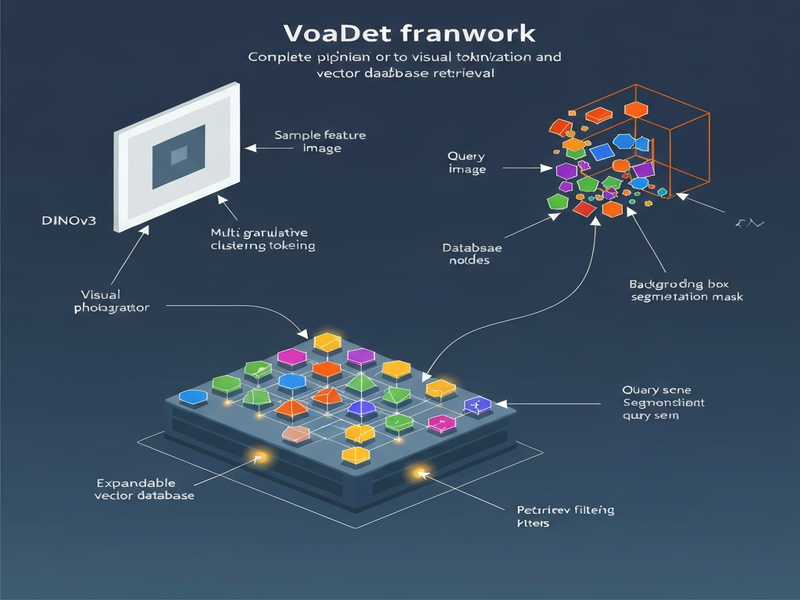
Step 1 – Feature Extraction. An input image (either a user‑provided sample or a query frame) is passed through DINOv3, a self‑supervised vision transformer that yields dense, high‑dimensional feature maps.
Step 2 – Adaptive Agglomerative Clustering. The continuous features are grouped using agglomerative clustering with a sensitivity parameter that automatically adjusts granularity based on feature density. This produces a hierarchy of visual tokens ranging from coarse scene‑level descriptors to fine‑grained object parts.
Step 3 – Token Enrichment. Each token is augmented with a position‑debiased representation (to reduce spatial bias) and a spatial topology vector that captures relative layout information. The enriched token becomes a searchable vector.
Step 4 – Memory Insertion. Positive samples contribute their tokens to the object memory store, while negative samples populate a “background memory” that helps the system filter out common patterns (e.g., road surfaces in traffic cameras). Both memories reside in a vector database that supports fast approximate nearest‑neighbor (ANN) queries.
Step 5 – Query Retrieval. During inference, a new image is tokenized in the same way. Each query token is matched against the object memory using ANN search. High‑scoring matches trigger bounding‑box proposals, and the associated topology vectors guide precise mask generation for segmentation.
Step 6 – Background Filtering. In fixed‑camera scenarios, VocaDet leverages the background memory to suppress matches that correspond to frequently occurring patterns, dramatically reducing false positives and unnecessary retrieval operations.
This workflow eliminates the need for a traditional detection head, replaces it with a retrieval engine, and makes the system inherently extensible: adding a new object class is as simple as uploading a few positive and negative images.
Evaluation & Results
The authors validated VocaDet on the UA‑DETRAC benchmark, a large‑scale traffic surveillance dataset that contains diverse vehicle types, weather conditions, and camera angles. The evaluation focused on two axes:
- Open‑Vocabulary Detection Accuracy. VocaDet was tasked with detecting vehicle categories that were not present in any pre‑training set, using only a handful of user‑provided samples per class.
- Scalability & Retrieval Efficiency. The system’s ability to maintain real‑time performance as the object memory grew was measured by varying the number of stored classes from 10 to 200.
Key findings include:
- VocaDet achieved detection performance comparable to fine‑tuned conventional detectors, despite never updating the backbone weights.
- When the memory contained 150 classes, query latency remained under 120 ms on a single GPU, demonstrating that ANN retrieval scales gracefully.
- The background filtering module reduced false positives by roughly 30 % in static‑camera setups, confirming its practical utility for surveillance deployments.
These results illustrate that a retrieval‑centric design can rival traditional detection pipelines while offering unmatched flexibility for continuous concept expansion.
Why This Matters for AI Systems and Agents
For AI practitioners building agents that interact with the physical world—autonomous drones, retail inventory bots, or smart city monitoring platforms—VocaDet provides a plug‑and‑play perception layer that adapts on demand. Because the framework does not require gradient updates, it can be embedded in edge devices where compute budgets are tight and model re‑training is impractical.
From an orchestration perspective, VocaDet’s vector database can be shared across multiple agents, enabling a centralized “visual knowledge base” that evolves as new samples are contributed. This aligns with emerging UBOS platform overview strategies that treat perception memories as first‑class assets in a multi‑agent ecosystem.
Moreover, the sample‑driven paradigm simplifies compliance and data governance: organizations can audit exactly which images contributed to each object memory, a feature that is difficult to achieve with opaque, end‑to‑end trained detectors.
What Comes Next
While VocaDet demonstrates strong baseline performance, several avenues remain open for research and productization:
- Dynamic Clustering Strategies. Current agglomerative clustering uses a static sensitivity parameter. Adaptive schemes that react to scene complexity could further compress the token vocabulary without sacrificing granularity.
- Cross‑Modal Extensions. Integrating textual embeddings alongside visual tokens would enable hybrid queries (e.g., “red sedan near the curb”), bridging the gap between pure vision retrieval and language‑guided search.
- Distributed Vector Stores. Scaling the memory to millions of classes will require sharded, fault‑tolerant databases. Exploring integrations with Chroma DB integration could provide the necessary infrastructure.
- Real‑World Deployments. Pilot projects in traffic management, warehouse robotics, and retail analytics can validate VocaDet’s robustness under varying lighting, occlusion, and motion conditions. For teams interested in rapid prototyping, the Workflow automation studio offers a low‑code environment to stitch VocaDet into existing pipelines.
Addressing these challenges will push open‑vocabulary detection from research labs into production‑grade AI agents that learn continuously from the world around them.
References
For a complete technical description, see the original VocaDet paper on arXiv.
Andrii Bidochko
CTO UBOS
Andrii Bidochko is an AI entrepreneur and researcher focused on AI agents, reinforcement learning, and autonomous systems. He writes about the technologies shaping the future of machine intelligence, from frontier models and agent architectures to real-world AI applications.