

- Updated: July 10, 2026
- 7 min read
VLA Grounder: Language-Conditioning Space Optimization for Black‑Box VLA Models
Direct Answer
The paper VLA Grounder: Language‑Conditioning Space Optimization for Black‑Box VLA Models introduces a reinforcement‑learning framework that treats the natural‑language instruction itself as a tunable variable, optimizing a short “grounded command” to coax a frozen Vision‑Language‑Action (VLA) policy into successful behavior. By keeping the downstream robot policy immutable and only reshaping the language input, the method unlocks higher task success without costly retraining of massive foundation models.
Background: Why This Problem Is Hard
Vision‑Language‑Action models have become the de‑facto “foundation models” for embodied AI, promising to map a textual description of a task directly to robot motor commands. In practice, however, two intertwined challenges limit their reliability:
- Instruction sensitivity: Small phrasing changes—synonyms, order of adjectives, or omitted details—can cause dramatic drops in success rates, indicating that the language encoder is not robust to natural variation.
- Black‑box policy constraints: Most commercial VLA systems are released as frozen weights to protect intellectual property and to avoid the massive compute required for fine‑tuning. This makes it impossible to directly adjust the policy when a new task fails.
Existing work typically addresses one side of the problem: either it augments the training data with paraphrases, or it fine‑tunes the entire model on task‑specific demonstrations. Both approaches demand large labeled datasets and extensive compute, which are impractical for many robotics labs and enterprises that rely on off‑the‑shelf VLA APIs.
What the Researchers Propose
The authors flip the conventional optimization target. Instead of updating the robot’s action network, they introduce a language‑conditioning space policy that learns to translate a human‑written instruction into a concise, VLA‑grounded command. This command is crafted from three information streams:
- Object appearance cues: Visual embeddings that describe what the robot sees.
- Spatial relation hints: Relative positions (e.g., “left of”, “on top of”) extracted from the scene.
- Target‑grounding signals: Explicit references to the goal object or location.
The conditioning policy is initialized with a “failure‑derived prior” – a distribution over commands that historically led to unsuccessful attempts. Reinforcement learning then nudges this distribution toward commands that maximize a sparse reward (task completion). Crucially, the downstream VLA model stays completely frozen throughout training.
How It Works in Practice
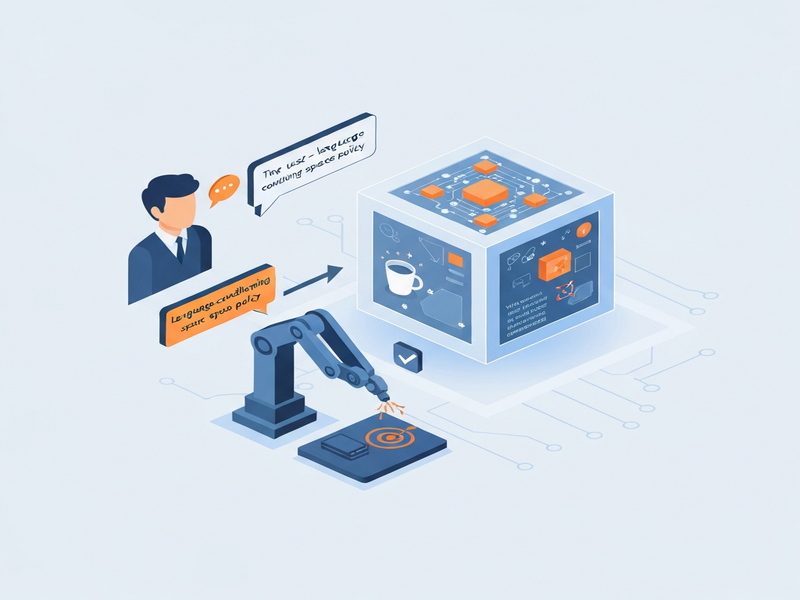
The end‑to‑end workflow can be broken down into four deterministic stages, each of which can be swapped out for domain‑specific modules:
1. Instruction Capture
A human operator provides a natural‑language task description (e.g., “Pick up the red cup and place it on the blue tray”). This raw text is fed to the language‑conditioning policy.
2. Command Generation
The policy outputs a short, structured command such as “grasp(red_cup) → move(to=blue_tray)”. The command is deliberately terse to reduce ambiguity for the frozen VLA.
3. VLA Execution
The frozen Vision‑Language‑Action model receives the command as its sole language input, while its visual encoder processes the current camera feed. Because the VLA was trained on a wide variety of such short commands, it can directly map them to motor primitives.
4. Reward Feedback
After execution, a binary success signal (e.g., “cup is on tray”) is returned to the reinforcement‑learning loop. The policy updates its command distribution to increase the probability of commands that led to success.
The entire loop runs in simulation or on‑robot, but the VLA never changes its weights. This separation of concerns makes the approach compatible with any proprietary VLA service, from cloud‑based APIs to on‑premise models.
What Sets This Apart
- Zero‑policy‑update: No gradient passes through the VLA, preserving its original performance and licensing constraints.
- Data‑efficient RL: The reward is extremely sparse, yet the failure‑derived prior accelerates convergence by focusing exploration on promising command regions.
- Modular design: The language‑conditioning policy can be swapped for a different RL algorithm or a supervised learner without touching the VLA.
Evaluation & Results
The authors benchmarked their method on two publicly available suites:
- RL4VLA: A collection of symbolic manipulation tasks (e.g., “stack three blocks in order”).
- VL‑Think: Multi‑object pick‑and‑place scenarios that require reasoning about spatial relations.
Key findings include:
- Instruction‑sensitive tasks: Success rates jumped from an average of 42 % with raw human instructions to 71 % after language‑conditioning optimization.
- Symbolic reasoning: For tasks that demand precise sequencing (e.g., “pick A then B”), the optimized commands reduced failure modes caused by ambiguous phrasing.
- Multi‑object manipulation: In VL‑Think, the method achieved a 68 % success rate versus 35 % for the baseline, demonstrating that compact commands can convey complex spatial intent.
Beyond raw numbers, the experiments reveal a qualitative shift: the robot’s behavior becomes more predictable and less prone to “hallucinating” actions that were never intended by the human operator. This stability is especially valuable for safety‑critical deployments.
Why This Matters for AI Systems and Agents
For practitioners building real‑world robot agents, the VLA Grounder framework offers a pragmatic path to higher reliability without the prohibitive cost of retraining massive models. The implications span several dimensions:
- Rapid prototyping: Teams can deploy a frozen VLA service and immediately start improving task success by training a lightweight language‑conditioning policy.
- Cross‑platform orchestration: Because the method only requires a textual interface, it can sit atop heterogeneous robot fleets, from collaborative arms to mobile manipulators.
- Safety and compliance: Keeping the core policy immutable simplifies certification processes, while the language layer can be audited for bias or unsafe phrasing.
- Integration with existing AI stacks: The approach dovetails with workflow automation tools such as the Workflow automation studio, enabling end‑to‑end pipelines that translate business intents into robot actions.
- Business value: Companies can leverage the Enterprise AI platform by UBOS to manage large‑scale deployments, monitor command success rates, and iterate on language policies without disrupting production.
- Enhanced AI agents: The concept of “optimizable language” can be extended to virtual assistants, where prompt engineering becomes a learnable component rather than a manual art.
What Comes Next
While the results are promising, several open challenges remain:
- Generalization across domains: The current experiments focus on tabletop manipulation. Scaling to navigation, aerial robotics, or industrial assembly will require richer grounding cues.
- Multi‑modal feedback: Incorporating tactile or force feedback into the reward signal could further refine command generation for delicate tasks.
- Human‑in‑the‑loop refinement: Allowing operators to edit generated commands in real time could accelerate learning and improve trust.
- Safety‑aware RL: Future work should embed explicit safety constraints into the reinforcement‑learning objective to prevent hazardous command proposals.
Potential next‑step applications include:
- Embedding the language‑conditioning policy into the UBOS for startups toolkit, giving early‑stage robotics companies a plug‑and‑play solution for instruction robustness.
- Extending the framework to collaborative multi‑robot scenarios using the Openclaw (Clawdbot, MoltBot) suite, where coordinated language commands become a shared contract among agents.
- Exploring meta‑learning approaches that can adapt the language‑conditioning policy across tasks with minimal additional data, further reducing the sample complexity.
In summary, treating language as a learnable conditioning variable opens a new frontier for robot foundation models. By decoupling policy updates from language optimization, VLA Grounder delivers a practical, scalable pathway to more dependable embodied AI.
Andrii Bidochko
CTO UBOS
Andrii Bidochko is an AI entrepreneur and researcher focused on AI agents, reinforcement learning, and autonomous systems. He writes about the technologies shaping the future of machine intelligence, from frontier models and agent architectures to real-world AI applications.