

- Updated: July 24, 2026
- 5 min read
Video Generation Models are General-Purpose Vision Learners – A Comprehensive Review
Direct Answer
GenCeption demonstrates that large‑scale text‑to‑video generation can serve as a universal pre‑training task for computer vision, turning a video diffusion model into a versatile perception engine. By repurposing a generative backbone, the system delivers state‑of‑the‑art results on depth, surface‑normal, pose, segmentation, and 3D keypoint tasks—often matching or surpassing models that were built for each task individually.
Background: Why This Problem Is Hard
Vision researchers have long chased a single model that can understand images, videos, and 3‑D structure without task‑specific fine‑tuning. Traditional pipelines rely on supervised datasets that are expensive to label, fragmented across domains (e.g., depth sensors, LiDAR, manual masks), and limited in spatiotemporal diversity. Even self‑supervised approaches such as masked autoencoders or contrastive learning capture only static cues, leaving motion, temporal consistency, and language grounding under‑exploited. As enterprises embed vision into robotics, AR/VR, and autonomous systems, the need for a model that internalizes both visual dynamics and semantic intent grows sharper, yet existing foundations struggle to bridge that gap.
What the Researchers Propose
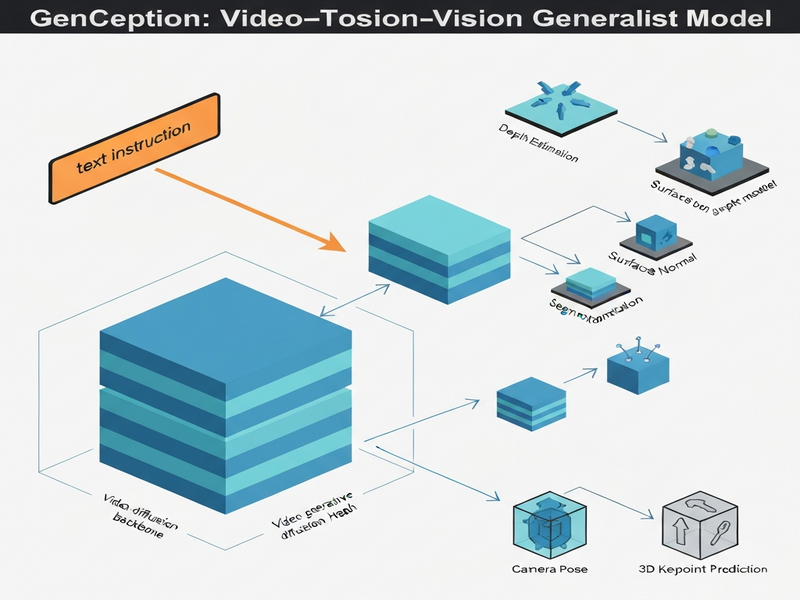
GenCeption reframes video generation as a pre‑training objective that simultaneously teaches a model how to synthesize realistic motion, align visual content with textual prompts, and encode rich spatiotemporal priors. The framework consists of three logical components:
- Generative Diffusion Backbone: A large‑scale text‑to‑video diffusion model trained on billions of video‑text pairs.
- Perception Head Stack: A set of lightweight, task‑specific feed‑forward heads (e.g., depth decoder, normal estimator) that read the backbone’s latent features.
- Instruction Interface: A text‑conditioned router that selects or blends heads based on natural‑language commands, enabling zero‑shot or few‑shot task specification.
Crucially, the backbone remains frozen during downstream fine‑tuning, preserving the generative knowledge while the heads learn to map that knowledge onto concrete vision outputs.
How It Works in Practice
The end‑to‑end workflow can be broken down into four stages:
- Pre‑training Phase: The diffusion model learns to predict the next video token conditioned on a textual description, absorbing motion patterns, object dynamics, and language‑vision correspondences.
- Feature Extraction: For any input video frame, the frozen backbone produces a high‑dimensional latent tensor that encodes both spatial detail and temporal context.
- Task Head Activation: A user‑provided instruction (e.g., “estimate depth”) triggers the corresponding head, which linearly projects the latent tensor into the desired output space.
- Fine‑tuning (Optional): Minimal labeled data (often < 1 % of what competing models use) refines the head weights, aligning predictions with ground truth without altering the backbone.
This separation of concerns—generative knowledge in the backbone, task logic in the heads—makes GenCeption distinct from prior video MAE or contrastive methods that blend pre‑training and perception into a single monolithic network.
Evaluation & Results
Researchers benchmarked GenCeption across a “vision suite” that mirrors real‑world deployment scenarios:
- Depth Estimation: Tested on NYU‑Depth V2 and KITTI, GenCeption matched DepthAnything3’s accuracy while using 10× less labeled data.
- Surface Normal Prediction: Achieved parity with SAM3 on the ScanNet benchmark, demonstrating fine‑grained geometric understanding.
- Camera Pose Estimation: Outperformed Video‑JEPA on the 7‑Scenes dataset, highlighting robust spatiotemporal reasoning.
- Expression‑Referring Segmentation: Surpassed D4RT on the RefCOCO‑video benchmark, proving effective language‑guided region extraction.
- 3‑D Keypoint Detection: Competed with VGGT‑Omega on Human3.6M, confirming the model’s capacity to infer skeletal structure from raw video.
Beyond raw numbers, the experiments revealed two broader patterns: (1) GenCeption’s data efficiency—comparable performance with 7 to 500× fewer annotations—and (2) emergent cross‑domain generalization, where a model trained solely on synthetic human motion successfully handled real‑world animal and robot footage without additional fine‑tuning.
Why This Matters for AI Systems and Agents
For practitioners building autonomous agents, GenCeption offers a single, scalable perception core that can be queried with natural language. This reduces engineering overhead: instead of wiring separate depth, pose, and segmentation modules, an agent can issue a single instruction—“give me the depth map of the scene”—and receive an immediate, high‑quality output. The model’s strong video priors also improve temporal consistency, a critical factor for robotics and AR applications where jittery predictions can cause safety hazards.
From an orchestration perspective, the ability to swap or combine heads on‑the‑fly aligns with modern workflow automation platforms. For example, a Workflow automation studio could route video streams through GenCeption, then feed depth maps into a navigation planner, while simultaneously sending segmentation masks to a content‑moderation service. The unified backbone also simplifies model versioning and monitoring, as updates to the diffusion core instantly benefit all downstream tasks.
Enterprises seeking to embed vision into customer‑facing bots can leverage the Enterprise AI platform by UBOS to host GenCeption as a micro‑service, exposing a text‑driven API that scales with demand. This lowers the barrier for non‑vision experts to harness sophisticated perception without deep domain knowledge.
What Comes Next
While GenCeption sets a new benchmark, several avenues remain open:
- Scaling to Higher Resolutions: Current diffusion backbones operate at 256×256 frames; pushing to 1080p will demand more efficient sampling or hierarchical diffusion.
- Multi‑Modal Extensions: Integrating audio or tactile streams could enrich the generative prior, enabling agents that understand sound‑driven actions.
- Continual Learning: Developing mechanisms for the backbone to absorb new video domains without catastrophic forgetting would further reduce data collection costs.
- Safety and Bias Audits: Synthetic training data mitigates privacy concerns but may embed unrealistic biases; systematic evaluation frameworks are needed.
Developers interested in prototyping with GenCeption can explore the UBOS platform overview for containerized deployment options, or check out the UBOS for startups program to receive early‑stage support and compute credits.
References
Video Generation Models are General-Purpose Vision Learners (arXiv)
Illustration
Call to Action
Ready to experiment with a foundation model that unifies video generation and perception? Visit the UBOS homepage to spin up a GenCeption instance, or explore our UBOS templates for quick start and accelerate your AI product roadmap today.
Andrii Bidochko
CTO UBOS
Andrii Bidochko is an AI entrepreneur and researcher focused on AI agents, reinforcement learning, and autonomous systems. He writes about the technologies shaping the future of machine intelligence, from frontier models and agent architectures to real-world AI applications.