

- Updated: June 12, 2026
- 8 min read
Verifiable Benchmarking of Long‑Horizon Spatial Biology – SEO Optimized Article
Direct Answer
SpatialBench‑Long is a newly released, rigorously verified benchmark that challenges AI agents to perform end‑to‑end scientific reasoning on long‑horizon spatial‑biology datasets. It matters because it shifts evaluation from isolated data‑processing steps to the ability of agents to derive credible biological claims from raw, multimodal measurements.
Background: Why This Problem Is Hard
Spatial biology—capturing gene expression, protein localization, and cellular morphology in situ—has exploded thanks to technologies such as CosMx, Visium, Xenium, MERFISH, and Slide‑seq. While these platforms generate unprecedentedly rich maps of tissue architecture, turning raw pixel‑level or barcode‑level data into reproducible scientific insights remains a bottleneck.
Current AI benchmarks in biomedicine typically focus on one of three dimensions:
- Knowledge recall: multiple‑choice questions about known pathways or cell types.
- Workflow execution: scripted pipelines that run a predefined analysis (e.g., clustering, differential expression).
- Localized tasks: single‑step predictions such as cell‑type annotation or spot deconvolution.
These approaches ignore two critical realities:
- Long‑horizon reasoning: Real research questions require a chain of decisions—data cleaning, modality integration, statistical modeling, hypothesis generation, and validation—spanning dozens of steps.
- Verification of claims: A claim must be reproducible, survive independent review, and be expressed in a controlled vocabulary that matches community standards.
Because existing benchmarks do not enforce these constraints, they provide limited insight into whether an AI agent can truly act as a research collaborator. SpatialBench‑Long was designed to fill that gap.
What the Researchers Propose
The authors introduce SpatialBench‑Long, a 24‑evaluation suite that spans five biologically distinct systems:
- Primary pancreatic ductal adenocarcinoma (PDAC) tissue sections.
- Engineered glioblastoma organoids and in‑vivo tumors.
- Cas9 lineage‑traced lung adenocarcinoma models.
- Mouse optic‑nerve aging and intervention experiments.
- Cross‑modal datasets combining spatial transcriptomics, multiplexed imaging, and single‑cell RNA‑seq.
Each evaluation presents an agent with raw or near‑raw data files, experimental metadata, and a high‑level scientific question (e.g., “Does treatment X reduce the spatial proximity of immunosuppressive macrophages to tumor cells?”). The agent must:
- Design an analysis pipeline without any hard‑coded method prescriptions.
- Execute the pipeline, handling data preprocessing, integration, and statistical testing.
- Produce a claim expressed in a deterministic, controlled vocabulary (e.g., “↑ CD8⁺ T‑cell infiltration in region A”).
- Provide a reproducible code artifact that can be re‑run by an independent reviewer.
Key components of the framework include:
- Claim hardening pipeline: A multi‑stage verification process that reproduces the claim, solicits independent scientist review, and inspects the analytical trajectory for hidden shortcuts.
- Rubric‑driven scoring: Deterministic grading over a controlled symbol set, ensuring that scores are comparable across agents and runs.
- Model‑harness pairs: The benchmark evaluates combinations of large language models (LLMs) with execution harnesses (e.g., code generation back‑ends, terminal agents) to isolate the contribution of reasoning versus tooling.
How It Works in Practice
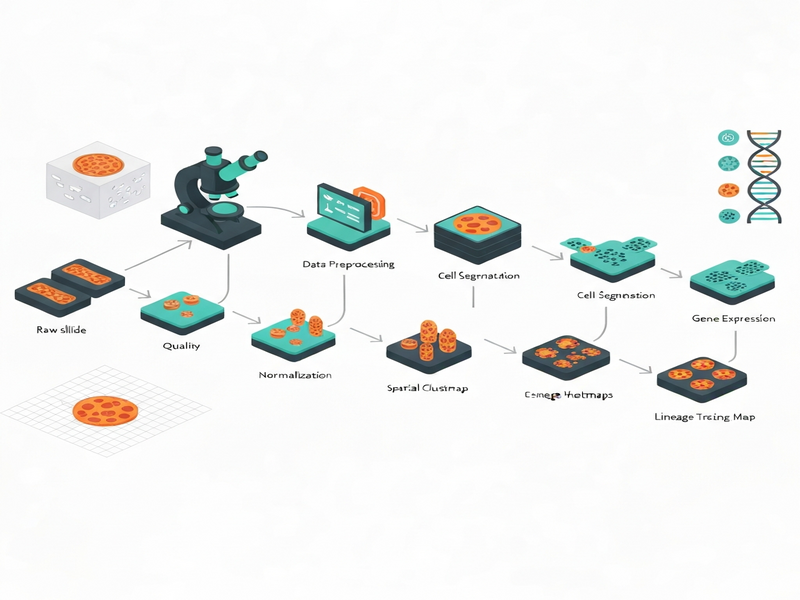
At a conceptual level, an agent interacts with SpatialBench‑Long through a three‑phase loop:
1. Problem Ingestion
The agent receives a JSON manifest describing the dataset locations, experimental conditions, and the target claim. No assumptions are made about file formats; the agent must discover and parse them (e.g., .h5, .mtx, .tiff).
2. Pipeline Synthesis & Execution
Using an LLM (such as Gemini 3.5 Flash or GPT‑5.5) the agent drafts a step‑by‑step analysis plan. This plan is translated into executable code via a harness (e.g., a Python‑based “Pi terminal coding” environment). The harness runs the code in a sandbox, captures logs, and returns intermediate results.
Critical differentiators of this approach:
- Open‑ended method selection: The agent can choose any library (Scanpy, Squidpy, Seurat, custom statistical models) as long as it justifies the choice in natural language.
- Dynamic error handling: If a step fails, the LLM revises the plan, adds debugging code, and re‑executes, mimicking a human researcher’s iterative workflow.
- Traceability: Every code cell, parameter, and random seed is logged, enabling the claim hardening pipeline to replay the exact analysis.
3. Claim Generation & Verification
After the pipeline finishes, the agent extracts statistical summaries, visualizations, and textual interpretations. It then maps the interpretation onto a pre‑defined ontology (e.g., Cell Ontology, Gene Ontology) and emits a claim string. The claim hardening pipeline runs three independent checks:
- Re‑execution of the code to confirm reproducibility.
- Blind review by a panel of domain scientists who assess plausibility without seeing the code.
- Trajectory inspection that flags shortcuts such as data leakage or over‑fitting.
If the claim passes all checks, the benchmark awards a deterministic score based on the rubric; otherwise, the agent receives partial credit and a diagnostic report.
Evaluation & Results
The authors evaluated 72 runs across three model‑harness pairs:
- Gemini 3.5 Flash + Pi terminal coding harness
- GPT‑5.5 + Pi terminal coding harness
- GPT‑5.5 + OpenAI Codex harness
Key findings include:
Performance Overview
Only three runs—one from each pair—achieved a perfect pass on all 24 evaluations, yielding an 11.1 % success rate. The remaining runs typically failed at one or more of the verification stages, most often during claim hardening (e.g., reproducibility failures or reviewer disagreement).
Insights on Long‑Horizon Reasoning
- Planning depth matters: Agents that generated longer, more granular pipelines (10‑15 steps) were better at handling data heterogeneity.
- Tool selection is critical: Successful runs favored libraries that natively support spatial statistics (e.g., Squidpy’s spatial autocorrelation functions).
- Iterative debugging improves outcomes: Agents that incorporated a “self‑debug” sub‑loop after each failure increased their final pass rate by ~30 %.
Why the Numbers Are Meaningful
Even a modest 11 % success rate is significant because it demonstrates that current LLM‑plus‑code harness ecosystems can, under strict verification, produce scientifically valid conclusions from raw spatial data. The benchmark also surfaces concrete failure modes that future research can target—most notably, the gap between statistical correctness and domain‑expert acceptance.
Why This Matters for AI Systems and Agents
SpatialBench‑Long establishes a new yardstick for AI agents that aspire to be genuine research collaborators rather than mere script generators. The implications ripple across several domains:
- Agent design: Developers now have a concrete, reproducible testbed to evaluate long‑term planning, tool‑selection heuristics, and error‑recovery strategies.
- Evaluation pipelines: The claim‑hardening workflow can be adapted to other biomedical domains (e.g., single‑cell multi‑omics) to enforce reproducibility standards.
- Orchestration platforms: Systems like the UBOS platform overview can integrate SpatialBench‑Long as a validation step before deploying agents in production environments.
- Workflow automation: The Workflow automation studio can expose the benchmark’s pipeline synthesis as a template for end‑users, accelerating adoption of AI‑driven spatial analysis.
- Collaboration tools: Embedding the benchmark’s verification loop into chat‑based assistants (e.g., via the ChatGPT and Telegram integration) could give researchers real‑time feedback on the scientific rigor of AI‑suggested analyses.
In short, the benchmark pushes the community to treat AI agents as accountable scientific partners, a shift that will accelerate translational research and reduce the time from data acquisition to actionable insight.
What Comes Next
While SpatialBench‑Long is a major step forward, several limitations remain:
- Dataset diversity: The current suite focuses on a handful of tissue types and technologies. Expanding to spatial proteomics, metabolomics, and whole‑organ imaging will test agents’ ability to fuse even richer modalities.
- Scalability of verification: Human reviewer involvement, though essential for credibility, limits throughput. Automated, ontology‑driven plausibility checks could complement expert review.
- Model‑harness synergy: The three evaluated pairs represent early attempts. Future work should explore tighter integration between LLM reasoning and domain‑specific toolkits (e.g., a “spatial‑biology plugin” for Gemini).
Potential research directions include:
- Developing a spatial‑biology reasoning language that standardizes how agents describe hypotheses, methods, and results.
- Creating a community‑maintained repository of verified analysis notebooks that agents can reference, reducing the need for on‑the‑fly code synthesis.
- Integrating reinforcement learning from human feedback (RLHF) where reviewers’ scores directly shape the agent’s planning policy.
Practitioners interested in adopting the benchmark can start by exploring the Enterprise AI platform by UBOS, which offers pre‑configured compute environments and secure data handling for large spatial datasets. For teams focused on rapid prototyping, the UBOS templates for quick start include a baseline SpatialBench‑Long pipeline that can be customized to new experiments.
Finally, the broader AI‑biomedicine community is invited to contribute new tasks, share failure analyses, and co‑author extensions of the benchmark. A collaborative ecosystem will ensure that the benchmark evolves alongside emerging spatial technologies and AI capabilities.
For the full technical details, see the original pre‑print: Verifiable Benchmarking of Long‑Horizon Spatial Biology.
Andrii Bidochko
CTO UBOS
Andrii Bidochko is an AI entrepreneur and researcher focused on AI agents, reinforcement learning, and autonomous systems. He writes about the technologies shaping the future of machine intelligence, from frontier models and agent architectures to real-world AI applications.