

- Updated: June 30, 2026
- 6 min read
VeriEvol: Scaling Multimodal Mathematical Reasoning via Verifiable Evol-Instruct
Direct Answer
VeriEvol introduces a verifiable, evolution‑driven pipeline that scales multimodal mathematical reasoning data while guaranteeing answer reliability. By separating prompt difficulty from answer correctness, the framework lets reinforcement‑learning agents train on far larger, trustworthy visual‑math datasets.
Background: Why This Problem Is Hard
Training agents to solve visual mathematics—where a model must interpret an image, understand a question, and produce a numeric or symbolic answer—requires two intertwined resources:
- Rich, diverse prompts that push the model beyond textbook examples.
- Accurate supervision so that the reward signal reflects the true solution.
Existing pipelines address the first need by generating harder questions, but they assume the original answers are flawless. As data volume grows, even a tiny error rate can corrupt millions of samples, leading to noisy gradients and stalled performance. Moreover, most reinforcement‑learning (RL) recipes, such as GRPO, treat the label as immutable, offering no mechanism to reject or correct faulty supervision.
Consequently, scaling visual‑math RL has hit a bottleneck: without a systematic way to verify each answer, researchers cannot safely expand datasets, and agents remain confined to limited, low‑diversity training regimes.
What the Researchers Propose
The authors present VeriEvol, an iterative framework that decouples two axes before any policy update:
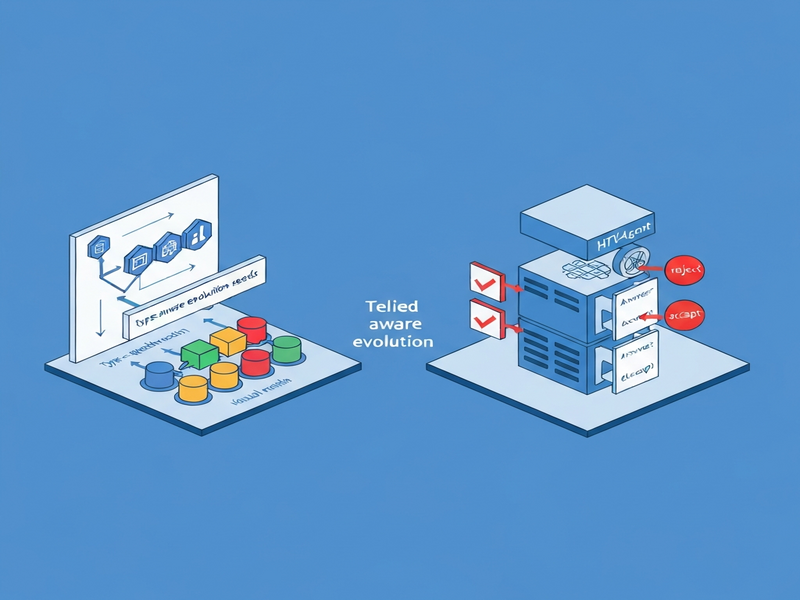
- Prompt Difficulty – expanded through a type‑aware evolution module that rewrites simple image‑question seeds into more challenging, image‑grounded prompts.
- Answer Reliability – enforced by an HTV‑Agent verifier that only accepts an answer after exhaustive offline hypothesis‑test falsification (HTV) fails to produce counter‑evidence.
In essence, VeriEvol treats data scaling as a verifiable construction problem rather than a blind generation task. The framework is deliberately modular: new evolution routes (e.g., geometry‑to‑algebra transformations) or additional verifier channels (e.g., symbolic solvers, external theorem provers) can be plugged in without redesigning the whole pipeline.
For readers who want to dive deeper, the full VeriEvol paper on arXiv provides the technical specifications and experimental details.
How It Works in Practice
The VeriEvol workflow proceeds in three repeatable phases:
1. Seed Generation
Researchers start with a modest corpus of low‑difficulty visual‑math samples (≈10 K). Each seed consists of an image, a natural‑language question, and a ground‑truth answer derived from a trusted symbolic engine.
2. Evolution Module
The evolution module examines the type of the seed (e.g., arithmetic, geometry, calculus) and applies a route‑specific operator:
- Complexity Injection: adds extra visual elements, such as additional shapes or overlapping equations.
- Conceptual Shift: transforms a linear‑equation problem into a system of equations or a word‑problem into a diagram‑based query.
- Noise Augmentation: perturbs colors, perspectives, or occlusions to mimic real‑world visual variance.
The output is a harder prompt that remains grounded in the original image content, preserving the semantic link needed for downstream reasoning.
3. HTV‑Agent Verification
Before an evolved sample enters the RL loop, the HTV‑Agent runs a battery of independent checks:
- Symbolic Re‑solver: feeds the question to a separate symbolic engine; if the result diverges from the proposed answer, the sample is rejected.
- Cross‑Modal Consistency: uses a vision‑language model to re‑interpret the image and regenerate the answer; disagreement triggers a falsification flag.
- Counter‑Evidence Search: queries external knowledge bases (e.g., theorem libraries) for contradictory statements.
Only when all channels fail to produce counter‑evidence does the verifier emit a verified label, which is then added to the training pool.
Iterative Loop
Verified samples feed into a standard supervised‑fine‑tuning (SFT) stage, after which a GRPO‑style RL algorithm updates the policy. The newly improved policy can generate fresh seeds, restarting the cycle and progressively expanding the dataset from 10 K to 250 K samples in the authors’ experiments.
Evaluation & Results
The authors benchmarked VeriEvol on five visual‑math suites covering arithmetic, geometry, algebra, calculus, and combinatorics. Their evaluation protocol mirrors real‑world deployment:
- Baseline RL: a GRPO agent trained on the original 10 K seed set.
- Evolved SFT Only: SFT on the 250 K evolved, but unverified, samples.
- VeriEvol Full Stack: evolved SFT plus HTV‑Agent verification, followed by the same GRPO recipe.
Key findings include:
- Scaling verified data alone lifted mean accuracy from 35.42 % to 54.73 %—a 19.31‑point jump.
- When the full VeriEvol pipeline was applied, the RL agent achieved an additional +3.88 % over the un‑evolved RL baseline.
- Decomposing the gain shows +1.82 % stems from harder prompts, while +2.06 % originates from the HTV‑Agent’s filtering.
- Performance gains were consistent across all five benchmarks, indicating that verification benefits are not domain‑specific.
These results demonstrate that reliable scaling is possible without sacrificing supervision quality, and that the verification step contributes a measurable boost beyond mere data quantity.
Why This Matters for AI Systems and Agents
For practitioners building multimodal agents—whether for education platforms, automated tutoring, or scientific data extraction—the VeriEvol paradigm offers three concrete advantages:
- Trustworthy Training Data: The HTV‑Agent ensures that every reward signal is vetted, reducing the risk of model drift caused by mislabeled examples.
- Scalable Difficulty Curriculum: The evolution module can generate arbitrarily hard problems, enabling curriculum learning strategies that adapt to an agent’s competence.
- Modular Integration: Because VeriEvol’s components are plug‑and‑play, teams can embed the pipeline into existing RL stacks, such as those built on the UBOS platform overview or the Workflow automation studio, without rewriting core training loops.
In practice, a company that deploys AI tutoring bots can now generate a continuous stream of verified, progressively harder math problems, keeping the bot’s knowledge fresh and its confidence calibrated. Similarly, research labs can accelerate the development of visual‑reasoning models for scientific diagram interpretation, knowing that each training sample has survived a multi‑source falsification process.
What Comes Next
While VeriEvol marks a significant step forward, several open challenges remain:
- Verifier Diversity: Current HTV‑Agent channels rely on symbolic solvers and vision‑language models. Adding formal theorem provers or domain‑specific simulators could further tighten correctness guarantees.
- Cost Efficiency: Offline hypothesis testing is computationally intensive. Future work should explore adaptive verification schedules that prioritize high‑uncertainty samples.
- Cross‑Domain Generalization: Extending the evolution operators beyond mathematics—to physics diagrams, circuit schematics, or medical imaging—will test the framework’s universality.
Developers interested in experimenting with VeriEvol can start by exploring the Enterprise AI platform by UBOS, which offers ready‑made integrations for data pipelines, model serving, and monitoring. For startups seeking rapid prototyping, the UBOS for startups page outlines lightweight deployment options that can host the evolution module and HTV‑Agent as micro‑services.
Finally, the authors have released the full prompt library, verified dataset, model checkpoints, and a trace of every verification decision. This openness invites the community to audit, extend, and benchmark the pipeline, fostering a transparent ecosystem for scaling multimodal reasoning.
Ready to explore how verifiable data scaling can accelerate your AI projects? Visit the UBOS homepage for more resources, tutorials, and partnership opportunities.
Andrii Bidochko
CTO UBOS
Andrii Bidochko is an AI entrepreneur and researcher focused on AI agents, reinforcement learning, and autonomous systems. He writes about the technologies shaping the future of machine intelligence, from frontier models and agent architectures to real-world AI applications.