

- Updated: July 19, 2026
- 7 min read
V-VLAPS: Value-Guided Planning for Vision-Language-Action Models
Direct Answer
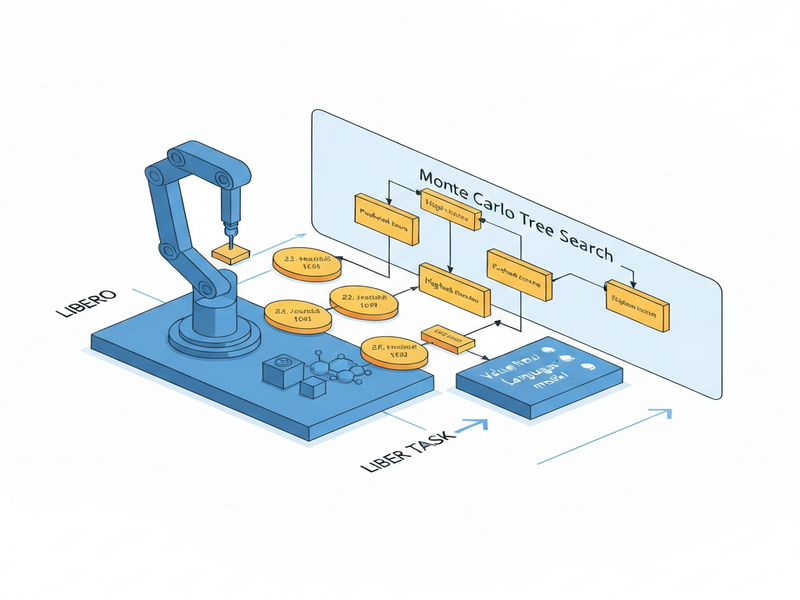
V‑VLAPS (Value‑Guided Vision‑Language‑Action Planning and Search) augments existing vision‑language‑action (VLA) planners with a lightweight value estimator that predicts Monte‑Carlo returns from offline rollouts. By feeding these value predictions into Monte Carlo Tree Search (MCTS), the system can prioritize higher‑utility branches, reducing failures that stem from over‑reliance on policy priors.
Background: Why This Problem Is Hard
Robotic manipulation in unstructured environments demands that an agent understand visual cues, interpret language instructions, and generate low‑level motor commands—all in a single pipeline. Vision‑language‑action (VLA) models have made impressive strides by learning joint embeddings that map images, text, and actions into a shared space. However, two persistent bottlenecks limit their deployment:
- Reactive bias: Purely policy‑driven VLA agents react to the current observation without foresight, causing them to stumble when the environment shifts or when tasks require multi‑step reasoning.
- Exploration‑exploitation imbalance: Planning methods that graft MCTS onto VLA policies still rely heavily on the policy’s action probabilities for node selection. If the policy assigns high probability to sub‑optimal actions, the search tree inherits that bias, leading to dead‑ends or timeouts.
These challenges are especially acute in long‑horizon benchmarks such as LIBERO, where a single misstep early in the episode can cascade into irreversible failure. Existing planners mitigate the issue by increasing the search budget, but that approach scales poorly and does not address the root cause: the lack of a learned value signal that can correct policy mis‑predictions.
What the Researchers Propose
The authors introduce Value‑Guided VLA Planning and Search (V‑VLAPS), a framework that couples a pretrained VLA policy with a compact value head. The value head is trained offline on a large corpus of VLA rollouts, learning to predict the expected return (i.e., success probability) of a given state‑action pair. During planning, V‑VLAPS injects these predictions into the MCTS selection formula, allowing the tree search to favor branches that are not only likely under the policy but also estimated to yield higher returns.
Key components of the system are:
- VLA Policy Backbone: A frozen transformer‑based model that encodes visual observations, natural‑language goals, and candidate actions.
- Value Head: A shallow neural network attached to the VLA latent space, outputting a scalar value estimate for each node.
- Monte Carlo Tree Search Engine: An MCTS implementation that integrates both policy priors and value predictions when computing the Upper Confidence Bound (UCB) for node expansion.
How It Works in Practice
The workflow of V‑VLAPS can be broken down into three stages:
- Offline Value Training: The researchers collect a massive set of VLA rollouts across diverse LIBERO tasks. For each visited state‑action pair, they compute the Monte Carlo return (the discounted sum of future rewards) and train the value head to regress toward this target.
- Online Planning: At inference time, the robot receives a language instruction and an initial visual observation. The VLA policy proposes a distribution over possible actions, while the value head evaluates the expected return of each candidate.
- Tree Search Integration: MCTS expands nodes using a modified UCB score:
UCB = Q + c₁·π + c₂·V, whereπis the policy prior,Vis the value estimate, andc₁, c₂are tunable coefficients. This blended score balances exploration (via visit counts), exploitation of the policy, and exploitation of the learned value.
The result is a planner that can “look ahead” beyond the immediate policy suggestion, pruning low‑value branches early and allocating more simulations to promising trajectories. Unlike prior approaches that treat the policy as the sole guide, V‑VLAPS leverages the latent knowledge already embedded in VLA representations to produce a learned value signal without requiring a separate, heavyweight critic.
Evaluation & Results
To validate the approach, the authors benchmarked V‑VLAPS on five suites from the V‑VLAPS paper, covering a spectrum of manipulation challenges in the LIBERO benchmark:
- LIBERO‑Object: Object‑centric pick‑and‑place tasks.
- LIBERO‑10: Ten‑step sequential tasks with varying object configurations.
- Three additional suites that stress long‑horizon reasoning and dynamic obstacles.
Two primary metrics were reported:
- Success Rate: Percentage of episodes that completed the instruction without timeout.
- Search Efficiency: Number of MCTS simulations required to reach a successful leaf node.
Key findings include:
- At the default search budget (≈200 simulations per decision), V‑VLAPS matched the value‑free baseline in aggregate performance, confirming that the added value head does not degrade existing capabilities.
- When the budget was increased (≈800 simulations), V‑VLAPS consistently outperformed the baseline across all suites, achieving +6 percentage points on LIBERO‑Object and +4 percentage points on LIBERO‑10.
- Failure analysis revealed that many “hard” errors in the baseline were root‑level timeouts where the policy’s priors were indistinguishable; V‑VLAPS’s value estimates provided a decisive tie‑breaker, allowing the planner to escape early dead‑ends.
These results demonstrate that a lightweight value head can meaningfully influence planning outcomes, especially when the search depth is sufficient to let value‑guided ranking surface.
Why This Matters for AI Systems and Agents
For practitioners building autonomous agents—whether in manufacturing, warehouse logistics, or home robotics—the ability to combine strong perception‑language grounding with reliable long‑term planning is a decisive competitive edge. V‑VLAPS offers several practical benefits:
- Reduced Reliance on Massive Search Budgets: By steering the tree search toward high‑value branches early, developers can achieve comparable success rates with fewer simulations, lowering compute costs.
- Robustness to Distribution Shift: The value head, trained on diverse rollouts, captures failure patterns that the policy alone may miss, improving resilience when the robot encounters novel object arrangements.
- Modular Integration: Because the value head attaches to any frozen VLA backbone, existing pipelines can be upgraded without retraining the entire policy network.
- Facilitates Hierarchical Control: Higher‑level task planners can query the value estimator to rank sub‑goals before delegating execution to low‑level controllers.
These capabilities align closely with emerging enterprise AI platforms that aim to orchestrate multiple agents across heterogeneous environments. For example, the UBOS platform overview highlights how modular AI components—vision, language, and decision modules—can be composed into end‑to‑end workflows. V‑VLAPS fits naturally into such ecosystems, providing a plug‑and‑play value‑guided planner that can be wrapped by higher‑level orchestration layers.
What Comes Next
While V‑VLAPS marks a clear step forward, several open challenges remain:
- Scalability of Value Training: The current offline training relies on exhaustive rollout data. Future work could explore semi‑supervised or self‑supervised value learning to reduce data requirements.
- Generalization Across Domains: Extending the value head to handle entirely new task families (e.g., deformable object manipulation) will test its ability to capture abstract success signals.
- Real‑World Deployment: Bridging the sim‑to‑real gap demands robust domain randomization and possibly online fine‑tuning of the value estimator.
- Multi‑Agent Coordination: Integrating value‑guided planning into collaborative scenarios could enable agents to negotiate shared resources based on predicted joint returns.
Addressing these directions could unlock new applications such as autonomous warehouse fleets that dynamically re‑plan based on real‑time inventory forecasts, or service robots that adapt to user preferences on the fly. Companies interested in rapid prototyping of such capabilities might explore the Workflow automation studio to stitch together vision, language, and planning modules without deep engineering effort.
Conclusion
V‑VLAPS demonstrates that a modest value head, trained on offline VLA rollouts, can substantially improve Monte Carlo Tree Search for vision‑language‑action planning. By marrying policy priors with learned value estimates, the framework mitigates the reactive bias of pure VLA models and delivers higher success rates on challenging long‑horizon benchmarks. For AI engineers and robotics researchers, the approach offers a practical pathway to more reliable, efficient, and adaptable autonomous agents.
References
- Ren, K., Salamatian, A., Pattison, K., & Neary, C. (2026). V‑VLAPS: Value‑Guided Planning for Vision‑Language‑Action Models. arXiv preprint.
- LIBERO Benchmark Suite. (2025). GitHub Repository.
- Monte Carlo Tree Search. (2023). Wikipedia.
Andrii Bidochko
CTO UBOS
Andrii Bidochko is an AI entrepreneur and researcher focused on AI agents, reinforcement learning, and autonomous systems. He writes about the technologies shaping the future of machine intelligence, from frontier models and agent architectures to real-world AI applications.