

- Updated: June 16, 2026
- 7 min read
Unlocking Fine-Grained and Within-Utterance Speaking Style Control in Prompt-Based Text-to-Speech Models
Direct Answer
The paper introduces a set of lightweight techniques that enable both smooth style interpolation across separate utterances and continuous style transitions within a single utterance for prompt‑based text‑to‑speech (TTS) models. This matters because it unlocks fine‑grained, real‑time control of voice attributes—such as gender, pitch, and speaking rate—without retraining the underlying acoustic model.
Background: Why This Problem Is Hard
Prompt‑based TTS systems have become popular for their ability to accept natural‑language descriptors (e.g., “a calm female voice”) and generate speech that matches the requested style. However, two practical bottlenecks limit their adoption in production environments:
- Coarse, global style control. Existing models treat a style prompt as a single, immutable embedding that governs the entire utterance. Changing the style mid‑sentence or gradually morphing from one persona to another is not supported.
- Lack of smooth inter‑utterance interpolation. When a conversation spans multiple turns, developers often need to shift the speaking style (e.g., from formal to casual) in a fluid manner. Current pipelines require discrete model switches or manual re‑prompting, leading to audible jumps.
These limitations stem from two technical factors:
- Prompt embeddings live in a high‑dimensional space where linear interpolation does not guarantee perceptually meaningful transitions.
- Autoregressive decoders exhibit a strong attention bias toward early tokens, causing the acoustic characteristics of the first few frames to dominate the rest of the generation.
Addressing both issues is essential for emerging use cases such as interactive voice agents, dynamic audiobooks, and multilingual dubbing pipelines where style must adapt on the fly.
What the Researchers Propose
The authors present a two‑pronged framework that augments any existing prompt‑based TTS model without architectural overhaul:
Inter‑Utterance Style Interpolation
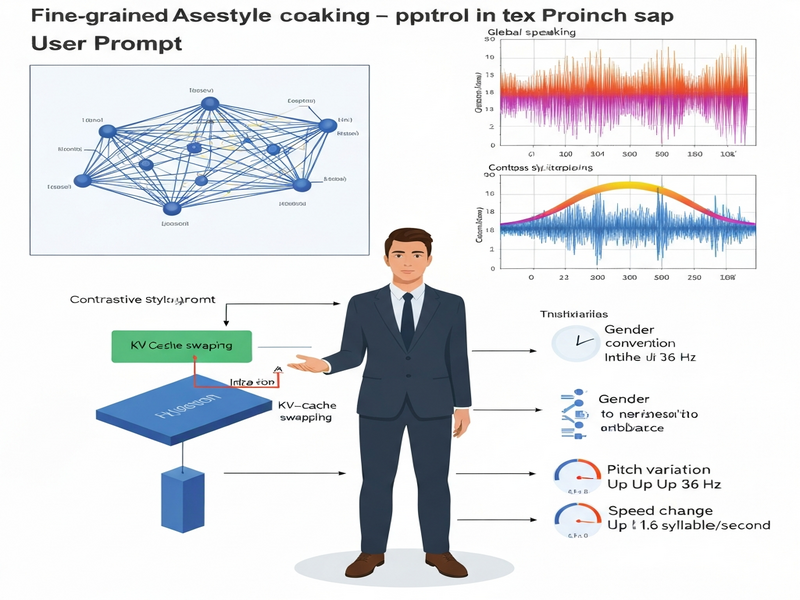
They compute a direction vector between two contrastive style prompts (e.g., “male” vs. “female”) in the embedding space. By linearly interpolating along this vector, the system can generate intermediate style embeddings that produce gradual transitions when applied to successive utterances.
Intra‑Utterance Style Transition
To break the decoder’s early‑token dominance, the paper introduces two complementary mechanisms:
- KV‑cache swapping. During generation, the key‑value cache of the transformer decoder is periodically swapped with a fresh cache that reflects the updated style prompt, allowing later frames to be conditioned on the new style.
- Sliding‑window attention masking. The attention matrix is constrained to a moving window, preventing the model from repeatedly attending to the initial tokens and thereby reducing the “sticky” effect of the first style.
Both techniques are model‑agnostic and can be toggled at inference time, making them attractive for production deployments where latency and memory budgets are tight.
How It Works in Practice
The workflow can be visualized as a pipeline of three logical stages:
- Prompt Encoding. The user supplies a natural‑language style description. The encoder maps it to a dense vector e. For inter‑utterance interpolation, two base prompts are encoded, and a direction vector d = e₂ – e₁ is derived.
- Embedding Interpolation. When generating a sequence of utterances, the system computes intermediate embeddings eₜ = e₁ + αₜ·d, where αₜ ∈ [0,1] is a step‑wise interpolation factor. Each utterance receives its own eₜ, ensuring a smooth stylistic drift.
- Decoder Conditioning with KV‑Cache Swapping & Sliding‑Window Masking. The autoregressive decoder consumes the current embedding while generating audio frames. After a predefined number of frames (e.g., every 200 ms), the KV‑cache is swapped with a fresh cache that incorporates the latest embedding. Simultaneously, the attention mask is limited to a sliding window of recent frames, preventing the model from over‑relying on the initial context.
The result is a speech stream that can change gender, pitch, or speed mid‑sentence without audible artifacts, and that can transition gracefully between styles across multiple turns.
Evaluation & Results
The authors validated their approach on a large‑scale, multi‑speaker TTS dataset covering diverse languages and speaking styles. Evaluation focused on three dimensions:
Inter‑Utterance Interpolation Success
- Gender conversion achieved a 99‑100 % success rate, meaning listeners consistently perceived the intended gender shift.
- Pitch could be varied by up to 36 Hz while maintaining naturalness, demonstrating fine‑grained control.
- Speaking rate adjustments of up to 1.6 syllables per second were realized without compromising intelligibility.
Intra‑Utterance Transition Quality
- Speaker similarity scores (cosine similarity of speaker embeddings) ranged from 0.81 to 0.91 across transition points, indicating that the voice identity remained stable.
- Perceptual smoothness, measured via a listening test, scored between 3.48 and 4.48 on a 5‑point Likert scale, confirming that listeners perceived the transitions as fluid rather than abrupt.
Ablation Studies
When KV‑cache swapping was disabled, the early‑token bias re‑emerged, causing noticeable “style lag” in later frames. Removing sliding‑window masking produced similar degradation, underscoring the complementary nature of the two techniques.
Overall, the experiments demonstrate that the proposed methods deliver both macro‑level style interpolation across utterances and micro‑level transitions within an utterance, all while preserving speaker identity and naturalness.
Why This Matters for AI Systems and Agents
Dynamic voice control is a missing piece in many conversational AI stacks. The ability to modulate speaking style on the fly opens up several practical opportunities:
- Personalized voice assistants. Agents can adapt their tone to match user mood or context (e.g., a calm voice for meditation, an energetic voice for workout coaching) without loading separate voice models.
- Multi‑modal storytelling. Interactive audiobooks can shift narrator style to reflect character changes, enhancing immersion.
- Real‑time dubbing and localization. Content creators can generate region‑specific voice styles on demand, reducing the need for multiple voice actors.
- Enterprise communication bots. Sales or support bots can adopt a formal style for high‑stakes interactions and a casual style for follow‑up chats, improving user satisfaction.
These capabilities align directly with the UBOS platform overview, which emphasizes modular AI pipelines that can be extended with custom voice modules. Integrating the proposed techniques into UBOS‑based agents would let developers expose a simple “style slider” in the Web app editor on UBOS, empowering non‑technical users to fine‑tune voice output.
Moreover, the ElevenLabs AI voice integration already provides high‑quality neural TTS; augmenting it with KV‑cache swapping and sliding‑window masking could transform a static voice service into a dynamic, context‑aware speaking engine.
What Comes Next
While the results are promising, several open challenges remain:
- Scalability to multilingual settings. The current experiments focus on a limited language set. Extending direction‑vector interpolation to languages with tonal or prosodic differences may require language‑specific calibration.
- Latency constraints. KV‑cache swapping introduces occasional memory copies. Optimizing this operation for edge devices is essential for real‑time applications.
- User‑friendly control interfaces. Translating high‑dimensional embeddings into intuitive UI elements (sliders, presets) warrants further UX research.
- Robustness to noisy prompts. Natural‑language style descriptions can be ambiguous; integrating a prompt‑clarification module could improve reliability.
Future research could explore:
- Learning a dedicated “style manifold” where linear interpolation is guaranteed to produce perceptually smooth outcomes.
- Combining the KV‑cache approach with non‑autoregressive decoders to further cut inference time.
- Applying reinforcement learning from human feedback (RLHF) to fine‑tune transition smoothness based on listener preferences.
For organizations looking to experiment with these ideas, the UBOS partner program offers access to sandbox environments where developers can plug in custom TTS modules and evaluate style‑control pipelines against real‑world workloads.
Call to Action
Ready to bring fine‑grained voice control to your AI products? Explore the UBOS homepage for a suite of integrations—including OpenAI ChatGPT integration and Chroma DB integration—that can be combined with the techniques described in this paper. Start building more natural, adaptable conversational experiences today.
References
Unlocking Fine-Grained and Within-Utterance Speaking Style Control in Prompt-Based Text-to-Speech Models, Kang et al., 2026.
Andrii Bidochko
CTO UBOS
Andrii Bidochko is an AI entrepreneur and researcher focused on AI agents, reinforcement learning, and autonomous systems. He writes about the technologies shaping the future of machine intelligence, from frontier models and agent architectures to real-world AI applications.