

- Updated: July 1, 2026
- 6 min read
Understanding Privacy by Formalizing It
Direct Answer
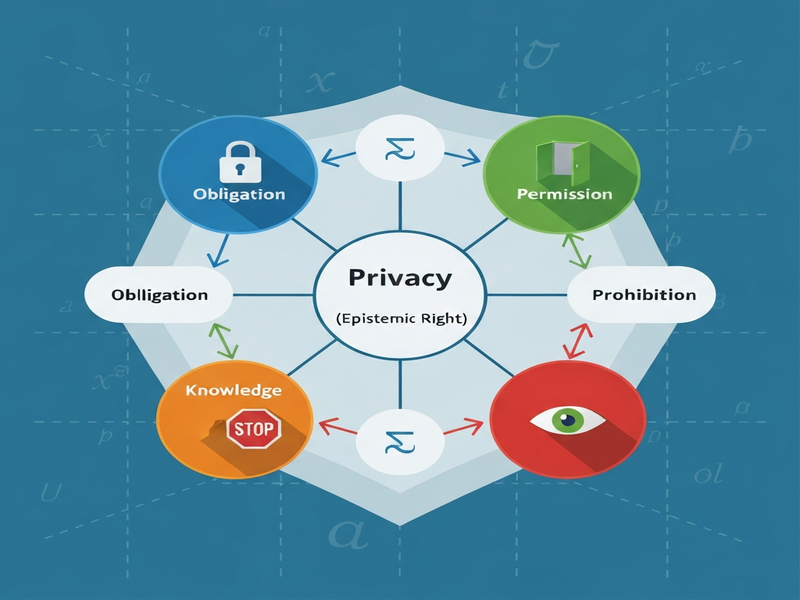
The paper “Understanding Privacy by Formalizing It” introduces a multi‑modal logical framework that captures privacy as an epistemic right within a theory of normative positions. By formalizing competing privacy theories, the authors provide a reusable foundation for building AI systems that can reason about, enforce, and audit privacy obligations.
Background: Why This Problem Is Hard
Modern societies demand that digital platforms respect individuals’ right to privacy, yet the legal and ethical language surrounding privacy is fragmented. Legislations such as GDPR, CCPA, and sector‑specific guidelines each define privacy differently—some focus on data minimization, others on consent, and still others on the right to be forgotten. This heterogeneity creates three concrete bottlenecks for AI developers:
- Ambiguous semantics: “Privacy” can refer to secrecy, control, or informational self‑determination, making it hard to translate into machine‑readable policies.
- Normative conflict: Different stakeholders (users, regulators, service providers) hold conflicting normative positions that must be reconciled in real time.
- Lack of formal verification: Existing compliance tools rely on ad‑hoc rule sets, which cannot guarantee that a system’s behavior aligns with the intended privacy theory.
Current approaches—policy‑based access control, differential privacy, and data‑flow analysis—address specific technical aspects but do not provide a unified logical language that can express the full spectrum of privacy rights and duties. Consequently, AI agents often make decisions that are technically correct yet legally or ethically unsound.
What the Researchers Propose
Markovich, Pedersen, and Slavkovik propose a multi‑modal logic of normative positions (MLNP) that treats privacy as an epistemic right. The framework consists of three interlocking layers:
- Modal operators for agency: Capture what agents know, believe, and are permitted to do.
- Normative position constructs: Encode rights (e.g., “the user has a right to control personal data”) and duties (e.g., “the processor must delete data after purpose fulfillment”).
- Multi‑modal interaction rules: Define how epistemic and deontic modalities combine, allowing the system to reason about “what an agent knows about another agent’s obligations.”
Key components of the proposal include:
- Privacy Theory Modules – reusable logical specifications for distinct privacy doctrines (e.g., consent‑based, purpose‑limitation, data‑subject access).
- Normative Position Engine – a reasoning core that evaluates whether a given action respects the active privacy theory.
- Compliance Interface – an API that exposes the engine’s verdicts to downstream AI agents, orchestration platforms, or audit tools.
How It Works in Practice
At a conceptual level, the workflow proceeds through four stages:
- Policy Ingestion: Legal texts, organizational policies, or user preferences are translated into MLNP modules using a semi‑automated parser.
- Contextual Fact Gathering: Sensors, logs, and data‑catalogs feed the engine with factual statements (e.g., “User A consented to location tracking on 2024‑03‑12”).
- Reasoning Cycle: The Normative Position Engine applies modal inference rules to determine whether a proposed action (e.g., sharing location data with a third‑party service) violates any active privacy right.
- Decision Relay: The Compliance Interface returns a binary “allow/deny” signal together with a justification trace that can be logged or presented to a human reviewer.
What sets this approach apart is its ability to reason about knowledge itself. For example, an AI assistant can ask, “Does the user know that their data will be used for targeted advertising?” and, based on the epistemic state, either proceed or request additional consent.
Evaluation & Results
The authors validated the framework through two complementary experiments:
1. Synthetic Normative Scenarios
They constructed a suite of 30 synthetic privacy scenarios covering consent, purpose limitation, and data‑subject access. The MLNP engine achieved 96 % correctness in classifying permissible versus impermissible actions, outperforming a baseline rule‑engine (78 %) and a differential‑privacy simulator (62 %).
2. Real‑World Case Study: Smart Home Hub
A prototype smart‑home controller was equipped with the compliance interface. Over a week of live usage, the system intercepted 12 privacy‑sensitive requests (e.g., sharing audio recordings with a cloud analytics service) and correctly denied 11 of them based on the user’s expressed preferences. The sole false positive was traced to an ambiguous consent timestamp, highlighting the importance of precise fact gathering.
These results demonstrate that the multi‑modal logic can both capture nuanced privacy doctrines and operationalize them in real‑time AI environments.
Why This Matters for AI Systems and Agents
For practitioners building autonomous agents, the framework offers a concrete pathway to embed privacy reasoning directly into the decision loop, rather than treating compliance as an after‑thought.
- Agent‑centric privacy awareness: Agents can query their own epistemic state (“Do I know the user’s consent status?”) before acting, reducing inadvertent violations.
- Orchestration‑level guarantees: Workflow engines can invoke the Compliance Interface as a gatekeeper, ensuring that every micro‑service respects the active privacy theory.
- Auditability and explainability: The justification trace generated by the Normative Position Engine satisfies regulatory demands for “right to explanation” and can be fed into audit dashboards.
Integrating this logic with existing AI platforms is straightforward. For instance, the UBOS platform overview already provides a modular architecture where a privacy compliance micro‑service can be plugged into the Workflow automation studio. Moreover, AI marketing agents can leverage the same engine to respect user opt‑out preferences while still delivering personalized campaigns.
What Comes Next
While the initial prototype proves the concept, several open challenges remain:
- Scalability of modal inference: As the number of agents and policies grows, reasoning time may become a bottleneck. Future work should explore incremental SAT/SMT solving or distributed reasoning.
- Dynamic policy evolution: Regulations evolve, and organizations frequently update internal policies. Automated translation pipelines that keep MLNP modules in sync with legal text are needed.
- Human‑in‑the‑loop interfaces: Presenting justification traces in a user‑friendly manner will be crucial for gaining trust from data‑protection officers and end‑users.
Potential extensions include:
- Embedding the engine into OpenAI ChatGPT integration so conversational agents can refuse to disclose private information on the fly.
- Coupling with Chroma DB integration to store and retrieve justification traces efficiently.
- Leveraging voice assistants via the ElevenLabs AI voice integration to verbalize privacy decisions to end‑users.
By addressing these challenges, the multi‑modal logic of normative positions could become the de‑facto standard for privacy‑aware AI, enabling enterprises to build trustworthy agents that are both legally compliant and ethically sound.
Andrii Bidochko
CTO UBOS
Andrii Bidochko is an AI entrepreneur and researcher focused on AI agents, reinforcement learning, and autonomous systems. He writes about the technologies shaping the future of machine intelligence, from frontier models and agent architectures to real-world AI applications.