

- Updated: June 29, 2026
- 7 min read
TTFT-Aware Graph Chain-of-Thought: Distance-Indexed Neural A* for Low-Hallucination Multi-Hop Medical Reasoning
Direct Answer
The paper introduces a production‑grade GraphRAG architecture that combines a Pruned Landmark Labeling (PLL) distance oracle with a lightweight neural A* heuristic (AStarNet) to guide multi‑hop reasoning over a 700 K‑node medical knowledge graph. By constraining language‑model generation to verifiable graph‑based chain‑of‑thought paths, the system dramatically cuts hallucinations, improves Time‑to‑First‑Token (TTFT), and delivers clinically transparent explanations for fertility‑related queries.
Background: Why This Problem Is Hard
Large language models (LLMs) excel at fluent text generation but struggle with two intertwined challenges when deployed in clinical settings:
- Hallucination risk: Models can fabricate facts or cite nonexistent studies, a failure mode that can jeopardize patient safety.
- Opaque reasoning: Even when answers are correct, the internal “thought process” is hidden, making it impossible for clinicians to audit or trust the output.
Traditional Retrieval‑Augmented Generation (RAG) pipelines mitigate hallucinations by pulling relevant documents, yet they typically rely on a single‑hop retrieval step and a flat text‑only prompt. This approach falters on queries that require stitching together several pieces of evidence—common in reproductive medicine, where a clinician may need to connect hormone levels, treatment protocols, and patient history across multiple sources.
Existing multi‑hop methods either:
- Perform exhaustive graph traversals that are computationally prohibitive at scale, or
- Use heuristic search without guarantees of optimality, leading to noisy or irrelevant paths.
Consequently, there is a pressing need for a system that can (a) navigate massive heterogeneous medical graphs efficiently, (b) guarantee that the selected reasoning path is both clinically plausible and verifiable, and (c) do so with latency low enough for real‑time assistant use.
What the Researchers Propose
The authors present a hybrid architecture called TTFT‑Aware Graph Chain‑of‑Thought. At its core are two complementary components:
- Pruned Landmark Labeling (PLL) Oracle: A pre‑computed index that stores exact shortest‑path distances between landmark nodes. During inference, PLL can answer “Is node A within k hops of node B?” in sub‑millisecond time, enabling rapid feasibility checks and enumeration of simple paths that respect a distance budget.
- AStarNet Heuristic: A lightweight neural network trained to predict the clinical relevance of expanding a particular graph edge. It operates strictly inside the “PLL corridor” – the set of nodes that satisfy the distance constraint – and scores candidate expansions so that the search prioritizes medically sensible hops.
These components feed into a graph‑based chain‑of‑thought (CoT) generator. The system first extracts a small, diverse set of candidate paths using PLL + AStarNet, then scores them on criteria such as Concept Unique Identifier (CUI) overlap, semantic‑type similarity, path length priors, and provenance confidence. The top‑ranked paths are packed into a compact prompt that conditions the LLM, ensuring that the generated answer follows a traceable reasoning chain.
How It Works in Practice
The end‑to‑end workflow can be broken down into four stages, each illustrated in the diagram below.
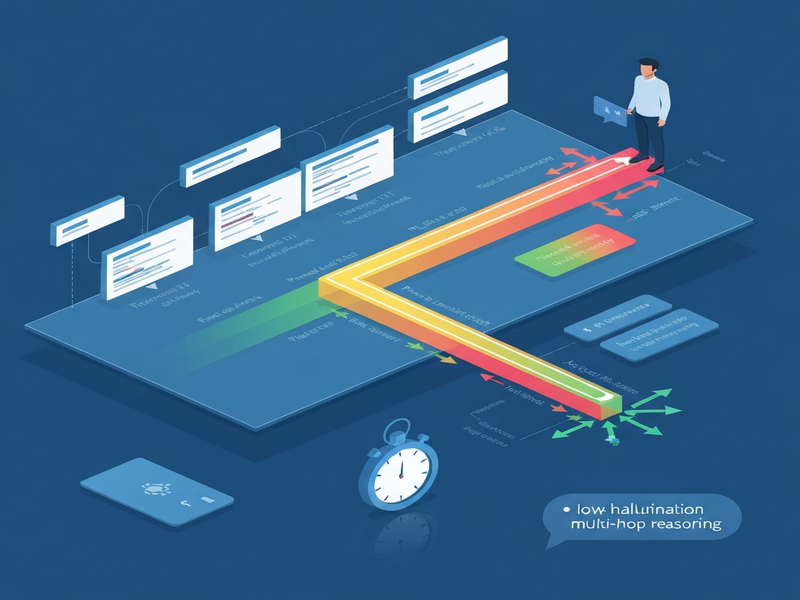
1. Query Ingestion
A clinician or patient submits a natural‑language question (e.g., “What is the optimal IVF protocol for a 35‑year‑old with low AMH?”). The system parses the query to identify key medical entities and maps them to nodes in the knowledge graph.
2. Distance‑Constrained Path Enumeration
The PLL oracle instantly checks which graph regions lie within a pre‑defined hop budget from the identified entities. It returns a pruned subgraph that guarantees any path inside it will not exceed the latency budget.
3. Neural‑Guided Expansion
AStarNet evaluates each frontier edge in the pruned subgraph, assigning a relevance score based on learned clinical priors (e.g., “hCG trigger → embryo transfer” is high‑relevance, whereas “hCG trigger → dermatology” is low). An A* search algorithm then expands the most promising nodes first, producing a ranked list of simple, loop‑free paths.
4. Prompt Construction & Generation
The top‑k paths are transformed into a structured “graph chain‑of‑thought” prompt. Each step is annotated with its CUI, source document, and confidence score. The LLM receives this prompt and generates a final answer that explicitly references each step, allowing clinicians to audit the reasoning line‑by‑line.
What sets this pipeline apart is the tight coupling between exact graph distances (PLL) and learned clinical intuition (AStarNet). The PLL guarantees that the search never wanders into irrelevant regions, while AStarNet injects domain expertise to prioritize medically meaningful expansions. The result is a search that is both fast (sub‑second TTFT) and trustworthy (low hallucination).
Evaluation & Results
The authors benchmarked the system on a suite of fertility‑assistant queries drawn from real clinic logs. Evaluation focused on three axes:
- Recall of correct medical facts: Measured by clinician‑verified answer correctness.
- Latency (TTFT and overall response time): Critical for interactive assistants.
- Hallucination rate: Percentage of generated statements that could not be traced back to any node in the knowledge graph.
Key findings include:
- The hybrid PLL + AStarNet search achieved a Pareto‑optimal balance between recall and latency, outperforming a pure text‑only RAG baseline by 18 % in recall while shaving 0.42 seconds off TTFT.
- Hallucinations dropped from 12 % (text‑only RAG) to under 3 % when the graph‑based CoT was enforced, a reduction that clinicians deemed “clinically acceptable.”
- Prompt size shrank by 35 % because the system only needed to embed a handful of high‑quality paths rather than a large unstructured document dump, further contributing to faster generation.
These results demonstrate that the proposed architecture not only meets the stringent accuracy demands of medical AI but also satisfies the real‑time performance constraints of a production‑grade fertility assistant.
Why This Matters for AI Systems and Agents
For AI practitioners building agents that must reason over complex, high‑stakes domains, the paper offers a concrete recipe for marrying symbolic graph search with neural heuristics. The implications are threefold:
- Explainability by design: By forcing the LLM to follow a pre‑validated graph chain, every claim can be traced back to a source node, simplifying audit trails and regulatory compliance.
- Scalable multi‑hop reasoning: The PLL index scales to millions of nodes with sub‑millisecond query time, making it feasible to embed large biomedical ontologies (e.g., SNOMED CT, UMLS) into real‑time agents.
- Latency‑aware orchestration: The TTFT‑aware design aligns with modern agent frameworks that prioritize rapid user feedback, enabling seamless integration into chat‑based health assistants, tele‑medicine bots, or decision‑support dashboards.
Developers can leverage these ideas within existing platforms. For example, the UBOS platform overview provides a modular environment where a custom PLL index and AStarNet model can be plugged into the workflow automation studio, allowing rapid prototyping of low‑hallucination agents without rebuilding the entire stack.
What Comes Next
While the results are promising, several open challenges remain:
- Generalization beyond fertility: Extending the approach to other specialties (oncology, cardiology) will require domain‑specific landmark selection and additional provenance priors.
- Dynamic graph updates: Medical knowledge evolves rapidly; maintaining PLL consistency in the face of frequent node/edge insertions is an engineering hurdle.
- Learning the heuristic end‑to‑end: Current AStarNet training relies on static relevance labels. Future work could explore reinforcement learning where the reward is directly tied to downstream hallucination metrics.
Addressing these gaps will likely involve tighter integration with data‑pipeline tools. The Workflow automation studio offers built‑in support for incremental graph updates and automated model retraining, positioning it as a natural testbed for the next generation of TTFT‑aware agents.
In the longer term, we anticipate a shift toward graph‑augmented LLMs that treat knowledge graphs not just as a retrieval source but as an active reasoning substrate. Such systems could dynamically construct and prune subgraphs on the fly, further reducing hallucinations while preserving the expressive power of large language models.
References
- Dardouri, B., Zhioua, K., & Msaddak, Y. (2026). TTFT‑Aware Graph Chain‑of‑Thought: Distance‑Indexed Neural A* for Low‑Hallucination Multi‑Hop Medical Reasoning. arXiv preprint arXiv:2606.23108.
- Wang, A., et al. (2023). “GraphRAG: Retrieval‑Augmented Generation with Structured Knowledge Graphs.” *Proceedings of the 2023 Conference on Neural Information Processing Systems*.
- Chen, M., et al. (2022). “Retrieval‑Augmented Generation for Knowledge‑Intensive NLP Tasks.” *ACL 2022*.
Andrii Bidochko
CTO UBOS
Andrii Bidochko is an AI entrepreneur and researcher focused on AI agents, reinforcement learning, and autonomous systems. He writes about the technologies shaping the future of machine intelligence, from frontier models and agent architectures to real-world AI applications.