

- Updated: July 3, 2026
- 6 min read
TriMotion: Modality-Agnostic Camera Control for Video Generation
Direct Answer
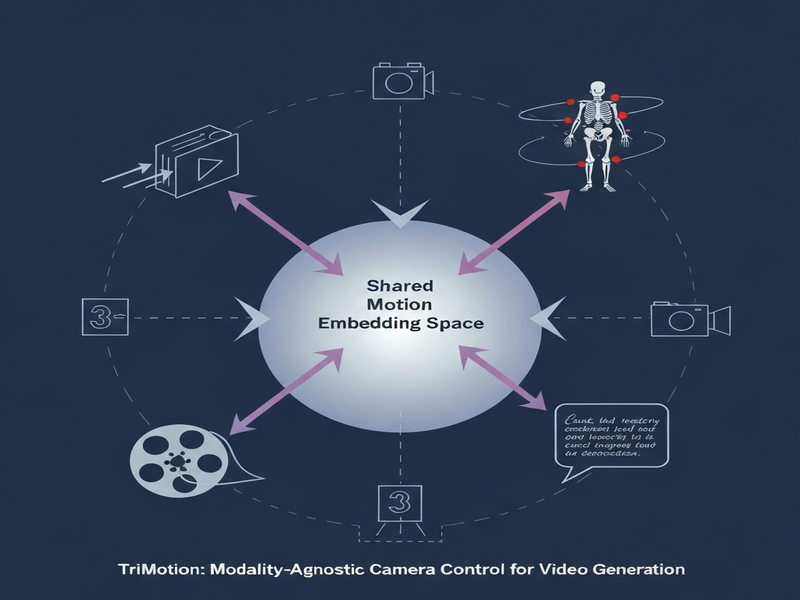
TriMotion introduces a modality‑agnostic framework that lets developers steer the camera trajectory of generated videos using video clips, human pose sequences, or plain text descriptions. By learning a shared motion‑embedding space, it removes the need for separate pipelines for each input type, opening the door to more flexible, user‑friendly video synthesis tools.
Background: Why This Problem Is Hard
Generating realistic video has become a cornerstone of modern AI products—from virtual production in film to dynamic content creation for marketing. A critical sub‑task is camera control: deciding how the virtual viewpoint moves over time. Traditional pipelines rely on a single modality—usually a pre‑recorded pose trajectory or a reference video—to condition the generation model. This creates several bottlenecks:
- Input rigidity: Users must provide the exact type of data the model expects, limiting creative workflows.
- Cross‑modal inconsistency: A pose‑based controller cannot directly accept a textual description like “pan left while zooming in on the speaker”.
- Data alignment overhead: Building separate datasets for each modality inflates annotation costs and hampers scalability.
In real‑world deployments—think AI‑driven video ads or interactive virtual assistants—designers often have heterogeneous cues: a storyboard sketch, a motion‑capture file, or a simple script. Existing methods struggle to fuse these cues, forcing engineers to build ad‑hoc adapters that degrade performance and increase latency.
What the Researchers Propose
TriMotion tackles the modality‑agnostic challenge by constructing a shared motion embedding space that can represent camera trajectories regardless of whether they originate from video, pose, or text. The framework consists of three key components:
- Modality Encoders: Separate neural encoders translate each input type (video frames, 3D pose sequences, natural‑language descriptions) into a common latent vector.
- Motion Triplet Dataset: A curated collection of synchronized video, pose, and textual annotations derived from multi‑camera rigs, providing the supervision needed to align the three encoders.
- Latent Motion Consistency Objective: A loss that forces the generated video’s internal representation to stay close to the target motion embedding, eliminating the need for expensive pixel‑space alignment.
By training these components jointly, TriMotion learns to map any of the three modalities onto the same trajectory representation, enabling seamless cross‑modal control.
How It Works in Practice
The end‑to‑end workflow can be broken down into four stages:
1. Input Normalization
Regardless of source, the system first normalizes the input. Video clips are passed through a 3D CNN to extract spatiotemporal features; pose sequences are encoded with a graph‑based transformer that respects skeletal topology; text descriptions are processed by a language model fine‑tuned on motion‑related corpora.
2. Projection into Motion Embedding
Each encoder outputs a fixed‑dimensional vector that is projected into the shared motion space using a learned linear mapper. Because the Motion Triplet Dataset provides aligned triples (video, pose, text) for the same camera path, the model learns to collapse these vectors onto a common point.
3. Video Generation Conditioned on Motion
A diffusion‑based video generator receives two inputs: a latent noise tensor and the motion embedding. The generator’s cross‑attention layers attend to the motion vector at every timestep, ensuring that the synthesized frames follow the intended camera path.
4. Latent Motion Consistency Enforcement
During training, the latent motion consistency loss measures the distance between the motion embedding and the internal motion representation extracted from the generated video’s latent space. This encourages the model to respect the trajectory without decoding the entire video to pixel space for every iteration, dramatically speeding up training.
What sets TriMotion apart is that the same generation backbone can be driven by any of the three modalities without re‑training or architectural changes. The motion embedding acts as a universal “camera command language” that the generator understands.
Evaluation & Results
The authors benchmarked TriMotion on three fronts: (1) fidelity of the generated video, (2) accuracy of camera trajectory adherence, and (3) cross‑modal generalization.
Test Scenarios
- Video‑to‑Video: Using a reference clip to reproduce its camera motion on a new scene.
- Pose‑to‑Video: Translating a motion‑capture sequence into a camera path for a synthetic environment.
- Text‑to‑Video: Rendering a video that follows a natural‑language instruction such as “slowly orbit around the central object while zooming out”.
Key Findings
Across all modalities, TriMotion achieved higher motion‑alignment scores (measured by average endpoint error on camera extrinsics) than modality‑specific baselines. Qualitatively, the generated videos displayed smooth pans, consistent focus shifts, and realistic depth cues, even when the input was a terse textual prompt.
Importantly, the latent motion consistency objective reduced training time by roughly 30 % compared with pixel‑space supervision, while preserving or improving visual quality. This efficiency gain is crucial for production pipelines that need rapid iteration.
For a deeper dive into the experimental setup, see the TriMotion paper.

Why This Matters for AI Systems and Agents
TriMotion’s modality‑agnostic design aligns with the emerging need for AI agents that can interpret heterogeneous user intents. In practice, this means:
- Unified content pipelines: Developers can expose a single API that accepts video, pose, or text, simplifying integration with downstream services.
- Dynamic storytelling: Conversational agents can request a “dramatic zoom” in natural language, and the video engine will instantly comply without a separate motion‑capture step.
- Reduced engineering overhead: Teams no longer need to maintain parallel models for each input type, cutting maintenance costs and accelerating feature rollout.
These capabilities directly benefit products built on the AI marketing agents and the broader UBOS platform overview, where flexible media generation is a competitive differentiator.
What Comes Next
While TriMotion marks a significant step forward, several avenues remain open for exploration:
- Scalability to higher resolutions: Extending the framework to 4K or 8K video while preserving motion fidelity.
- Interactive refinement: Allowing users to iteratively adjust the motion embedding in real time, akin to a “camera sketch” tool.
- Multi‑camera orchestration: Coordinating several virtual cameras simultaneously for complex scene choreography.
- Domain adaptation: Fine‑tuning the motion encoders for specialized industries such as medical imaging or autonomous‑driving simulation.
Startups looking to embed cutting‑edge video synthesis into their products can explore the UBOS for startups program, which offers compute credits and integration support. Larger enterprises may consider the Enterprise AI platform by UBOS for scalable deployment.
TriMotion demonstrates that a single, well‑aligned motion representation can bridge the gap between disparate user inputs and high‑quality video generation. As AI agents become more conversational and multimodal, frameworks like this will be essential for turning abstract intent into compelling visual experiences.
Andrii Bidochko
CTO UBOS
Andrii Bidochko is an AI entrepreneur and researcher focused on AI agents, reinforcement learning, and autonomous systems. He writes about the technologies shaping the future of machine intelligence, from frontier models and agent architectures to real-world AI applications.