

- Updated: July 3, 2026
- 6 min read
Translating Inference-Time Control to Radiology Vision-Language Models: Activation Steering for Pneumonia Classification on Chest X-rays
Direct Answer
The paper introduces Contrastive Activation Addition (CAA), an inference‑time steering technique that nudges frozen radiology vision‑language models (VLMs) toward better pneumonia detection on chest X‑rays without any weight updates. This matters because it offers a lightweight, deployment‑friendly way to improve diagnostic performance in high‑stakes medical AI systems.
Background: Why This Problem Is Hard
Chest‑radiograph interpretation is a cornerstone of emergency and primary‑care diagnostics, yet building AI that matches radiologists’ accuracy remains challenging for three intertwined reasons:
- Data scarcity and distribution shift: Public pneumonia datasets are small and differ from hospital‑specific imaging pipelines, causing models to degrade when transferred.
- Model rigidity after deployment: Traditional fine‑tuning requires access to the original training weights, large GPU budgets, and regulatory re‑approval—processes that are often infeasible in clinical settings.
- Opaque multimodal reasoning: Vision‑language models fuse visual features with textual prompts, making it difficult to isolate which internal activations drive a particular diagnosis.
Existing solutions either rely on costly retraining, handcrafted post‑processing, or simple prompt engineering, none of which can systematically reshape the model’s internal decision surface at inference time.
What the Researchers Propose
The authors present a three‑step framework built around activation steering:
- Steering vector construction: Using a small, curated development set, they compute contrastive vectors that capture the difference between “pneumonia” and “normal” concepts. Three flavors are explored:
- Answer‑bias control (biasing the Yes/No token logits).
- Pneumonia‑text contrast (derived from textual embeddings of “pneumonia” vs. “healthy”).
- Image‑conditioned contrast (derived from activation patterns of 30 pneumonia and 30 normal images).
- Contrastive Activation Addition (CAA): The steering vector is added to the model’s hidden activations at a selected layer, scaled by a factor chosen on a validation split. This operation is deterministic and does not alter any learned weights.
- Threshold calibration: After steering, a separate calibration set determines the optimal decision threshold for the binary “Yes/No” output, ensuring fair comparison with the zero‑shot baseline.
By keeping the base VLM frozen, the method sidesteps regulatory hurdles while still reshaping the model’s output distribution.
How It Works in Practice
The practical workflow can be broken down into four stages that fit neatly into an existing radiology AI pipeline:
- Model loading: Load a pre‑trained chest‑X‑ray VLM (e.g., MedGemma‑4B‑IT, NV‑Reason‑CXR‑3B, or CheXOne‑3B) in inference mode.
- Steering vector generation: Run a small, representative development set through the model, capture activations at the target layer, and compute the contrastive vector according to the chosen control type.
- Activation steering: For each new patient image, inject the scaled steering vector into the same layer before the final language head produces the “Yes” and “No” logits.
- Decision making: Apply the calibrated threshold to the adjusted logits and output a binary pneumonia prediction.
The key differentiator is that step 3 occurs entirely at inference time, meaning hospitals can deploy the same frozen model across sites and later adjust its behavior simply by updating the steering vector—a software‑only change.
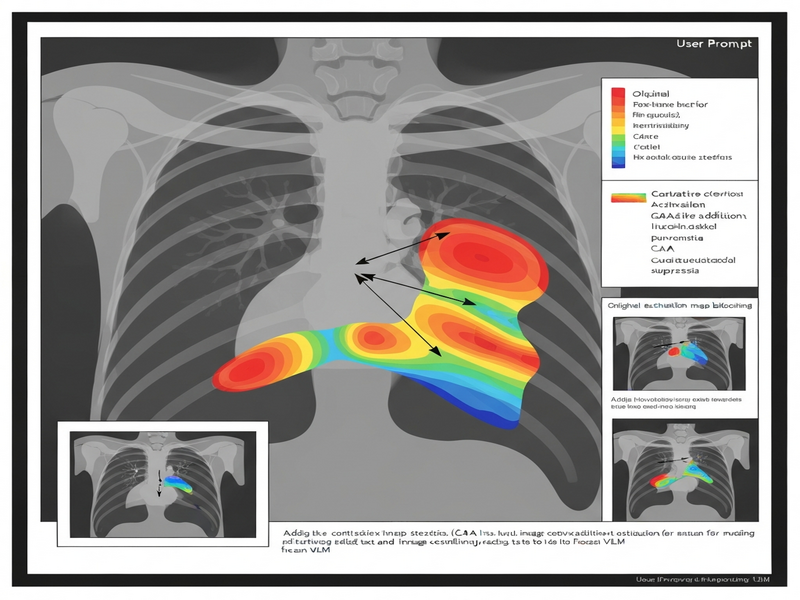
In this diagram, the blue block represents the frozen VLM, the orange arrow denotes the contrastive vector, and the green checkmark shows the final calibrated decision.
Evaluation & Results
The authors benchmarked CAA on the public Kermany pneumonia test set, using three state‑of‑the‑art VLMs. Evaluation metrics included ROC‑AUC, PR‑AUC, F1 score, and calibrated threshold analyses. Key findings:
- NV‑Reason‑CXR‑3B benefited the most: Calibrated F1 rose from 0.7692 (zero‑shot) to 0.8619 with pneumonia‑text steering and to 0.8727 with image‑conditioned steering.
- MedGemma‑4B‑IT showed modest gains: Fixed‑threshold F1 improved in several runs, though the improvement was not consistent across all steering types.
- CheXOne‑3B displayed a marginal lift: Pneumonia‑text steering increased calibrated F1 from 0.8528 to 0.8666, but the confidence interval overlapped zero, indicating statistical uncertainty.
- Score distribution shift: CAA dramatically reshaped the logits’ probability density, making the model more confident in true positives while reducing false‑negative rates.
Importantly, the authors ran reverse‑vector and random‑vector controls to confirm that the observed gains stem from meaningful contrastive information rather than arbitrary perturbations.
Why This Matters for AI Systems and Agents
From a systems‑engineering perspective, activation steering offers a new lever for runtime adaptation of high‑performing models:
- Regulatory agility: Because the underlying weights remain unchanged, updates can be classified as “software patches,” potentially accelerating FDA or CE clearance cycles.
- Resource efficiency: Hospitals avoid the compute‑heavy fine‑tuning loops, saving both GPU time and energy costs.
- Agent orchestration: In multi‑agent diagnostic pipelines, a steering module can be inserted as a micro‑service that dynamically adjusts model behavior based on patient demographics, imaging device type, or emerging disease patterns.
- Integration pathways: The technique aligns with existing OpenAI ChatGPT integration and can be wrapped inside a Workflow automation studio to trigger steering updates on a scheduled basis.
For AI product teams, CAA opens a path to “continuous improvement” without the overhead of model retraining, enabling faster iteration cycles and more responsive clinical decision support.
What Comes Next
While the study demonstrates promise, several open challenges remain:
- Generalization across pathologies: Extending CAA to other findings (e.g., atelectasis, pleural effusion) will require disease‑specific steering vectors and larger development sets.
- Robustness to distribution shift: Future work should test steering under varying acquisition protocols, patient positions, and equipment manufacturers.
- Explainability: Mapping steering vectors back to visual regions could provide radiologists with intuitive cues about why a model’s confidence changed.
- Automation of vector selection: Integrating a meta‑learning loop that automatically discovers optimal layers and scaling factors would make CAA truly plug‑and‑play.
Developers interested in prototyping these ideas can leverage the UBOS platform overview to spin up containerized VLM services, connect them to a Chroma DB integration for storing steering vectors, and expose the workflow through a Telegram integration on UBOS for rapid clinician feedback.
Ultimately, activation steering could become a standard component of AI‑augmented radiology suites, delivering incremental diagnostic gains while respecting the stringent safety and compliance constraints of healthcare.
Call to Action
Ready to explore how inference‑time control can accelerate your AI‑driven radiology solutions? Visit the UBOS homepage to learn more about our enterprise AI platform, request a demo, or join the UBOS partner program today.
For a deeper dive into the methodology and full experimental details, see the original arXiv paper.
Andrii Bidochko
CTO UBOS
Andrii Bidochko is an AI entrepreneur and researcher focused on AI agents, reinforcement learning, and autonomous systems. He writes about the technologies shaping the future of machine intelligence, from frontier models and agent architectures to real-world AI applications.