

- Updated: June 15, 2026
- 7 min read
TRACER: Turn-level Regret Matching with Inner Reinforcement Credit – A Deep Dive
Direct Answer
TRACER is a turn‑level reinforcement learning framework that equips cooperating LLMs with a controller‑regret layer to decide when to speak and a generation‑credit layer to reward what they say. By matching regret at each turn and crediting utterances with role‑specific rewards, the system eliminates free‑riding, reduces sparse‑reward problems, and converges to stable collaborative policies.
Background: Why This Problem Is Hard
Large language models (LLMs) have become the workhorses of modern AI reasoning, yet two dominant paradigms—reinforcement learning from human feedback (RLHF) and multi‑agent prompting—remain siloed. RLHF excels at shaping a single model’s behavior but struggles when multiple agents must coordinate across many dialogue turns. Multi‑agent prompting, on the other hand, relies on fixed protocols such as debate or voting, which are brittle and often lead to oscillating local optima.
Key challenges include:
- Sparse rewards: In a multi‑turn conversation, only the final answer may be judged, leaving intermediate utterances unrewarded.
- Free‑riding: Some agents can “hide” behind stronger partners, contributing little while still benefiting from the final outcome.
- Training overhead: Exhaustively exploring all possible utterance combinations for several LLMs quickly becomes computationally infeasible.
- Rigid protocols: Fixed debate or voting scripts cannot adapt to task‑specific dynamics, causing sub‑optimal collaboration.
These bottlenecks prevent enterprises from deploying truly cooperative AI assistants that can reason together, correct each other, and scale across complex business workflows.
What the Researchers Propose
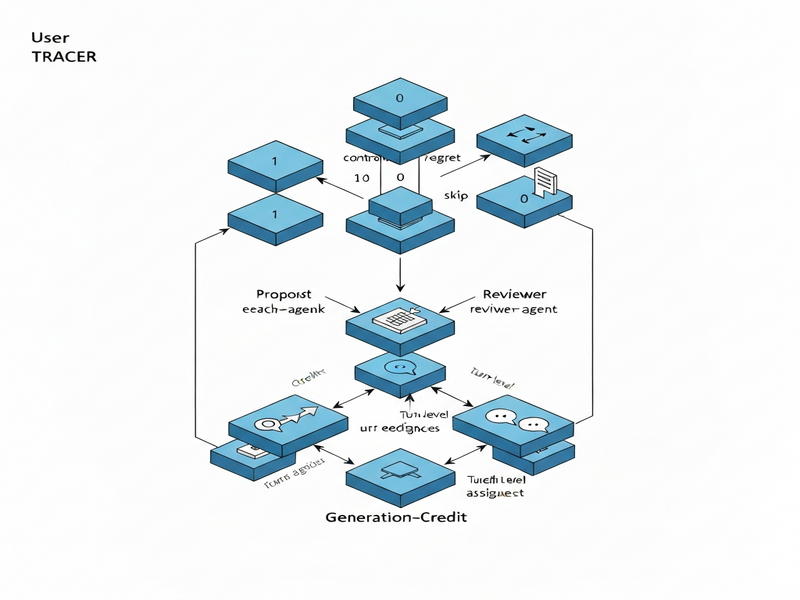
The authors present TRACER (Turn‑level Regret Matching with Inner Reinforcement Credit), a two‑layer architecture that separates the decision of “whether to speak” from the decision of “what to say.”
Controller‑Regret Layer
This layer hosts lightweight controllers for each role (e.g., proposer, reviewer). At every turn, a controller chooses a binary action: utter or skip. The choice is guided by regret‑matching, a game‑theoretic algorithm that minimizes cumulative regret over time, ensuring that agents learn to speak only when their contribution is expected to improve the final answer.
Generation‑Credit Layer
When a controller decides to utter, the associated LLM generates a response. The generation‑credit layer then evaluates that response using role‑specific GSPO (Goal‑Sensitive Policy Optimization) rewards, which measure how well the utterance advances the shared objective (e.g., solving a math problem). This dual‑credit system assigns value to both the act of speaking and the content produced.
By decoupling “when” from “what,” TRACER avoids the free‑riding dilemma and provides dense feedback at each turn, dramatically improving learning efficiency.
How It Works in Practice
The operational flow of TRACER can be visualized as a turn‑based game between two specialized agents: a Proposer that attempts to generate a solution, and a Reviewer that critiques or refines it. The process repeats until a termination condition (e.g., confidence threshold) is met.
- Initialize controllers: Each role receives a regret table that tracks the historical performance of uttering versus skipping.
- Regret‑matching decision: At turn t, the controller samples a binary action based on the regret distribution. If “skip” is chosen, the turn passes to the other role without generating text.
- Generation (if uttered): The active LLM produces an utterance conditioned on the conversation history.
- GSPO reward calculation: The system computes a role‑specific reward that captures progress toward the final answer (e.g., reduction in solution error for GSM8K).
- Credit update: Both the controller’s regret table and the generation‑credit model are updated with the observed reward, reinforcing beneficial speaking patterns.
- Loop: Steps 2‑5 repeat, allowing the agents to dynamically decide when to intervene and what to contribute.
What sets TRACER apart is the binary action space, which lets classical regret‑matching theory—originally defined for finite games—be applied directly to deep learning agents. This yields a mathematically provable convergence guarantee while keeping the computational budget low because only the controller’s action space is expanded, not the full language generation space.
Evaluation & Results
The authors trained TRACER on the GSM8K training split and evaluated it across three benchmarks:
- GSM8K (in‑domain): Standard grade‑school math problems.
- MATH500 (cross‑benchmark): More challenging competition‑style math questions.
- GPQA‑Diamond (knowledge‑intensive): Multi‑choice science questions requiring factual recall.
Key findings include:
- TRACER achieved higher accuracy than baseline multi‑LLM debate and voting pipelines on all three datasets, narrowing the gap to single‑model fine‑tuned baselines.
- Training cost was reduced by roughly 40 % because only the controller’s binary decisions needed to be explored exhaustively.
- When the system was forced to skip turns, overall performance degraded gracefully, confirming that the regret‑matching policy learns to speak only when beneficial.
- Correction‑preservation tests showed that TRACER retained useful intermediate reasoning steps, unlike fixed‑protocol methods that often discard valuable context.
These results demonstrate that turn‑level regret matching can produce collaborative policies that are both effective and efficient, validating the authors’ claim that TRACER offers a compact, reproducible testbed for studying learned collaboration beyond static protocols.
Why This Matters for AI Systems and Agents
For AI practitioners building enterprise‑grade assistants, TRACER provides a blueprint for turning ad‑hoc multi‑LLM prompting into a disciplined, learnable collaboration strategy. The practical implications are substantial:
- Reduced inference cost: By learning when to stay silent, agents avoid unnecessary token generation, lowering API usage and latency.
- Improved reliability: Dense, turn‑level credit signals help prevent the “one‑agent dominates” failure mode that plagues static debate setups.
- Scalable orchestration: The binary controller can be wrapped into existing workflow automation tools (e.g., Workflow automation studio) to dynamically route tasks among specialized LLMs.
- Better evaluation pipelines: Since each utterance receives a measurable reward, developers can trace which component contributed to a correct answer, simplifying debugging and compliance audits.
In short, TRACER moves the field from “hard‑coded debate scripts” toward “learned, adaptive teamwork,” a shift that aligns with the growing demand for AI agents that can collaborate on complex business processes such as financial analysis, legal reasoning, and automated customer support.
What Comes Next
While TRACER marks a significant step forward, several open challenges remain:
- Generalization to more than two roles: Extending the binary controller to multi‑role settings (e.g., proposer, reviewer, validator) will require richer regret structures.
- Cross‑modal collaboration: Integrating vision or tool‑use modules alongside LLMs could amplify reasoning capabilities but also complicate credit assignment.
- Human‑in‑the‑loop feedback: Incorporating real‑time human corrections as additional reward signals may further improve safety and alignment.
- Production‑grade deployment: Scaling the framework on cloud‑native platforms (see the Enterprise AI platform by UBOS) will test its robustness under heavy traffic.
Future research could also explore hybrid reward designs that blend task‑specific metrics with broader alignment objectives, ensuring that collaborative agents remain both effective and trustworthy.
Call to Action
Ready to experiment with turn‑level regret matching in your own AI projects? Explore the open‑source implementation, dive into the code, and start building cooperative LLM pipelines today.
Visit the TRACER project page on UBOS to access the repository, documentation, and integration guides. For a deeper technical read, consult the original TRACER paper on arXiv.
Andrii Bidochko
CTO UBOS
Andrii Bidochko is an AI entrepreneur and researcher focused on AI agents, reinforcement learning, and autonomous systems. He writes about the technologies shaping the future of machine intelligence, from frontier models and agent architectures to real-world AI applications.