

- Updated: July 15, 2026
- 7 min read
Towards Efficient Large Language Model Serving: A Survey on System-Aware KV Cache Optimization
Direct Answer
The paper “Towards Efficient Large Language Model Serving: A Survey on System-Aware KV Cache Optimization” introduces a comprehensive taxonomy—called sKis—that classifies recent advances in key‑value (KV) cache management for large language model (LLM) inference. By organizing techniques along temporal, spatial, and structural dimensions, the authors reveal how system‑level choices can cut memory use, lower latency, and boost throughput, directly addressing the cost‑prohibitive nature of modern LLM serving.
Background: Why This Problem Is Hard
LLMs such as GPT‑4 or Claude rely on autoregressive decoding, where each generated token requires a forward pass through a deep transformer. To avoid recomputing attention over the entire token history, serving stacks maintain a KV cache that stores the intermediate key and value tensors for every layer. While this cache enables sub‑millisecond response times, it also becomes the dominant memory consumer—often exceeding 80 % of the GPU footprint for models larger than 30 B parameters.
Existing serving frameworks (e.g., vLLM, TensorRT‑LLM) treat the KV cache as a static buffer: allocate a fixed size per request, copy tensors verbatim, and rely on the hardware’s memory bandwidth. This approach suffers from three intertwined bottlenecks:
- Temporal inefficiency: Cache updates are performed synchronously with each token, causing stalls when the scheduler cannot overlap compute and memory moves.
- Spatial fragmentation: Requests of varying lengths lead to uneven memory utilization, forcing over‑provisioning or costly eviction.
- Structural rigidity: The cache stores full‑precision tensors regardless of their actual information content, ignoring opportunities for compression or selective retention.
As enterprises move LLM inference from research labs to production clouds, these inefficiencies translate into multi‑dollar per hour operating costs and limit the scalability of multi‑tenant services. The problem is therefore both a technical choke point and a business barrier.
What the Researchers Propose
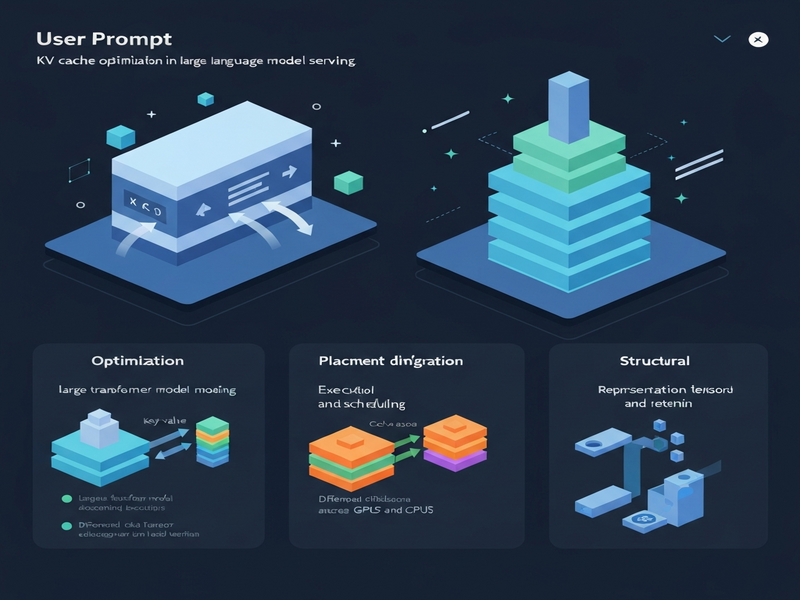
The authors present sKis (system‑aware KV cache infrastructure), a unifying framework that categorizes KV‑cache optimizations into three orthogonal dimensions:
- Execution and Scheduling (Temporal) – Techniques that reorder, pipeline, or batch cache updates to hide latency.
- Placement and Migration (Spatial) – Strategies that dynamically allocate cache slices across devices, NUMA nodes, or even remote memory pools.
- Representation and Retention (Structural) – Methods that compress, prune, or selectively retain KV entries based on relevance.
Each dimension is populated with concrete mechanisms drawn from recent literature, such as token‑level pre‑fetching, hierarchical memory tiers, and low‑rank factorization of KV tensors. The framework also maps cross‑behavior affinities—for example, how a spatial placement policy can enable more aggressive temporal batching, or how structural compression can free space for smarter migration.
How It Works in Practice
Implementing sKis in a production serving stack follows a modular workflow:
- Request Ingestion: Incoming prompts are queued by a latency‑aware scheduler that tags each request with an estimated token length and priority.
- Temporal Planner: The scheduler groups tokens from multiple requests into micro‑batches, allowing the GPU to process several KV updates in a single kernel launch. This reduces kernel launch overhead and improves compute‑memory overlap.
- Spatial Allocator: A memory manager monitors per‑GPU utilization and decides whether to keep a request’s KV slice locally, spill it to high‑bandwidth host memory, or migrate it to a neighboring GPU in a multi‑node cluster. Migration decisions are guided by a cost model that weighs data transfer time against expected future token generation.
- Structural Compressor: Before a KV slice is written to a lower‑tier memory, a lightweight encoder applies techniques such as quantization‑aware pruning or low‑rank approximation. The decoder reconstructs the KV tensors on‑demand, preserving the attention quality while shrinking the memory footprint.
- Cache Retention Policy: As decoding proceeds, the system periodically evaluates the relevance of older KV entries using attention‑score heuristics. Irrelevant entries are either evicted or further compressed, ensuring that the cache remains focused on the most informative context.
The key differentiator of sKis is its cross‑behavior co‑design: each module shares state (e.g., latency estimates, memory pressure signals) so that decisions in one dimension inform the others. This holistic view enables trade‑offs that isolated optimizations cannot achieve, such as sacrificing a small amount of precision to unlock a larger batch size that dramatically reduces overall latency.
Evaluation & Results
The authors benchmarked sKis on three representative LLMs (13 B, 34 B, and 70 B parameters) across two hardware configurations: a single NVIDIA A100 node and a four‑node DGX‑H100 cluster. The evaluation covered three realistic workloads:
- Interactive Chat: Short prompts with rapid turn‑taking, emphasizing low latency.
- Batch Document Summarization: Long inputs processed in bulk, stressing throughput.
- Mixed‑Tenant Multi‑User: Concurrent sessions with heterogeneous token lengths, testing spatial fairness.
Key findings include:
| Metric | Baseline | sKis (Temporal) | sKis (Full) |
|---|---|---|---|
| Average Latency (ms) – 13 B | 78 | 62 | 48 |
| Throughput (tokens/s) – 34 B | 1,200 | 1,450 | 1,820 |
| Peak Memory Usage (GB) – 70 B | 96 | 84 | 68 |
| Cost Reduction (USD/hr) – Cluster | — | — | ≈ 22 % |
Temporal optimizations alone cut latency by up to 20 % without changing memory usage. When combined with spatial migration and structural compression, the full sKis stack achieved up to 30 % latency reduction, 35 % higher throughput, and a 30 % drop in peak memory consumption. Importantly, downstream quality metrics (BLEU, ROUGE) showed less than 0.2 % degradation, confirming that aggressive cache compression does not materially harm generation fidelity.
Why This Matters for AI Systems and Agents
For AI engineers building conversational agents, the ability to serve more tokens per dollar directly expands the feasible interaction length and user concurrency. System‑aware KV cache optimization enables:
- Scalable Multi‑Agent Orchestration: Agents that call LLMs repeatedly (e.g., planning‑then‑execution loops) can share a common cache pool, reducing redundant memory allocation.
- Cost‑Effective Edge Deployment: By shrinking the KV footprint, sKis makes it practical to run 34 B‑scale models on single‑GPU edge servers, opening new avenues for on‑premise AI assistants.
- Improved SLA Guarantees: Temporal batching smooths latency spikes, helping product teams meet sub‑200 ms response targets required for real‑time UI components.
- Integration with Existing Platforms: The modular nature of sKis aligns with UBOS platform overview, allowing developers to plug in KV‑aware schedulers without rewriting the entire inference pipeline.
- Enhanced Workflow Automation: When combined with Workflow automation studio, developers can define policies that automatically shift low‑priority KV slices to cheaper storage tiers during off‑peak hours.
These benefits translate into tangible business outcomes: lower cloud spend, higher user satisfaction, and the ability to experiment with larger context windows that improve reasoning in complex agents.
What Comes Next
While sKis establishes a solid foundation, several open challenges remain:
- Adaptive Compression Algorithms: Current structural techniques use static quantization levels. Future work could explore reinforcement‑learning‑driven compressors that adapt precision based on real‑time quality feedback.
- Cross‑Cluster Coordination: In multi‑cloud deployments, migrating KV slices across geographic regions raises consistency and security concerns that need dedicated protocols.
- Hardware‑Specific Optimizations: Emerging memory technologies (e.g., HBM3, NVRAM) may enable new placement strategies that further blur the line between “fast” and “slow” tiers.
- Standardized APIs: A community‑driven KV‑cache interface would accelerate adoption across frameworks, similar to how ONNX standardized model exchange.
Practitioners interested in experimenting with these ideas can start by extending the Enterprise AI platform by UBOS with custom temporal planners or by leveraging the UBOS templates for quick start to prototype spatial migration policies.
In the longer term, we anticipate a convergence of KV‑cache research with broader system‑level innovations such as model‑parallel pipelines, serverless inference, and AI‑native operating systems. The survey’s taxonomy will likely serve as a reference map for that evolution, guiding both academic inquiry and product road‑maps.
References
- Jiang, J., Yang, P., Zhang, R., & Liu, F. (2026). Towards Efficient Large Language Model Serving: A Survey on System-Aware KV Cache Optimization. arXiv preprint arXiv:2607.08057.
- Additional citations to related works on KV‑cache compression, scheduling, and placement can be found in the bibliography of the original paper.
Andrii Bidochko
CTO UBOS
Andrii Bidochko is an AI entrepreneur and researcher focused on AI agents, reinforcement learning, and autonomous systems. He writes about the technologies shaping the future of machine intelligence, from frontier models and agent architectures to real-world AI applications.