

- Updated: July 4, 2026
- 6 min read
The Token Tax of Epistemic Accuracy: Comparing RAG and Long-Context Architectures for Document-Grounded Generative AI Applications
Direct Answer
The paper introduces the concept of a “token tax” that quantifies the cost of giving generative AI models broader evidentiary access, and it empirically compares retrieval‑augmented generation (RAG) with long‑context prompting on a safety‑training benchmark. The findings matter because they reveal a concrete trade‑off between epistemic accuracy and token consumption—a trade‑off that directly impacts the economics of deploying document‑grounded assistants in resource‑constrained enterprises.
Background: Why This Problem Is Hard
Document‑grounded assistants are increasingly tasked with high‑stakes, knowledge‑intensive work such as regulatory compliance, technical support, and safety training. To answer a user query correctly, the model must locate and incorporate the right evidence from a potentially massive corpus of manuals, standards, and SOPs. Two practical obstacles dominate the landscape:
- Evidence retrieval bottleneck: Traditional RAG pipelines retrieve a handful of passages (often 5‑10) and feed them to the language model. If the retrieved set omits a critical clause, the model’s answer will be factually wrong, regardless of its internal reasoning ability.
- Context‑length limitation: Large language models (LLMs) have a finite context window (e.g., 8k‑32k tokens). Loading an entire document collection into that window guarantees maximal evidence exposure but inflates the input token count dramatically, raising inference latency and API costs.
Existing approaches either accept the risk of missing evidence (RAG) or pay a steep computational price (long‑context prompting). Neither solution offers a principled way to evaluate the cost‑benefit balance, leaving organizations to guess how much “evidence bandwidth” they need for a given accuracy target.
What the Researchers Propose
The authors frame the problem as an “epistemic access” trade‑off and introduce two key constructs:
- Epistemic Accuracy: A metric that measures correctness only when the model has been supplied with the necessary evidence. It isolates the impact of evidence availability from pure model capability.
- Token Tax: The additional token consumption incurred when expanding evidentiary access, expressed as a ratio of tokens per query relative to a baseline RAG setup.
Using these constructs, the paper proposes a comparative evaluation framework that treats RAG and long‑context prompting as opposite ends of a cost‑accuracy frontier. The framework does not require new model architectures; it simply re‑positions existing pipelines on a unified metric space.
How It Works in Practice
The experimental workflow consists of three interchangeable components:
1. Document Repository
A curated set of manufacturing safety manuals, each broken into semantically coherent passages. The repository is static across all runs, ensuring a fair evidence baseline.
2. Evidence Access Layer
- RAG Mode: A dense vector retriever (e.g., SBERT) returns the top‑k passages (k = 5, 10, or 20). The retrieved passages are concatenated with the user query and fed to the LLM.
- Long‑Context Mode: All passages for a given machine are concatenated, respecting the model’s maximum context length. No retrieval step occurs; the model sees the entire knowledge base.
3. Generation Engine
A small‑to‑mid‑size LLM (e.g., Llama‑2‑7B and Mistral‑7B) generates the answer. The same prompting template is used across both modes to isolate the effect of evidence access.
The key differentiator is the token budget allocated to the evidence layer. In RAG, the token count per query stays under 500 tokens, while long‑context prompting can exceed 12,000 tokens—hence the “tax.”
Evaluation & Results
The authors built an expert‑validated benchmark covering three industrial machines (lathe, CNC mill, and robotic arm). For each machine, 324 safety‑related questions were generated, yielding a total of 972 query‑answer pairs. Human experts rated each answer for factual correctness and relevance, producing a binary “epistemically correct” label.
Key Findings
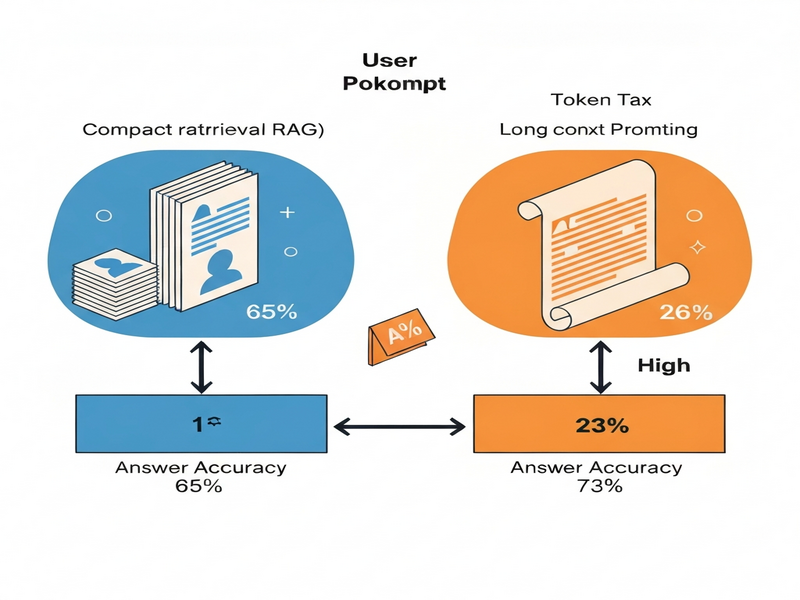
- Accuracy Gap: Long‑context prompting achieved 73.1 % epistemic accuracy, outperforming semantic RAG (65.4 %) by 7.7 percentage points.
- Token Tax Magnitude: The average per‑query token consumption for long‑context prompting was 26 × higher than RAG (≈12 k vs. ≈460 tokens).
- Model‑agnostic Trend: Both Llama‑2‑7B and Mistral‑7B exhibited the same relative advantage for long‑context prompting, suggesting the effect stems from evidence exposure rather than model size.
- Retrieval Saturation: Increasing k in RAG beyond 10 passages yielded diminishing returns, indicating that simply pulling more passages does not substitute for full‑document context.
These results validate the token‑tax hypothesis: broader evidentiary access improves epistemic accuracy, but the improvement comes at a steep token cost that may be prohibitive for high‑throughput or budget‑sensitive deployments.
Why This Matters for AI Systems and Agents
For practitioners building knowledge‑driven agents, the study offers three actionable insights:
- Cost‑aware Design: When latency and API spend are primary constraints, RAG remains a viable baseline. However, teams should budget for a token tax if they require near‑perfect factuality in safety‑critical domains.
- Hybrid Strategies: The frontier suggests a middle ground—e.g., dynamic retrieval that expands to longer context only when confidence in the initial passages is low. Such adaptive pipelines can capture most of the accuracy gain without paying the full token tax.
- Evaluation Standards: Epistemic accuracy should replace raw BLEU or ROUGE scores when assessing document‑grounded agents, because it directly ties correctness to evidence availability.
Enterprises can embed these principles into orchestration layers, such as the UBOS platform overview, to automate token‑budget monitoring and trigger fallback retrieval when cost thresholds are breached.
What Comes Next
While the paper establishes a clear cost‑accuracy relationship, several open challenges remain:
- Scalable Long‑Context Models: Emerging architectures with efficient attention (e.g., FlashAttention, Longformer) could reduce the token tax, but their real‑world performance on safety‑critical tasks is still untested.
- Evidence Compression: Techniques like semantic summarization or vector‑quantized storage might compress documents into fewer tokens while preserving critical facts.
- Dynamic Token Allocation: Future agents could learn to allocate tokens per query based on predicted difficulty, akin to a “budget‑aware” policy network.
Addressing these gaps will enable organizations to reap the accuracy benefits of full‑document grounding without incurring prohibitive costs. For teams ready to experiment, the Workflow automation studio offers a low‑code environment to prototype hybrid RAG‑plus‑long‑context pipelines, while the Enterprise AI platform by UBOS provides the scaling infrastructure needed for production workloads.
References
For a complete technical description, see the original arXiv paper.
Andrii Bidochko
CTO UBOS
Andrii Bidochko is an AI entrepreneur and researcher focused on AI agents, reinforcement learning, and autonomous systems. He writes about the technologies shaping the future of machine intelligence, from frontier models and agent architectures to real-world AI applications.