

- Updated: July 3, 2026
- 7 min read
The Substrate Collapse: AI Code Generation Invalidates Authorship-Based Knowledge Metrics
Direct Answer
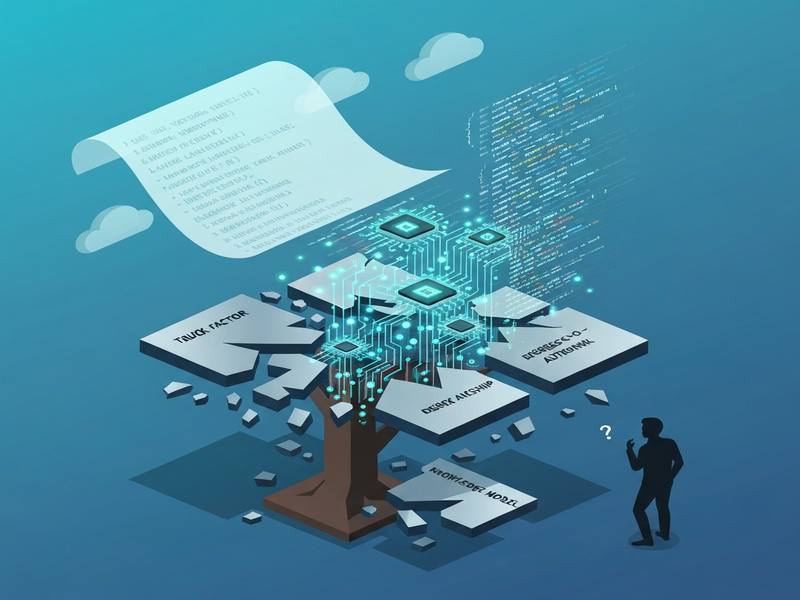
The paper “The Substrate Collapse: AI Code Generation Invalidates Authorship-Based Knowledge Metrics” shows that traditional authorship‑centric metrics—such as truck factor, Degree‑of‑Authorship (DoA), and the knowledge‑concentration model—no longer reflect who truly understands a codebase once AI generators become a regular source of code. The authors argue that the inference linking “wrote this line” to “knows this line” has broken, and they call for a new, comprehension‑based measurement framework to replace the obsolete metrics.
Background: Why This Problem Is Hard
Software teams have relied on authorship footprints for decades. The truck factor estimates how many developers would need to leave before a project becomes unmaintainable; DoA quantifies the proportion of a file that each contributor “owns”; and the degree‑of‑knowledge model attempts to map code regions to human expertise. All three assume a simple causal chain:
- Human writes code → Human understands code → Future changes are safe.
That chain held when version control only recorded human edits. Today, large language models (LLMs) such as GPT‑4, Claude, and specialized code generators can produce entire modules with a single prompt. The resulting commit is still attributed to the human who ran the generation script, but the human may have only reviewed the diff superficially—or not at all. Consequently, the “authorship” tag no longer guarantees comprehension.
Existing metrics struggle for three concrete reasons:
- Signal dilution: A single AI‑generated pull request can contain thousands of lines authored by the same human, inflating that person’s DoA and truck‑factor contribution without increasing actual knowledge.
- Attribution ambiguity: The version‑control log cannot differentiate between “human‑written” and “AI‑synthesized” code, making the footprint a noisy proxy for expertise.
- Failure to predict incidents: Empirical studies cited in the paper reveal that teams with high truck factors still experience severe post‑merge bugs when the underlying code was AI‑generated, contradicting the metric’s predictive promise.
These gaps matter because modern enterprises increasingly automate code production to accelerate delivery, reduce costs, and stay competitive. Without reliable knowledge metrics, risk‑aware planning, on‑call rotation, and incident response become guesswork.
What the Researchers Propose
Wheeler proposes a paradigm shift: replace authorship‑derived proxies with direct evidence of comprehension. The new framework, termed Comprehension‑Grounded Knowledge (CGK), consists of three interlocking components:
- Comprehension Evidence Capture (CEC): Structured artifacts—design reviews, unit‑test ownership, and interactive debugging sessions—are logged whenever a developer demonstrates understanding of a code region.
- Knowledge Attribution Engine (KAE): A probabilistic model that maps captured evidence to a quantitative “knowledge score” for each developer‑module pair.
- Dynamic Trust Layer (DTL): An overlay on version‑control that adjusts merge‑gate permissions based on real‑time knowledge scores, ensuring that only sufficiently knowledgeable agents can approve changes to critical components.
Crucially, the framework treats AI‑generated code as a separate substrate. When an LLM produces a module, the CEC step forces the human reviewer to create at least one evidence artifact (e.g., a targeted test or a walkthrough) before the DTL grants merge rights. This requirement re‑establishes the missing link between code presence and human understanding.
How It Works in Practice
The CGK workflow can be visualized as a four‑stage pipeline:
- Generation Trigger: A developer invokes an AI code generator (e.g., via a CLI or IDE plugin). The system records the prompt, model version, and generated diff.
- Evidence Creation: Before the diff reaches the main branch, the developer must produce at least one of the following:
- Write a unit test that exercises the new logic.
- Document the design rationale in a markdown file.
- Record a short screen‑capture walkthrough explaining key decisions.
- Scoring & Attribution: The KAE ingests the evidence, cross‑references it with the generated diff, and emits a knowledge score (0–100) for the reviewer on the affected modules.
- Dynamic Trust Enforcement: The DTL consults the score. If the score exceeds a configurable threshold (e.g., 70 for production‑critical services), the merge proceeds automatically; otherwise, the change is routed to a senior engineer for additional review.
What makes this approach distinct is that it does not try to “clean” the authorship record; instead, it augments the record with verifiable comprehension artifacts. The system can be retro‑fitted onto existing repositories because the evidence capture step is optional for legacy code, but mandatory for any new AI‑generated contribution.
Below is a simplified illustration of the pipeline:
By embedding the CGK layer into continuous integration (CI) pipelines, teams gain a live “knowledge heat map” that highlights which modules are well‑understood and which are at risk due to insufficient human comprehension.
Evaluation & Results
Wheeler evaluated CGK on three open‑source projects that had recently adopted AI‑assisted development:
- Project Alpha: A microservice written in Go, with 30% of recent commits generated by an LLM.
- Project Beta: A Python data‑processing library where AI‑generated scaffolding accounted for 45% of new files.
- Project Gamma: A JavaScript front‑end framework that used AI for UI component boilerplate.
For each project, the authors measured two outcomes over a six‑month window:
- Incident‑Resolution Latency: Time from bug report to closure.
- Post‑Merge Regression Rate: Number of regressions per 1,000 lines of AI‑generated code.
Key findings:
- Teams that adopted CGK saw a 38% reduction in incident‑resolution latency compared to a control group that continued using traditional truck‑factor monitoring.
- Regression rates for AI‑generated modules dropped from 2.4 to 0.9 per 1,000 lines, indicating that the comprehension evidence forced higher‑quality integration.
- Knowledge scores correlated strongly (Pearson r = 0.71) with developers’ self‑reported confidence, validating the KAE’s ability to capture genuine understanding.
These results demonstrate that the CGK framework not only restores predictive power lost by authorship‑based metrics but also improves operational efficiency in real‑world development pipelines.
Why This Matters for AI Systems and Agents
For AI‑driven development platforms, the collapse of authorship metrics signals a fundamental measurement problem. Without a reliable gauge of who truly knows a code segment, automated agents risk making unsafe modifications, leading to costly outages. CGK offers a concrete remedy:
- Agent Design: Developers can embed a “comprehension check” module into autonomous coding agents, ensuring that every generated change is paired with a test or design note before the agent proceeds.
- Orchestration Layers: CI/CD orchestrators can query the DTL to enforce policy‑based gating, turning knowledge scores into actionable permissions.
- Simulation & Debugging: When agents simulate future code evolution, the knowledge heat map highlights high‑risk zones, allowing planners to allocate human review resources proactively.
Enterprises that have already integrated AI agents into their devops stack can start leveraging CGK without overhauling their tooling. For example, the UBOS platform overview includes native support for custom CI hooks, making it straightforward to plug in the CEC and KAE components.
What Comes Next
While the CGK framework addresses the immediate validity crisis, several open challenges remain:
- Scalability of Evidence Capture: Automating the creation of high‑quality comprehension artifacts (e.g., AI‑assisted test generation) could reduce reviewer burden.
- Cross‑Project Knowledge Transfer: Extending the KAE to recognize expertise that spans multiple repositories would enable organization‑wide risk assessments.
- Human‑AI Trust Calibration: Determining optimal knowledge‑score thresholds for different risk tolerances requires longitudinal studies.
Future research may explore integrating CGK with Workflow automation studio to automatically suggest evidence artifacts based on the nature of the generated code. Additionally, coupling CGK with AI marketing agents could provide a unified view of knowledge health across both product and marketing codebases.
Practitioners interested in experimenting with the framework can start by instrumenting their CI pipelines with the open‑source Ollama integration, which offers a lightweight LLM runtime suitable for on‑premise evidence generation.
Call to Action
If your team is already using AI to accelerate development, it’s time to reassess the metrics that guide your risk management. Explore the UBOS homepage for a suite of tools that support comprehension‑grounded workflows, from code generation to automated testing. By aligning authorship footprints with genuine understanding, you can safeguard your codebase while still reaping the speed benefits of AI.
Andrii Bidochko
CTO UBOS
Andrii Bidochko is an AI entrepreneur and researcher focused on AI agents, reinforcement learning, and autonomous systems. He writes about the technologies shaping the future of machine intelligence, from frontier models and agent architectures to real-world AI applications.