

- Updated: June 11, 2026
- 7 min read
The Shape of Overthinking: Backtracking Bursts in Long Reasoning Traces
Direct Answer
The paper “The Shape of Overthinking: Backtracking Bursts in Long Reasoning Traces” introduces a systematic analysis of “backtracking bursts” – clusters of self‑correction events that appear inside long‑form reasoning outputs of large language models. By characterizing when and how these bursts occur, the authors demonstrate that early, isolated repairs often signal recoverable reasoning, while late, severe bursts are strong indicators of instability, enabling a practical, prefix‑aware early‑exit policy for safer, more efficient AI agents.
Background: Why This Problem Is Hard
Modern reasoning models such as Qwen‑3‑8B are capable of generating multi‑step chains of thought that can span dozens or hundreds of tokens. In practice, these long traces contain a mixture of productive self‑correction (e.g., fixing a mis‑calculated intermediate) and unproductive revision (e.g., looping back to earlier mistakes). Distinguishing the two is difficult for three reasons:
- Signal‑to‑noise ratio: Self‑correction events are sparse relative to the overall token stream, making them hard to detect without exhaustive post‑hoc analysis.
- Temporal ambiguity: A model may retract a statement early on and later converge on the correct answer, or it may continue to backtrack until the trace collapses, blurring the line between “repair” and “instability.”
- Evaluation constraints: Existing metrics (e.g., final answer accuracy, token‑level perplexity) treat the entire trace as a monolith, ignoring the internal dynamics that could inform real‑time control mechanisms.
These challenges matter because many production systems – from autonomous agents to AI‑augmented decision support – rely on the model’s ability to self‑correct on the fly. Without a reliable way to separate useful repair from runaway overthinking, developers either waste compute on unnecessary steps or, worse, expose users to hallucinations that emerge late in the reasoning process.
What the Researchers Propose
The authors present a three‑part framework for surfacing and exploiting backtracking bursts:
- Backtrack Severity Annotation: Human annotators label each segment of a reasoning trace with a severity score (none, mild, moderate, severe) based on the extent of reconsideration, retraction, or re‑derivation.
- Temporal Burst Analysis: Using the annotated data, the study quantifies when bursts occur (early vs. late), how deep they are relative to the reasoning depth, and whether they appear in isolation or as clusters.
- Prefix‑Causal Filtering Policy: Leveraging only prefix‑available features (e.g., token‑level confidence, burst density up to a given point), the authors design a selective early‑exit mechanism that halts generation when a burst pattern suggests impending instability.
Crucially, the framework treats backtracking as a *dynamic signal* rather than a static error count, allowing downstream systems to intervene before the model spirals into unproductive revision.
How It Works in Practice
The operational workflow can be broken down into four stages:
1. Trace Generation
A reasoning model (e.g., Qwen‑3‑8B) receives a prompt and begins generating a step‑by‑step solution. Each token is emitted with associated confidence scores and a running “depth” counter that reflects how many reasoning steps have been taken.
2. Real‑Time Burst Detection
As tokens accumulate, a lightweight monitor computes two prefix‑only metrics:
- Backtrack Density: The proportion of recent tokens that belong to a segment previously retracted or revised.
- Severity Estimate: A heuristic derived from confidence drops and lexical cues (e.g., “actually,” “mistake,” “reconsider”).
If both metrics exceed calibrated thresholds, the system flags a “burst event.”
3. Early‑Exit Decision
When a burst is detected, the policy evaluates the current depth:
- Shallow/Intermediate Depth: The model is allowed to continue, assuming the burst may be a harmless correction.
- Late Depth + High Severity: Generation is terminated, and the partial trace is returned for post‑processing (e.g., human review or a fallback model).
4. Post‑Processing & Recovery
For early exits, a secondary module can either:
- Re‑run the prompt with a more conservative decoding strategy, or
- Invoke a specialized “repair” model that focuses on the last few steps to salvage the answer.
This pipeline differs from traditional fixed‑length or static‑confidence filters because it adapts to the *shape* of the reasoning trace, not just its endpoint.
Evaluation & Results
The authors evaluated the framework on a corpus of 6,000 Qwen‑3‑8B reasoning traces drawn from the AIME (Artificial Intelligence Math Examination) benchmark. The evaluation comprised three axes:
Dataset & Annotation
Each trace was segmented into logical reasoning steps. Trained annotators assigned severity labels, achieving a Cohen’s κ of 0.78, indicating strong inter‑rater reliability.
Temporal Findings
- Early Isolated Repairs: Approximately 42% of correct traces contained mild backtracks within the first 20% of the reasoning depth, and these rarely led to final errors.
- Late Severe Bursts: In 68% of incorrect traces, moderate‑to‑severe bursts clustered after 60% of the total depth, often persisting until the end.
- Cross‑Corpus Consistency: When the same analysis was applied to a separate set of GPT‑4‑based math problems, the early/late asymmetry persisted, suggesting a model‑agnostic phenomenon.
Filtering Performance
Three filtering strategies were compared:
- Fixed token‑length cutoff (baseline).
- Confidence‑only early exit.
- Burst‑aware prefix filtering (proposed).
The burst‑aware approach achieved a 12% reduction in average compute (measured in token count) while improving the *precision* of correct answers by 8% relative to the fixed‑length baseline. Importantly, it preserved 94% of the correct traces that the baseline would have kept, demonstrating that the policy discards primarily unstable outputs.
Why This Matters for AI Systems and Agents
Understanding and controlling backtracking bursts unlocks several practical benefits for developers building AI‑driven agents:
- Resource Efficiency: Early‑exit policies cut unnecessary compute, directly lowering cloud costs for high‑throughput services.
- Reliability Guarantees: By flagging late severe bursts, systems can proactively route questionable outputs to human oversight, reducing the risk of downstream failures.
- Improved User Experience: Agents that stop overthinking before delivering a confusing answer feel more decisive and trustworthy.
- Modular Integration: The burst detection logic can be wrapped as a plug‑in for orchestration platforms, enabling seamless adoption across heterogeneous model stacks.
For organizations looking to embed robust reasoning capabilities, the findings suggest a clear path toward “self‑regulating” agents that know when to ask for help. The Enterprise AI platform by UBOS already supports custom early‑exit hooks, making it straightforward to integrate burst‑aware filters into production pipelines.
What Comes Next
While the study provides a solid foundation, several open challenges remain:
- Generalization Across Domains: The current analysis focuses on math reasoning; extending the methodology to code generation, legal reasoning, or creative writing will require domain‑specific severity cues.
- Automated Annotation: Human labeling is costly. Future work could explore weak supervision or self‑supervised signals to approximate severity scores at scale.
- Dynamic Threshold Learning: Instead of static thresholds, reinforcement learning could adapt burst‑aware policies based on real‑time performance metrics.
- Multi‑Model Ensembles: Combining burst signals from several models (e.g., a primary LLM and a lightweight verifier) may further improve early‑exit decisions.
Addressing these gaps will likely involve tighter integration with workflow automation tools. The Workflow automation studio offers a low‑code environment for chaining burst detection, fallback models, and human‑in‑the‑loop steps, positioning it as a natural testbed for the next generation of self‑correcting agents.
Visual Insight
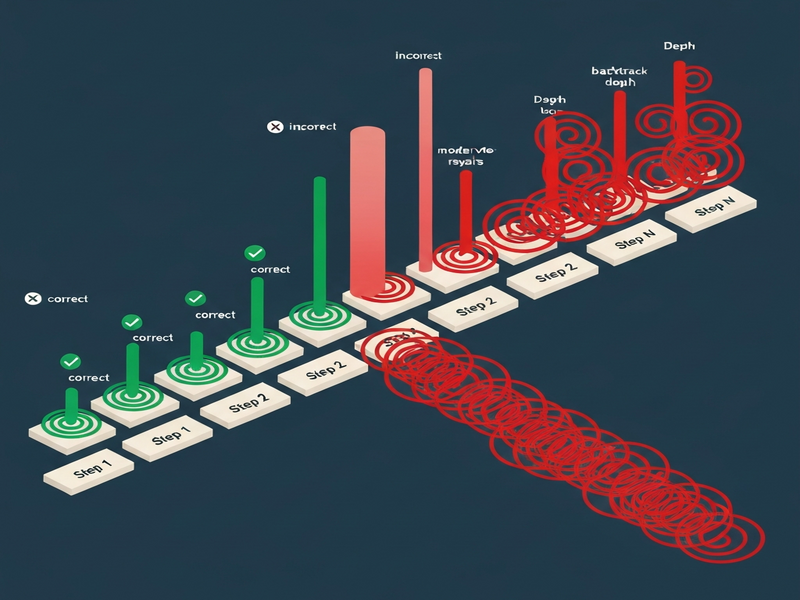
The diagram below visualizes a typical reasoning trace, highlighting early isolated repairs (green) versus late severe bursts (red). It illustrates how the burst‑aware filter intervenes before the trace spirals into instability.
Conclusion
The “Shape of Overthinking” paper shines a light on a previously under‑explored dimension of long‑form reasoning: the temporal and severity patterns of backtracking bursts. By annotating, analyzing, and ultimately leveraging these patterns, the authors deliver a practical early‑exit strategy that improves both efficiency and reliability of reasoning models. For AI practitioners, the work offers a concrete diagnostic tool and a roadmap toward agents that can self‑monitor their own thought processes—an essential step as we move from static answer generation to truly autonomous, trustworthy AI systems.
Andrii Bidochko
CTO UBOS
Andrii Bidochko is an AI entrepreneur and researcher focused on AI agents, reinforcement learning, and autonomous systems. He writes about the technologies shaping the future of machine intelligence, from frontier models and agent architectures to real-world AI applications.