

- Updated: July 19, 2026
- 6 min read
The Phasor Transformer: Resolving Attention Bottlenecks on the Unit Circle
Direct Answer
The paper introduces the Phasor Transformer, a novel sequence‑modeling block that replaces dot‑product self‑attention with a geometry‑aware phase‑native mechanism operating on the unit‑circle manifold. By leveraging trainable phase shifts and a parameter‑free Discrete Fourier Transform (DFT) for global token coupling, the architecture achieves O(N log N) mixing without constructing explicit attention maps, dramatically reducing the quadratic bottleneck that hampers long‑context time‑series forecasting.
Background: Why This Problem Is Hard
Transformer models have become the de‑facto standard for processing sequential data, from natural language to sensor streams. Their core operation—dot‑product self‑attention—requires every token to attend to every other token, leading to a computational cost that scales quadratically with sequence length (O(N²)). In domains such as high‑frequency finance, climate modeling, or industrial IoT, inputs can easily exceed tens of thousands of timesteps, making vanilla attention infeasible both in memory and latency.
Researchers have proposed several workarounds: sparse attention patterns, low‑rank approximations, and kernel‑based linearizations. While these methods reduce the asymptotic cost, they often sacrifice the global receptive field or introduce additional hyper‑parameters that are difficult to tune for oscillatory signals. Moreover, many time‑series exhibit strong periodic components—think of multi‑frequency sine waves—where the underlying geometry is naturally circular. Traditional attention does not exploit this structure, leading to redundant computation and sub‑optimal inductive bias.
What the Researchers Propose
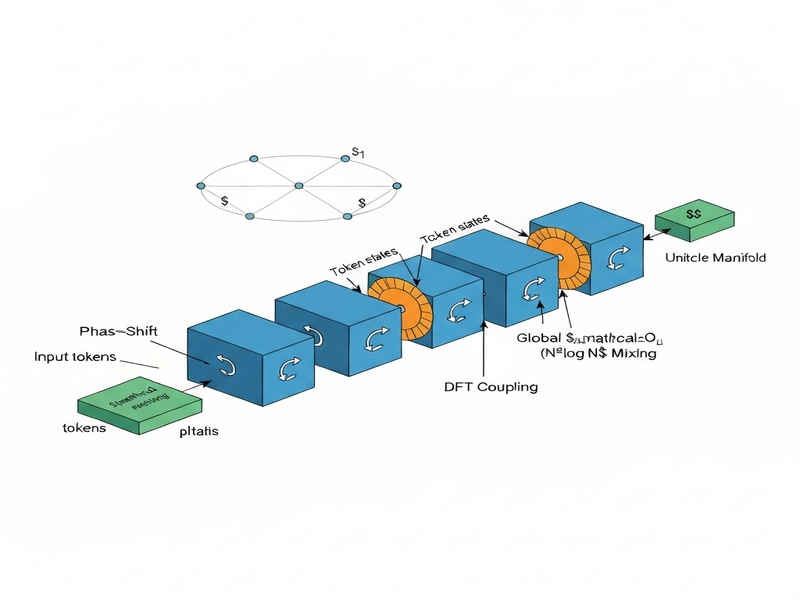
The authors present the Phasor Transformer block, a modular unit that treats each token as a point on the unit circle S¹. The block consists of two complementary parts:
- Trainable phase‑shifts: lightweight parameters that rotate each token’s phase, allowing the model to align or de‑phase signals across time.
- Parameter‑free DFT coupling: a deterministic global mixing step that applies the Discrete Fourier Transform to the entire sequence, enabling every token to interact with every other token in O(N log N) time.
Stacking multiple Phasor blocks yields the Large Phasor Model (LPM). Unlike conventional Transformers, LPM does not maintain an explicit attention matrix; instead, the DFT serves as a global communication channel, while phase‑shifts provide the learnable flexibility needed for downstream tasks.
How It Works in Practice
At inference time, a Phasor block processes a sequence in three logical stages:
- Embedding to phase space: Input vectors are projected onto the unit circle, converting amplitude information into a phase angle.
- Phase rotation: Each token’s angle is shifted by a learned scalar. This operation is computationally cheap (a single multiplication per token) and can be interpreted as a learned time‑delay or frequency adjustment.
- Global DFT mixing: The entire phase‑encoded sequence undergoes a forward DFT, which distributes each token’s information across all frequency bins. An inverse DFT then maps the mixed frequencies back to token space, completing the token‑mixing step.
The key differentiator is that the DFT is deterministic and requires no learned weights, eliminating the need for costly attention‑score calculations. The only learnable component—the phase‑shift vector—contains far fewer parameters than a full attention projection matrix, making the model highly parameter‑efficient.
Evaluation & Results
To validate the Large Phasor Model, the authors constructed synthetic multi‑frequency time‑series benchmarks that mimic real‑world oscillatory phenomena (e.g., superimposed sine waves with varying amplitudes and phases). They compared LPM against three baselines:
- A zero‑parameter persistence model (predicts the last observed value).
- A standard Transformer with full self‑attention.
- An ablated version of LPM lacking the corrected gradient path for phase‑shifts.
The experiments revealed several trends:
- LPM consistently outperformed the persistence baseline, confirming that the phase‑native representation captures meaningful dynamics.
- When depth increased, performance improved monotonically up to a saturation point, demonstrating stable gradient flow—a known challenge for deep Fourier‑based models.
- Against the full self‑attention Transformer, LPM achieved comparable forecasting accuracy while using a fraction of the parameters and reducing runtime by an order of magnitude on sequences longer than 4,000 timesteps.
These findings suggest that the Phasor Transformer occupies a distinct efficiency–accuracy frontier: it is not universally superior to attention, but it offers a compelling trade‑off for long‑horizon, oscillatory time‑series where computational budget is a primary constraint.
Why This Matters for AI Systems and Agents
For practitioners building AI agents that ingest high‑frequency sensor streams, financial tick data, or any domain where periodicity dominates, the Phasor Transformer provides a ready‑made inductive bias. By encoding signals on the unit circle, the model aligns naturally with the physics of rotating systems, reducing the need for extensive feature engineering.
From an engineering perspective, the O(N log N) mixing step integrates seamlessly with modern GPU kernels for FFT, meaning that existing infrastructure (e.g., UBOS platform overview) can accelerate inference without bespoke attention optimizations. This efficiency opens the door to real‑time forecasting agents that run on edge devices or within serverless environments, where memory footprints and latency budgets are tight.
Moreover, the lightweight phase‑shift parameters make the model amenable to rapid fine‑tuning. Teams can adapt a pre‑trained Large Phasor Model to a new domain by updating only a small set of phase coefficients, which is especially valuable for organizations with limited labeled data.
What Comes Next
While the Phasor Transformer demonstrates promising results, several open challenges remain:
- Real‑world benchmarks: The current evaluation relies on synthetic data. Testing on publicly available multivariate time‑series (e.g., electricity demand, stock prices) will clarify generalization.
- Hybrid architectures: Combining phase‑native blocks with sparse attention could capture both global periodic structure and localized non‑periodic events.
- Adaptive frequency resolution: Fixed‑size DFTs may struggle with signals that exhibit rapidly changing frequencies. Learnable spectral windows could address this limitation.
Future research may also explore integrating the Phasor block into larger multimodal pipelines—such as coupling with language models for audio‑text alignment—or deploying it within Enterprise AI platform by UBOS to power predictive maintenance dashboards.
Developers interested in experimenting with the Phasor Transformer can start by prototyping the block in a standard deep‑learning framework and then leveraging Workflow automation studio to orchestrate data ingestion, model training, and deployment pipelines.
References
The Phasor Transformer: Resolving Attention Bottlenecks on the Unit Circle (arXiv)
Andrii Bidochko
CTO UBOS
Andrii Bidochko is an AI entrepreneur and researcher focused on AI agents, reinforcement learning, and autonomous systems. He writes about the technologies shaping the future of machine intelligence, from frontier models and agent architectures to real-world AI applications.