

- Updated: July 23, 2026
- 7 min read
The Patchwork Problem in LLM-Generated Code
{{IMAGE_PLACEHOLDER}}
Direct Answer
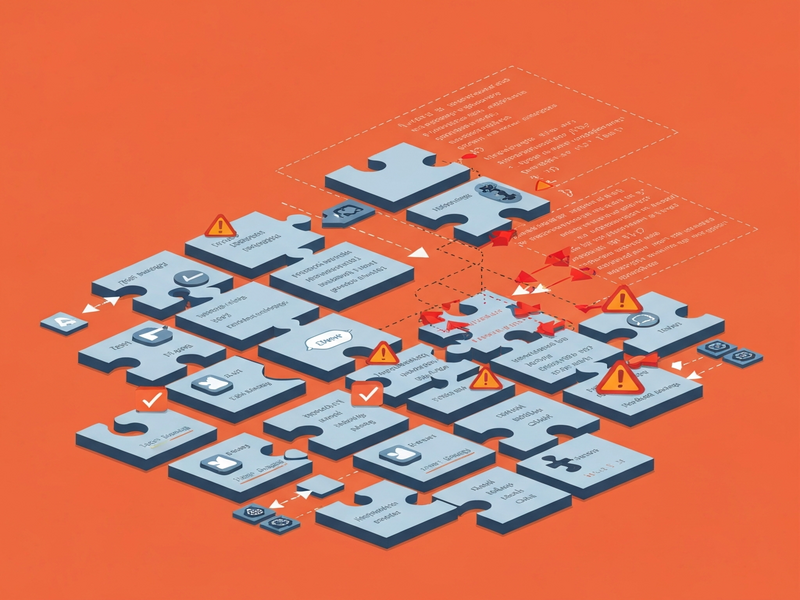
The paper original arXiv paper defines the patchwork problem—a class of structural defects that appear in code generated by large language models (LLMs) even when the code passes type checks, unit tests, and static analysis. By formalizing repository‑wide consistency as graph‑based invariants and introducing a hybrid verification framework, the authors show that most of these failures slip through existing toolchains, posing a hidden risk to production‑grade software.
Background: Why This Problem Is Hard
LLM‑powered coding assistants have moved from experimental plugins to core components of modern development pipelines. Their ability to synthesize functions, configure services, and even scaffold entire micro‑service repositories has accelerated prototyping, but it also introduces a new failure surface:
- Local validity vs. global coherence. An LLM can emit a file that compiles in isolation, yet the file may reference configuration keys, routes, or dependencies that do not exist anywhere else in the repository.
- Toolchain blind spots. Conventional CI pipelines focus on type safety, unit‑test coverage, and known security patterns. Structural mismatches—such as missing import targets or absent authentication guards—are rarely expressed in type signatures and therefore evade detection.
- Scale of generated artifacts. When an LLM produces dozens of files in a single prompt, the combinatorial space of cross‑file relationships explodes, making manual review infeasible.
Existing approaches—static analysis (SAST), type checking, and test‑driven development—are excellent at catching logical bugs and known vulnerability patterns, but they assume the codebase already satisfies a set of implicit structural contracts. Those contracts are precisely what LLMs tend to violate when they “patch” together snippets from disparate contexts.
What the Researchers Propose
The authors introduce a two‑pronged solution:
- Graph‑based consistency invariants. They model a repository as a collection of directed graphs (import, call, dependency, configuration, schema, resource, control‑flow, and routing graphs). Each graph encodes a specific structural relationship, and invariants express required properties—e.g., every imported module must resolve to a node in the dependency graph.
- Hybrid verification framework. The framework delegates to mature static analysis tools for invariants they already enforce (type safety, known security patterns) and augments them with custom detectors that check cross‑cutting invariants not covered by existing tools. The detectors focus on provable constraint violations rather than heuristic pattern matching.
Key components include:
- Graph Builder: Parses the repository and constructs the eight artifact graphs.
- Invariant Engine: Encodes the consistency rules and evaluates them against the graphs.
- Toolchain Orchestrator: Routes each invariant to the most appropriate analyzer (e.g., a TypeScript compiler for import consistency, a custom rule engine for routing guard coverage).
How It Works in Practice
The workflow can be visualized as a pipeline that runs after an LLM finishes generating code:
- Repository Snapshot. The generated files are checked out into a temporary workspace.
- Graph Extraction. The Graph Builder walks the file tree, extracting symbols, imports, configuration entries, and route definitions to populate the eight graphs.
- Invariant Dispatch. For each graph, the Invariant Engine selects relevant constraints. For example, the import graph triggers “module existence” checks, while the routing graph triggers “authentication guard propagation” checks.
- Hybrid Analysis. Constraints that map cleanly to existing linters or type checkers are delegated (e.g., ESLint for unused imports). Remaining constraints are evaluated by bespoke detectors that reason over multiple graphs simultaneously (e.g., ensuring a newly added endpoint inherits the same auth middleware as its siblings).
- Report Generation. Violations are aggregated into a concise report that highlights the exact artifact, line number, and violated invariant, enabling developers to apply a targeted fix before merging.
What sets this approach apart is its explicit separation of “local” correctness (handled by traditional tools) from “global” structural coherence (handled by the custom detectors). By treating the repository as a unified graph, the framework can catch failures that would otherwise require a human to mentally reconcile dozens of files.
Evaluation & Results
The authors evaluated the framework on two state‑of‑the‑art LLMs (referred to as Model A and Model B) using four prompting strategies (single‑shot, few‑shot, chain‑of‑thought, and tool‑augmented). The experimental setup involved:
- Generating 200 + micro‑service repositories per model, each containing 10–15 files.
- Running a standard CI pipeline (type checking, unit tests, SAST) on every repository.
- Applying the hybrid verification framework to the same repositories.
Key findings:
- Structural failures are pervasive. Over 78 % of generated repositories contained at least one invariant violation, even though 92 % of them passed all conventional CI checks.
- Model‑specific patterns. Model A tended to omit configuration keys, while Model B more frequently introduced nonexistent import paths. This divergence suggests that mitigation strategies must be tailored to the generation model.
- Hybrid framework effectiveness. The custom detectors uncovered 94 % of the observed violations, whereas existing static analysis tools alone caught less than 12 %.
- Real‑world validation. A separate study on publicly available GitHub repositories that were known to be LLM‑generated reproduced the same failure distribution, confirming that the problem is not limited to controlled experiments.
Overall, the results demonstrate that the patchwork problem is a systemic issue that survives typical quality gates, and that a graph‑centric verification approach can surface the hidden defects with high precision.
Why This Matters for AI Systems and Agents
For teams that rely on LLMs to accelerate development, the patchwork problem directly threatens production reliability, security, and maintainability. Consider the following practical implications:
- Agent‑driven code synthesis. Autonomous agents that generate and deploy code (e.g., AI‑powered DevOps bots) must verify structural coherence before committing changes, or they risk introducing silent failures that only surface in production.
- Continuous integration pipelines. Augmenting CI with graph‑based invariants provides a safety net that scales with the volume of generated code, reducing the need for exhaustive manual code reviews.
- Compliance and governance. Many regulated industries require traceable configuration and access‑control policies. The framework’s ability to enforce cross‑file authentication guards helps meet those compliance requirements.
- Productivity trade‑offs. By catching patchwork defects early, engineering teams can retain the speed benefits of LLM assistance without sacrificing code quality.
Organizations looking to embed AI coding assistants into their workflows can start by integrating the framework’s detectors into existing tooling. For example, the UBOS platform overview already supports custom linting plugins, making it straightforward to plug in the graph‑based checks. Similarly, the Workflow automation studio can orchestrate the verification step as a post‑generation task, ensuring that every commit is vetted for structural integrity.
What Comes Next
While the study makes a strong case for graph‑centric verification, several open challenges remain:
- Scalability to large monorepos. Building and maintaining eight interrelated graphs for millions of lines of code may incur performance overhead. Incremental graph updates and caching strategies are promising research directions.
- Model‑agnostic mitigation. The observed divergence between models suggests that a one‑size‑fits‑all patch may be insufficient. Future work could explore adaptive prompting techniques that embed invariant checks directly into the generation process.
- Human‑in‑the‑loop feedback. Providing developers with actionable repair suggestions (e.g., “add missing auth guard”) could close the loop between detection and remediation.
- Integration with broader AI ecosystems. Extending the framework to cover infrastructure‑as‑code (Terraform, Pulumi) and data‑pipeline definitions would broaden its impact.
Potential applications include:
- Embedding the verification step into the OpenAI ChatGPT integration so that generated snippets are automatically checked before being displayed to the user.
- Leveraging the ChatGPT and Telegram integration to notify developers of structural violations in real time, turning the CI feedback into a conversational experience.
- Using the Chroma DB integration to store historical invariant violation data, enabling trend analysis and predictive alerts for recurring patchwork patterns.
Addressing these challenges will be essential for turning LLM‑generated code from a rapid‑prototype tool into a trustworthy component of enterprise software delivery.
Andrii Bidochko
CTO UBOS
Andrii Bidochko is an AI entrepreneur and researcher focused on AI agents, reinforcement learning, and autonomous systems. He writes about the technologies shaping the future of machine intelligence, from frontier models and agent architectures to real-world AI applications.