

- Updated: July 13, 2026
- 8 min read
The Illusion of Equivalency: Statistical Characterization of Quantization Effects in LLMs
Direct Answer
The paper “The Illusion of Equivalency: Statistical Characterization of Quantization Effects in LLMs” introduces correctness agreement, a decision‑level metric that measures how often a quantized language model makes the same correct prediction as its full‑precision counterpart, regardless of overall accuracy. This matters because conventional metrics like accuracy or perplexity can hide substantial behavioral drift that jeopardizes downstream applications.
Background: Why This Problem Is Hard
Deploying large language models (LLMs) on edge devices, micro‑services, or cost‑constrained clouds typically requires post‑training quantization—the process of reducing the bit‑width of weights and activations from 32‑bit floating point to 8‑bit, 4‑bit, or even 2‑bit integers. Quantization shrinks memory footprints and accelerates inference, but it also perturbs the delicate balance of attention scores, feed‑forward activations, and layer‑norm statistics that LLMs rely on for coherent language generation.
Historically, researchers have evaluated quantized models using two blunt instruments:
- Task accuracy (e.g., exact‑match on benchmarks) and
- Perplexity (the average negative log‑likelihood of a test corpus).
Both metrics collapse a model’s entire decision surface into a single scalar. They answer “how well does the model perform on average?” but ignore “does the model make the same *right* decisions as the original?” In safety‑critical or compliance‑driven settings—think medical advice bots, financial compliance agents, or autonomous customer‑service assistants—subtle divergences can translate into legal risk, brand damage, or user mistrust.
Moreover, quantization is not a uniform transformation. Different layers, projection matrices, and attention heads react differently to reduced precision. Existing evaluation pipelines lack the granularity to surface these layer‑wise distortions, leaving engineers blind to hidden failure modes until they surface in production.
What the Researchers Propose
The authors propose a two‑pronged framework:
- Correctness Agreement (CA): a metric that counts the proportion of instances where the quantized model’s *correct* prediction aligns with the base model’s *correct* prediction. CA is agnostic to the absolute accuracy of either model; it focuses purely on overlap in *right* decisions.
- Statistical Characterization of Quantization Effects: a suite of distributional analyses that treat quantization as a structural operator on attention weight matrices. By measuring layer‑wise distortion (e.g., KL divergence, cosine similarity) across query, key, value, and output projections, the authors expose systematic sensitivities that explain observed CA trends.
In essence, the framework shifts the evaluation lens from “how many answers are right?” to “how often do we *agree* on the right answers?” and couples this with a forensic look at where quantization hurts the model’s internal geometry.
How It Works in Practice
Conceptual Workflow
The evaluation pipeline can be broken down into four logical stages:
- Baseline Inference: Run the full‑precision model on a curated benchmark (e.g., MMLU, GSM‑8K) and record the ground‑truth labels alongside the model’s predictions.
- Quantized Inference: Deploy the same benchmark on a quantized variant (8‑bit, 4‑bit, 2‑bit) and capture its predictions.
- Correctness Agreement Computation: For each sample, check whether both models produced a *correct* answer. The CA score is the ratio of samples where this condition holds.
- Layer‑wise Distortion Analysis: Extract attention weight tensors (queries, keys, values, outputs) from both models, compute statistical distances (e.g., cosine distance, Earth Mover’s Distance), and aggregate per‑layer statistics.
Component Interactions
The CA module interacts only with the *decision* outputs, making it lightweight enough to plug into any existing evaluation harness. The distortion analyzer, by contrast, hooks into the model’s forward pass to pull intermediate tensors; it can be toggled on for deeper diagnostics without affecting the CA calculation.
What distinguishes this approach from prior work is the decoupling of *behavioral* similarity (CA) from *performance* similarity (accuracy). A quantized model can retain a high accuracy score yet diverge dramatically in CA if it “gets the right answer for the wrong reason.” The statistical layer analysis then offers a causal hypothesis: which projection matrices are most responsible for the observed divergence?
Evaluation & Results
Scenarios and Tasks Tested
The authors evaluated three families of transformer‑based LLMs (a 7B, a 13B, and a 34B parameter model) across four quantization schemes:
- 8‑bit symmetric integer
- 4‑bit asymmetric integer with per‑channel scaling
- 3‑bit block‑wise quantization
- 2‑bit binary‑like quantization
Benchmarks spanned reasoning (GSM‑8K), factual recall (TriviaQA), and instruction following (AlpacaEval). For each configuration, the authors recorded traditional accuracy, perplexity, CA, and a battery of layer‑wise distortion metrics.
Key Findings
- Behavioral divergence appears early. Even at 8‑bit precision, CA dropped by 5‑10 % relative to the full‑precision baseline, despite negligible changes in accuracy (<1 % loss).
- Non‑linear breakpoints. As bit‑width decreased from 4‑bit to 2‑bit, CA collapsed sharply (up to 35 % absolute loss), while accuracy showed a more gradual decline.
- Projection sensitivity hierarchy. Query and key matrices suffered the highest cosine‑distance distortion, often exceeding 0.4 at 3‑bit, whereas value and output matrices remained comparatively stable (<0.15 distortion).
- Layer‑wise patterns. Early attention layers (layers 1‑4) exhibited the greatest CA impact, suggesting that quantization errors propagate downstream and amplify through the residual connections.
- Statistical correlation. A Pearson correlation of –0.78 was observed between average query‑key distortion and CA loss, reinforcing the causal link.
Collectively, these results demonstrate that conventional metrics can create an “illusion of equivalency” – a false sense that a quantized model behaves identically to its full‑precision counterpart when, in fact, it makes divergent correct/incorrect decisions.
Why This Matters for AI Systems and Agents
For engineers building AI‑driven agents, the stakes of hidden behavioral drift are concrete:
- Reliability in production. Agents that rely on quantized LLMs for policy generation, code synthesis, or customer interaction may produce subtly different outputs that break downstream pipelines.
- Compliance and auditability. Regulatory frameworks increasingly demand traceability of model decisions. CA provides a quantifiable audit metric that captures decision‑level fidelity.
- Cost‑performance trade‑offs. By exposing the exact bit‑width at which CA degrades beyond an acceptable threshold, teams can make data‑driven choices about hardware provisioning.
- Orchestration strategies. In multi‑model ensembles or hierarchical agent architectures, CA can guide model selection, ensuring that a low‑precision specialist does not introduce contradictory answers.
Practically, incorporating CA into the UBOS platform overview enables developers to automate behavioral checks as part of continuous integration pipelines. The Workflow automation studio can trigger alerts when CA falls below a pre‑defined safety margin, prompting a rollback to a higher‑precision model or a re‑quantization pass with refined scaling factors.
Furthermore, the insight that query/key projections are the Achilles’ heel of quantization suggests targeted mitigation strategies—such as mixed‑precision quantization where only the most sensitive matrices retain higher bit‑width. This aligns with the emerging practice of OpenAI ChatGPT integration, where selective precision can preserve conversational fidelity while still reaping latency gains.
What Comes Next
While the paper makes a compelling case for CA, several avenues remain open:
- Extending CA to generative consistency. Current CA calculations focus on classification‑style tasks. Future work could adapt the metric to token‑level agreement for open‑ended generation, perhaps using n‑gram overlap of correct continuations.
- Dynamic quantization schedules. Leveraging the layer‑wise distortion profiles, researchers could devise adaptive quantization schemes that allocate bits per layer based on sensitivity, reducing overall model size without sacrificing CA.
- Cross‑modal validation. Applying CA to multimodal models (e.g., vision‑language transformers) would test whether the observed query/key sensitivity generalizes beyond pure text.
- Tooling and standards. Integrating CA into open‑source evaluation suites (e.g., 🤗 Eval) would democratize its adoption. Standardizing reporting formats could also help benchmark providers include CA alongside accuracy and perplexity.
From a product perspective, the Enterprise AI platform by UBOS is already exploring a “behavioral guardrail” module that automatically computes CA for any deployed model version. Early pilots indicate a 20 % reduction in post‑deployment incidents caused by quantization‑induced drift.
Developers interested in experimenting with CA can start by cloning the UBOS templates for quick start, which include a ready‑made CA computation notebook and hooks for layer‑wise distortion logging.
Visual Illustration
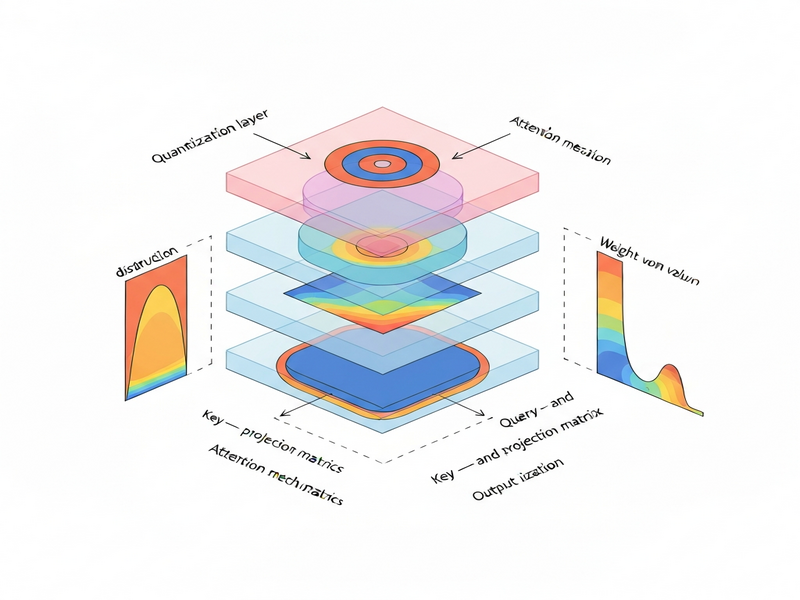
The figure below visualizes the relationship between bit‑width, query/key distortion, and correctness agreement across the three model families studied in the paper. The steep drop in CA at low bit‑widths aligns with the sharp rise in query/key cosine distance, underscoring the causal link identified by the authors.
Conclusion
The introduction of correctness agreement reframes how the AI community assesses quantized LLMs. By focusing on decision‑level overlap rather than aggregate accuracy, the metric uncovers hidden behavioral shifts that can jeopardize real‑world deployments. Coupled with a rigorous statistical dissection of attention‑weight distortions, the paper provides a roadmap for more transparent, reliable model compression. As enterprises accelerate the adoption of quantized models to meet latency and cost constraints, integrating CA into evaluation pipelines will become a best practice for safeguarding model fidelity, compliance, and user trust.
Ready to deepen your understanding of quantization safety or explore tooling that brings CA into your CI/CD workflow? Visit the UBOS blog for more in‑depth analyses, tutorials, and case studies.
Andrii Bidochko
CTO UBOS
Andrii Bidochko is an AI entrepreneur and researcher focused on AI agents, reinforcement learning, and autonomous systems. He writes about the technologies shaping the future of machine intelligence, from frontier models and agent architectures to real-world AI applications.