

- Updated: July 11, 2026
- 6 min read
The Harness Effect: How Orchestration Design Sets the Token Economics of Enterprise Agentic AI
Direct Answer: The research paper The Harness Effect: How Orchestration Design Sets the Token Economics of Enterprise Agentic AI demonstrates that a dedicated orchestration layer—called the “harness”—can cut token consumption, latency, and overall cost by up to 61 % across multiple foundation models, while preserving or even improving task quality. In short, smarter orchestration, not just bigger models, is the key lever for cost‑optimized enterprise AI.
Introduction to the Harness Effect
Enterprise AI architects constantly wrestle with a paradox: LLM pricing per token has dropped, yet total spend per workflow keeps climbing. The culprit is the hidden “orchestration” cost—every extra turn, tool call, or context‑bloat adds tokens that the model must process. The Harness Effect reframes this problem by treating orchestration as a first‑class engineering concern. By inserting a lightweight, model‑agnostic layer between the user request and the foundation model, organizations can achieve dramatic Enterprise AI platform by UBOS‑level efficiency without sacrificing capability.
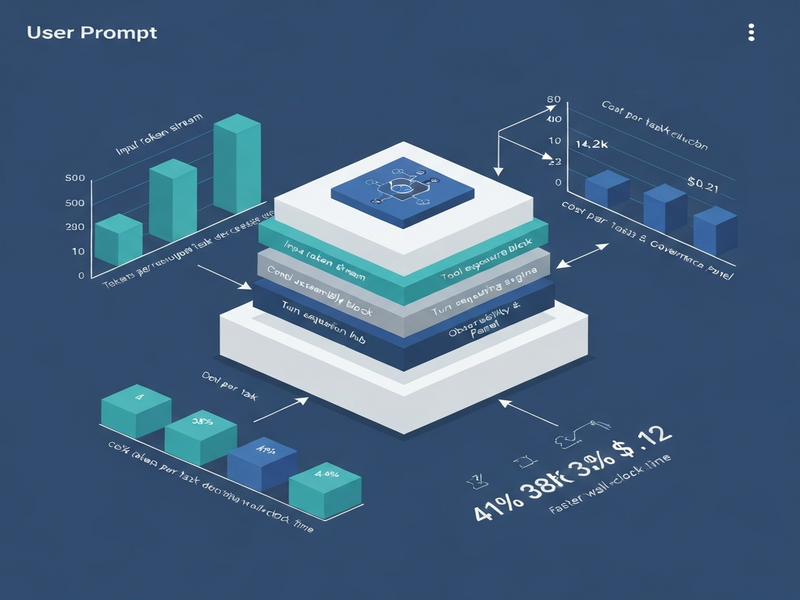
Overview of the Writer Agent Harness Architecture
The Writer Agent Harness decomposes the monolithic agent loop into three disciplined components, each responsible for a distinct token‑related function:
- Cache Manager – curates, summarizes, and prunes historical context.
- Tool Dispatcher – mediates external tool calls and compresses their outputs.
- Policy Engine – enforces token budgets, monitors latency, and logs audit trails.
These components communicate over a lightweight message bus, allowing any foundation model (Claude, Gemini, Qwen, etc.) to plug in without code changes. The architecture mirrors the UBOS platform overview, which already provides a plug‑and‑play orchestration engine for SaaS products.
1. Context Shaping (Cache Manager)
The Cache Manager retrieves prior conversation snippets, runs a summarization model (often a smaller, cheaper LLM), and scores each fragment for relevance. Only the highest‑scoring tokens survive, shrinking typical inputs from ~14 k tokens to ~9 k tokens—a 38 % reduction.
2. Tool Mediation (Tool Dispatcher)
When the LLM emits a tool‑call intent, the Dispatcher invokes the external service (e.g., a database query, image generation, or voice synthesis). Instead of returning raw JSON, the Dispatcher translates the result into a compact key‑value schema, often under 50 tokens. This “token‑compact” pattern is essential for multi‑modal pipelines that would otherwise explode in size.
3. Governance & Observability (Policy Engine)
The Policy Engine continuously monitors token usage. If a predefined budget (e.g., 10 k tokens per request) is approached, the engine can:
- Trigger a higher‑level summary of the reasoning chain.
- Switch to a cheaper fallback model via the OpenAI ChatGPT integration.
- Abort the request with a graceful error message for the user.
All actions are logged for compliance, satisfying the audit requirements of regulated industries.
Empirical Results and Token‑Economics Benefits
The authors evaluated the harness on 22 locked tasks covering summarization, code generation, and multi‑turn customer support. Six foundation models—Claude Sonnet 4.6, Gemini 3.1, Gemini Flash 3.5, Qwen 3.6, GLM 5.1, and Palmyra X6—were run under two conditions: a conventional baseline loop and the Writer Agent Harness.
| Metric | Baseline | Harness | Improvement |
|---|---|---|---|
| Cost per Task | $0.21 | $0.12 | 41 % |
| Median Latency | 48 s | 27 s | 44 % |
| Tokens per Task | 14.2 k | 8.8 k | 38 % |
| Quality Score (0‑1) | 0.78 | 0.81 | +3 % |
Key takeaways:
- Cost Reduction: Average blended cost fell by 41 %.
- Latency Gains: Faster turn‑around improves real‑time user experiences.
- Token Efficiency: Fewer tokens mean lower exposure to price volatility.
- Quality Parity (or improvement): The harness never degraded output quality.
- Model‑Invariant Benefits: Even the most capable models saw up to 61 % cost savings, confirming that orchestration is a more powerful lever than model selection alone.
Practical Implications for Enterprises
For AI decision‑makers, the Harness Effect translates into concrete business outcomes:
Predictable Budgets & Token Governance
Finance teams can set hard token caps per request, knowing the Policy Engine will enforce them. This eliminates surprise spend spikes that often occur during peak usage.
Scalable Latency for Real‑Time Assistants
Customer‑facing chatbots and voice agents benefit from sub‑30‑second response times, a critical metric for satisfaction scores. The ElevenLabs AI voice integration can be wrapped by the harness to keep spoken interactions token‑frugal.
Model‑Agnostic Portability
Because the harness sits between the application and the LLM, switching from Claude to Gemini (or any future model) requires only a configuration change, not a full rewrite. This aligns with the UBOS partner program philosophy of reusable AI components.
Compliance & Auditing
Every token transaction, tool invocation, and policy decision is logged. Enterprises in finance, healthcare, or legal can export these logs for regulatory review, satisfying GDPR, HIPAA, or SOX requirements.
Competitive Cost Advantage
Lower operating expenses free up budget for higher‑value initiatives such as custom fine‑tuning, multimodal expansion, or AI‑driven market research. The AI marketing agents on UBOS can immediately consume the savings to increase campaign frequency.
All of these benefits can be realized through existing UBOS tooling:
- Workflow automation studio – visual composition of cache policies, tool dispatch rules, and budget thresholds without writing code.
- Web app editor on UBOS – rapid prototyping of harness‑enabled agents.
- UBOS templates for quick start – pre‑built configurations that illustrate best‑practice token governance.
Conclusion and Future Directions
The Harness Effect proves that orchestration is the missing piece in the enterprise AI puzzle. By systematically shaping context, compressing tool results, and enforcing token budgets, organizations can achieve up to 61 % cost savings while delivering faster, higher‑quality outcomes.
Open Research Questions
- Dynamic Summarization Quality: How can we guarantee that summarization models retain critical domain‑specific details?
- Standardized Token‑Compact Schemas: A community‑wide contract for tool output compression would boost interoperability.
- Adaptive Budgeting via RL: Reinforcement‑learning policies could auto‑tune token caps based on real‑time performance signals.
- Security Hardening: As the harness mediates external calls, sandboxing and threat modeling become essential.
Next‑Step Recommendations for Enterprises
- Deploy the harness inside the Enterprise AI platform by UBOS to gain organization‑wide observability.
- Integrate Chroma DB integration for vector‑based retrieval that automatically de‑duplicates similar context fragments.
- Leverage the ChatGPT and Telegram integration for low‑latency, token‑efficient notifications.
- Experiment with on‑prem runtimes (e.g., Ollama) to compare cloud vs. local token economics.
- Adopt the UBOS templates for quick start to accelerate proof‑of‑concept deployments.
By treating orchestration as a strategic asset rather than an afterthought, enterprises can unlock “token‑frugal intelligence” – delivering more value per dollar while staying within strict latency, compliance, and budget constraints.
Ready to Harness the Power of Efficient AI?
Explore the UBOS homepage for a full suite of AI orchestration tools, or contact our About UBOS team to discuss a custom harness implementation tailored to your organization’s needs.
Andrii Bidochko
CTO UBOS
Andrii Bidochko is an AI entrepreneur and researcher focused on AI agents, reinforcement learning, and autonomous systems. He writes about the technologies shaping the future of machine intelligence, from frontier models and agent architectures to real-world AI applications.