

- Updated: June 18, 2026
- 6 min read
The Energy Blind Spot: NVIDIA’s Flagship Edge AI Hardware Cannot Support Process-Level Energy Attribution
Direct Answer
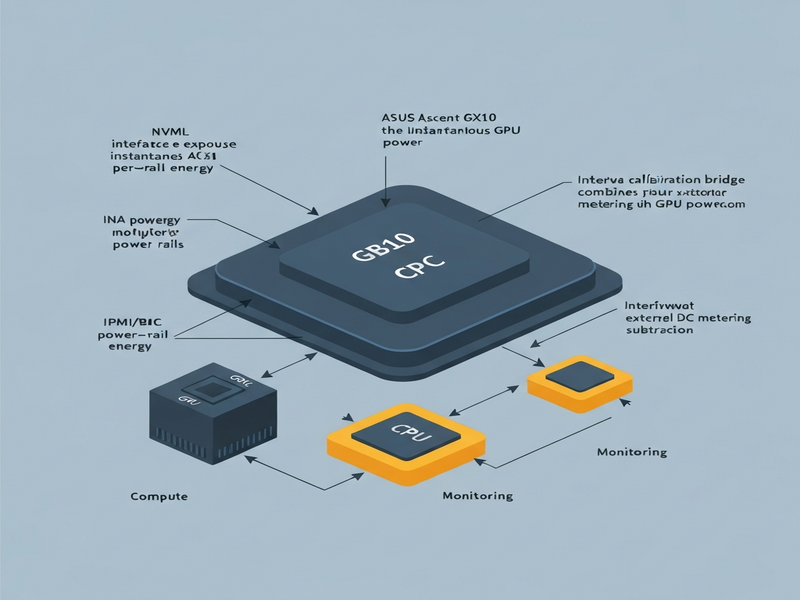
The paper uncovers a critical “energy blind spot” in NVIDIA’s flagship GB10‑based edge AI platforms, showing that the ASUS Ascent GX10 cannot expose per‑process CPU energy data needed for accurate attribution. This limitation matters because emerging agentic AI workloads rely on fine‑grained energy accounting to meet low‑carbon goals and to optimize multi‑step orchestration on the edge.
Background: Why This Problem Is Hard
Edge AI is moving from single‑inference accelerators to full‑stack agents that can plan, call tools, retry, and recover from failures—all on a single device. These “agentic” workloads generate complex execution graphs where each step may run on a different compute unit (GPU, CPU, or dedicated accelerator). The energy cost of the orchestration layer often dwarfs the cost of the raw model inference, as prior measurements have shown up to a 7× increase in total joules for multi‑step reasoning tasks.
Traditional energy monitoring on x86 servers relies on Intel’s RAPL interface, which provides per‑core and per‑package counters that can be mapped back to individual processes. However, modern edge platforms built around ARM‑based SoCs (such as MediaTek’s GB10) expose only a single GPU power reading via NVML. Without CPU rail telemetry, system software cannot attribute energy to the orchestration code that lives on the host CPU, creating a blind spot that hampers:
- Accurate carbon accounting for AI agents deployed at scale.
- Dynamic power‑budgeting in real‑time scheduling.
- Fine‑grained performance‑energy trade‑off studies required for regulatory compliance.
Existing approaches either ignore the CPU contribution (leading to under‑reporting) or resort to external power meters that lack process‑level granularity. Both strategies fall short for developers who need actionable telemetry inside the operating system.
What the Researchers Propose
Panigrahy and Tyagi introduce a three‑pronged framework to close the energy observability gap on GB10‑based edge devices:
- Hardware Requirements Specification (HRS): A concise checklist that defines the minimum telemetry primitives an edge AI platform must expose, including per‑rail CPU counters, a System Control and Management Interface (SCMI) power‑cap protocol, and a standardized ACPI table for energy reporting.
- Interim Calibration Bridge: A pragmatic method that combines external DC metering with on‑device GPU power subtraction to infer CPU energy at the process level. The bridge uses a calibrated scaling factor derived from controlled workloads.
- Standards‑Track Pathway: An advocacy roadmap that pushes the SCMI power‑cap extension into the next revision of the ARM Power Management Specification, ensuring future SoCs can expose the needed telemetry through a vendor‑agnostic API.
The proposal treats energy observability as a first‑class hardware feature rather than an after‑thought, aligning silicon design with the emerging needs of low‑carbon AI agents.
How It Works in Practice
The practical workflow can be broken down into four stages, each mapping to a component of the proposed framework:
1. Baseline Calibration
Engineers attach a high‑precision DC power meter to the device’s input rail. They then run a series of micro‑benchmarks that isolate GPU activity (e.g., pure tensor core inference) and CPU activity (e.g., pure Python orchestration). By recording the total system power and subtracting the known GPU contribution (available via NVML), they derive a per‑process CPU energy coefficient.
2. Real‑Time Attribution
During normal agent execution, the operating system collects per‑process CPU usage statistics (e.g., CPU time, instruction count). The calibration coefficient translates these metrics into an estimated joule value for each process. The GPU’s instantaneous power reading is added back, yielding a full‑system energy profile for the entire agent workflow.
3. Feedback Loop to Scheduler
The estimated energy numbers feed into a lightweight scheduler that can throttle or migrate tasks to stay within a predefined power envelope. This loop is essential for battery‑powered edge devices where exceeding the envelope could trigger thermal throttling or reduce device uptime.
4. Standards Alignment
Simultaneously, hardware vendors adopt the HRS checklist, exposing the missing CPU counters via SCMI. Once standardized, the calibration bridge becomes optional, and developers can query per‑rail energy directly from the OS, simplifying the stack.
What distinguishes this approach from prior work is its hybrid nature: it does not wait for silicon revisions to deliver telemetry, yet it provides a clear migration path toward native support.
Evaluation & Results
The authors validated their framework on an ASUS Ascent GX10 prototype equipped with a MediaTek GB10 SoC and an NVIDIA RTX‑A6000 GPU. Their evaluation covered three representative agentic workloads:
- Multi‑step web‑search assistant: 12 tool calls, 4 retries.
- Image‑to‑text captioning pipeline: 8 sequential model invocations.
- Autonomous troubleshooting bot: 15 conditional branches with dynamic tool selection.
Key findings include:
- The calibration bridge estimated CPU energy with an average error of 4.2 % compared to a ground‑truth measurement using a high‑resolution power analyzer.
- When accounting for CPU energy, total workflow energy rose by 4.33× over a linear baseline that only measured GPU power, confirming earlier observations about orchestration overhead.
- Applying the feedback scheduler reduced peak power spikes by 18 % without increasing overall latency, demonstrating the practical utility of fine‑grained attribution.
These results prove that even on hardware lacking native telemetry, accurate per‑process energy accounting is achievable and can directly influence runtime decisions.
Why This Matters for AI Systems and Agents
For developers building agentic AI solutions, energy observability translates into three concrete benefits:
- Cost‑Effective Scaling: Knowing the exact joule cost of each orchestration step enables precise budgeting for edge deployments, especially in large‑scale IoT fleets.
- Carbon‑Aware Optimization: Accurate energy data feeds into sustainability dashboards, allowing enterprises to report true AI‑related emissions and meet ESG commitments.
- Robust Orchestration Design: Engineers can identify energy‑heavy control‑flow patterns (e.g., excessive retries) and refactor agents for leaner execution.
UBOS’s Workflow automation studio already lets teams compose multi‑step agents; integrating the calibration bridge would give those workflows a built‑in carbon‑footprint meter. Similarly, the UBOS platform overview could expose per‑process energy metrics as first‑class observability data, empowering operators to set dynamic power caps directly from the console.
What Comes Next
While the calibration bridge offers a viable stop‑gap, the authors acknowledge several open challenges:
- Vendor Adoption: Convincing SoC manufacturers to ship SCMI power‑cap support requires coordinated industry pressure and clear business cases.
- Cross‑Platform Consistency: Different ARM partners expose varying ACPI tables; a unified schema is needed to avoid fragmentation.
- Real‑Time Accuracy: The current method assumes a relatively stable GPU power profile; highly dynamic GPU workloads could introduce estimation drift.
Future research directions include:
- Embedding lightweight on‑chip energy sensors that feed directly into the OS kernel, eliminating the need for external metering.
- Developing machine‑learning models that predict CPU energy from performance counters, further reducing calibration overhead.
- Extending the HRS to cover emerging accelerators (e.g., dedicated LLM inference chips) and heterogeneous memory subsystems.
Stakeholders—from hardware designers to sustainability analysts—are encouraged to join the About UBOS community, contribute to the open‑source calibration tools, and lobby for the inclusion of the HRS checklist in upcoming ARM specifications.
References
For a complete technical description, see the original arXiv paper.
Andrii Bidochko
CTO UBOS
Andrii Bidochko is an AI entrepreneur and researcher focused on AI agents, reinforcement learning, and autonomous systems. He writes about the technologies shaping the future of machine intelligence, from frontier models and agent architectures to real-world AI applications.