

- Updated: August 4, 2026
- 7 min read
The Art of Not Forgetting: A Local Learning Architecture for Continual Learning
Direct Answer
The paper introduces Cognitive Memory Primitive (CMP), a continual‑learning architecture that stores inputs as sparse relational codes in a two‑tier competitive memory and updates its knowledge using purely local learning rules—eliminating the need for end‑to‑end back‑propagation through the feature extractor. By combining sparse representations, persistent memory, and local updates, CMP dramatically reduces catastrophic forgetting compared with a Transformer baseline that relies on Elastic Weight Consolidation (EWC).
Background: Why This Problem Is Hard
Continual learning (CL) aims to enable a single model to acquire new skills over time without erasing previously learned knowledge. In real‑world deployments—autonomous robots, personalized assistants, or fraud‑detection pipelines—data arrives in streams, and retraining from scratch is infeasible due to latency, compute cost, and privacy constraints.
Two intertwined challenges dominate the field:
- Catastrophic forgetting: Gradient‑based updates shift shared parameters, causing performance on earlier tasks to collapse.
- Scalability of memory mechanisms: Replay‑based methods store raw examples or embeddings, but memory footprints grow linearly with tasks, and retrieval becomes a bottleneck.
Existing solutions—regularization (EWC, SI), replay buffers, and dynamic architectures—still rely on global back‑propagation. This creates a tension: the more expressive the model, the more susceptible it is to interference across tasks. Moreover, back‑propagation is biologically implausible and hardware‑inefficient for edge devices that must learn on‑the‑fly.
What the Researchers Propose
The authors propose a three‑component framework that re‑thinks how a continual‑learning system encodes, stores, and updates information:
- Sparse Relational Coding: Raw inputs are transformed into high‑dimensional binary vectors where only a tiny fraction of bits are active. This sparsity enforces a natural separation between concepts, reducing overlap in the memory space.
- Two‑Tier Competitive Memory: A fast, local “working” memory captures the most recent codes, while a slower “consolidated” memory aggregates patterns over longer horizons. Competition (winner‑take‑all) ensures that only the most salient codes survive, keeping the memory footprint bounded.
- Local Learning Rules: Instead of propagating error gradients through the entire encoder, CMP updates synaptic strengths only within the memory tier that generated the active code. Hebbian‑style potentiation and anti‑Hebbian depression drive adaptation, preserving earlier representations.
Collectively, these mechanisms constitute the Cognitive Memory Primitive, a self‑organizing system that “remembers” without the heavy bookkeeping of conventional deep networks.
How It Works in Practice
The operational flow of CMP can be broken down into four stages, each of which can be implemented with off‑the‑shelf tensor libraries:
1. Input Encoding
An incoming data point—text, image, or sensor reading—is first passed through a shallow feature extractor (e.g., a convolutional block or a byte‑level embedding layer). The extractor outputs a dense vector that is then projected onto a high‑dimensional binary space using a random, fixed matrix followed by a hard threshold. The result is a sparse relational code where typically < 5 % of bits are “1”.
2. Competitive Allocation
The sparse code competes for slots in the working memory. A winner‑take‑all (WTA) circuit selects the subset of memory cells whose current patterns most closely match the incoming code (e.g., via dot‑product similarity). Only the winning cells are activated; the rest remain silent, preserving energy and computational budget.
3. Local Synaptic Update
Once a winner set is identified, CMP applies a Hebbian update: co‑active cells strengthen their mutual connections, while non‑co‑active connections decay. Crucially, this update is confined to the working memory tier—no gradient flows back into the feature extractor. This locality prevents interference with previously learned representations.
4. Consolidation Phase
Periodically (e.g., after a fixed number of samples), the working memory “flushes” its most stable patterns into the consolidated memory. Consolidation uses a slower learning rate and a stricter competition rule, ensuring that only patterns that have survived multiple updates become part of the long‑term store.
The diagram below visualizes the pipeline. 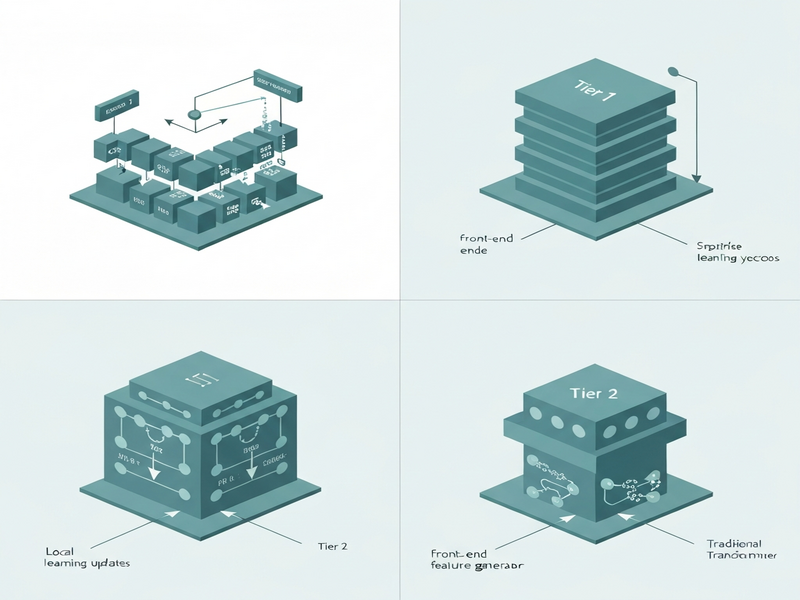
Evaluation & Results
To validate CMP, the authors designed a controlled domain‑incremental language‑modeling benchmark. The protocol presents 15 byte‑level language domains sequentially, forcing the model to adapt without revisiting earlier data. Two key metrics were tracked:
- Backward Transfer (BWT): The change in performance on previously learned domains after training on new ones. Lower (less negative) BWT indicates reduced forgetting.
- Forward Transfer (FWT): The ability to leverage prior knowledge when learning a new domain.
Results across three random seeds showed:
- CMP achieved substantially lower negative BWT than a parameter‑matched Transformer trained with online EWC, indicating that its memory‑centric design preserves earlier skills.
- While the Transformer maintained a higher absolute accuracy on the most recent domain (a “single‑domain gap”), CMP’s performance remained stable across all domains, demonstrating a trade‑off between peak accuracy and long‑term retention.
- On a vision benchmark (CIFAR‑100 split), CMP did not outperform the baseline, highlighting that the benefits may be domain‑specific.
- Attempts to combine CMP with an external accuracy‑boosting module (e.g., knowledge distillation) failed, underscoring the delicate balance of its local learning dynamics.
Overall, the experiments confirm that sparse relational coding plus local updates can mitigate catastrophic forgetting without resorting to heavyweight regularization.
Why This Matters for AI Systems and Agents
For practitioners building AI agents that must evolve in situ—think customer‑support bots that learn new product FAQs, autonomous drones that adapt to changing terrain, or recommendation engines that ingest fresh user behavior—the CMP paradigm offers several concrete advantages:
- Memory‑efficient continual adaptation: The two‑tier memory caps storage growth, making it suitable for edge devices with limited RAM.
- Reduced compute overhead: Local updates avoid full back‑propagation, cutting training latency and power consumption.
- Robustness to distribution shift: Sparse codes naturally separate unrelated concepts, lowering the risk that a new task overwrites an old one.
- Compatibility with existing pipelines: CMP can be slotted in front of any pretrained encoder, preserving the encoder’s performance while adding a forgetting‑resistant memory layer.
Enterprises looking to embed lifelong learning into their AI stack can leverage CMP‑style modules within the UBOS platform overview, where the platform’s workflow automation studio already supports custom memory components. Moreover, the OpenAI ChatGPT integration can be extended with CMP to create agents that retain conversation context across sessions without exploding token limits.
What Comes Next
While CMP marks a promising step, several open challenges remain:
- Generalization beyond language: The vision benchmark showed limited gains; future work must explore richer encoders and hierarchical memory for visual data.
- Hybrid regularization: Combining CMP with lightweight replay buffers or meta‑learning could bridge the single‑domain accuracy gap.
- Theoretical grounding: Formal analysis of sparsity‑induced orthogonality and its impact on forgetting would strengthen the design principles.
- Hardware acceleration: Implementing WTA competition and local Hebbian updates on neuromorphic chips could unlock ultra‑low‑power continual learners.
Developers interested in prototyping these ideas can start with the Workflow automation studio, which provides drag‑and‑drop components for custom memory tiers. For startups seeking a turnkey solution, the UBOS for startups page outlines pricing and support options that include pre‑built CMP modules.
Finally, the broader AI community is encouraged to replicate the authors’ methodology on open‑source continual‑learning suites and to publish negative results—just as this paper does—so that the field can converge on the most reliable forgetting‑mitigation strategies.
References
Andrii Bidochko
CTO UBOS
Andrii Bidochko is an AI entrepreneur and researcher focused on AI agents, reinforcement learning, and autonomous systems. He writes about the technologies shaping the future of machine intelligence, from frontier models and agent architectures to real-world AI applications.