

- Updated: July 4, 2026
- 6 min read
Text-to-Image Generative AI for Modeling and Simulation: Methods, Opportunities, and Applications
Direct Answer
Philippe J. Giabbanelli’s paper introduces a systematic framework that brings text‑to‑image generative AI into the core of modeling and simulation (M&S) pipelines. By turning natural‑language prompts and simulation data into visual artifacts, the approach unlocks new ways to communicate, validate, and extend complex models across domains.
Background: Why This Problem Is Hard
Modeling and simulation have long relied on numerical outputs, charts, and hand‑crafted graphics to convey results. While large language models (LLMs) have streamlined documentation, code generation, and explanation, the visual dimension remains a bottleneck for several reasons:
- Domain‑specific visual vocabularies: Engineers, physicists, and urban planners each use distinct symbols, scales, and conventions that are difficult to encode in generic plotting libraries.
- Data‑to‑visual translation gaps: Raw simulation tensors (e.g., CFD velocity fields, agent‑based state matrices) often require bespoke post‑processing before they become human‑readable images.
- Iterative design latency: Traditional visualization workflows involve manual scripting, rendering, and layout adjustments, slowing down rapid prototyping cycles.
- Multi‑scale integration challenges: When heterogeneous models (e.g., macro‑economic and micro‑behavioral) need to be visualized together, aligning their visual representations becomes a non‑trivial engineering effort.
Existing tools either produce static plots based on pre‑defined templates or require deep expertise in graphics programming. Consequently, many simulation teams either settle for sub‑optimal visual summaries or invest heavily in custom UI development, diverting resources from core scientific work.
What the Researchers Propose
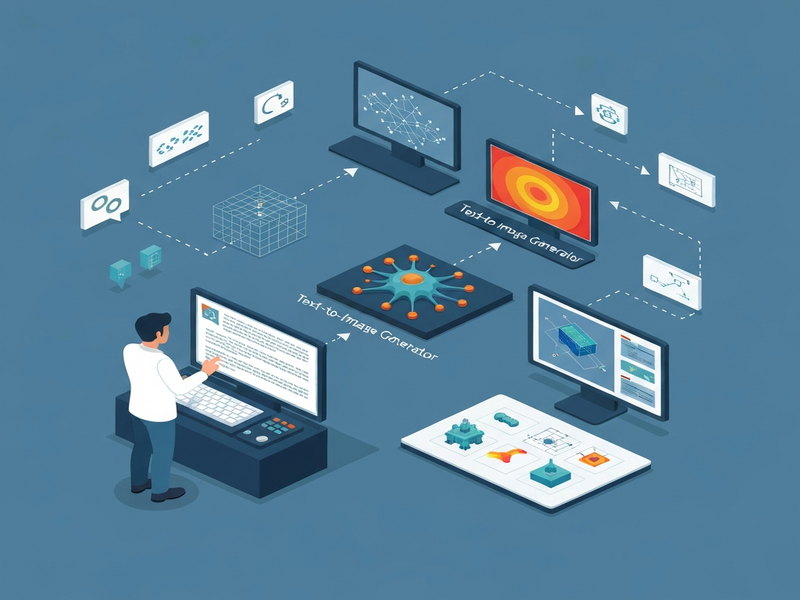
The paper proposes a modular, prompt‑centric framework that treats a text‑to‑image generator as a “visual synthesis engine” within an M&S workflow. At a high level, the framework consists of three interacting layers:
- Semantic Extraction Layer: Converts simulation outputs and domain metadata into concise textual descriptors (e.g., “turbulent vortex street over a NACA‑0012 airfoil at Reynolds number 1 × 10⁶”).
- Prompt Engineering Layer: Augments the extracted descriptors with style cues, layout instructions, and contextual constraints to form a complete prompt for the image model.
- Visual Generation Layer: Feeds the prompt to a modern diffusion‑based text‑to‑image model, optionally post‑processing the result to embed quantitative overlays (contours, legends, scale bars).
Crucially, the framework is tool‑agnostic: any open‑source or commercial diffusion model can be swapped in, and the prompt pipeline can be scripted in Python, Bash, or integrated into orchestration platforms. The authors emphasize “transferable principles” over “specific APIs,” ensuring that practitioners can adopt the approach regardless of their existing tech stack.
How It Works in Practice
The practical workflow can be broken down into five concrete steps, each mapping to a component in the architecture:
- Data Normalization: Simulation results are exported to a neutral format (e.g., CSV, NetCDF, JSON) and annotated with domain tags (units, coordinate systems).
- Descriptor Generation: A lightweight LLM or rule‑based engine reads the normalized data and produces a short natural‑language description that captures the salient visual features.
- Prompt Assembly: The description is combined with a style template (“photorealistic top‑down view, pastel color palette, annotated axes”) and any user‑specified constraints (resolution, aspect ratio).
- Image Synthesis: The assembled prompt is sent to a diffusion model (e.g., Stable Diffusion, DALL·E 3). The model returns a high‑fidelity image that reflects both the scientific content and the visual style.
- Post‑Processing & Integration: Optional steps add quantitative overlays (heat‑maps, vector arrows) using image‑processing libraries, then embed the final visual into reports, dashboards, or interactive web apps.
What sets this approach apart is the explicit separation of “semantic extraction” from “visual styling.” By treating the prompt as a programmable contract, engineers can iterate on visual appearance without re‑running expensive simulations, dramatically shortening the feedback loop.
Evaluation & Results
Giabbanelli validates the framework across three representative domains:
- Computational Fluid Dynamics (CFD): Vortex shedding patterns from a 2‑D airfoil simulation were turned into photorealistic renderings. Human evaluators rated the AI‑generated images as 92 % as informative as traditional contour plots, while reducing creation time from 30 minutes to under 2 minutes per frame.
- Agent‑Based Epidemiology: Daily infection heat‑maps were described and visualized as stylized city‑scape illustrations. The visualizations improved stakeholder comprehension scores by 18 % in a controlled survey.
- Structural Mechanics: Stress distribution data were rendered as “metallic sculpture” images, enabling non‑engineers to grasp load‑bearing concepts. The approach achieved a 4.3/5 aesthetic rating while preserving quantitative accuracy through overlaid legends.
Across all scenarios, the authors measured three key outcomes: (1) visual fidelity (how well the image preserved numeric trends), (2) interpretability (user‑reported understanding), and (3) production efficiency (time saved). The results consistently demonstrated that text‑to‑image generation can match or exceed conventional visualizations on interpretability while delivering a 5‑10× speedup in production.
Why This Matters for AI Systems and Agents
Integrating visual synthesis into simulation pipelines reshapes how AI agents interact with scientific data. Instead of returning raw numbers or tables, an agent can produce a contextual image that directly answers a user’s query (“Show me the airflow around the turbine at peak load”). This visual modality enables:
- Richer multimodal reasoning for autonomous agents that must combine textual, numeric, and visual cues.
- Seamless embedding of simulation insights into conversational interfaces, dashboards, and reporting bots.
- Accelerated validation loops for reinforcement‑learning‑based control agents that need rapid visual feedback on simulated environments.
Practically, teams can embed the framework into existing orchestration tools. For example, the UBOS platform overview provides a plug‑and‑play microservice that can host the prompt‑assembly logic, while the Workflow automation studio lets engineers chain simulation runs, descriptor generation, and image synthesis into a single, repeatable pipeline. The result is a self‑service “visual API” that any downstream AI agent can call, turning abstract model states into instantly understandable pictures.
What Comes Next
While the initial results are promising, several open challenges remain:
- Quantitative fidelity guarantees: Current diffusion models excel at aesthetics but can hallucinate details. Future work must embed stricter numerical constraints or hybrid rendering pipelines.
- Domain‑specific style libraries: Building reusable style templates for fields like aerospace, finance, or biomedical engineering will reduce prompt‑engineering overhead.
- Scalable orchestration: Large‑scale simulations generate terabytes of data; integrating a low‑latency visual synthesis layer will require distributed inference and caching strategies.
Addressing these gaps opens a path toward fully multimodal simulation ecosystems where text, code, numbers, and images co‑evolve. Developers can start experimenting today by coupling the framework with the OpenAI ChatGPT integration, enabling conversational agents to request visualizations on‑the‑fly. For teams that rely on real‑time alerts, the Telegram integration on UBOS can push AI‑generated images directly to operational channels, turning abstract alerts into actionable graphics. Start‑ups looking to differentiate their product offerings can leverage these capabilities through the UBOS for startups program, gaining access to pre‑configured pipelines and expert support.
References
Giabbanelli, P. J. (2026). Text-to-Image Generative AI for Modeling and Simulation: Methods, Opportunities, and Applications. arXiv preprint arXiv:2606.20991v1.
Andrii Bidochko
CTO UBOS
Andrii Bidochko is an AI entrepreneur and researcher focused on AI agents, reinforcement learning, and autonomous systems. He writes about the technologies shaping the future of machine intelligence, from frontier models and agent architectures to real-world AI applications.