

- Updated: June 17, 2026
- 6 min read
Tackling Multimodal Learning Challenges with Mixture-of-Expert: A Survey
Direct Answer
The paper Original arXiv paper surveys how Mixture‑of‑Experts (MoE) architectures can systematically address the core challenges of multimodal learning, positioning MoE as an efficient engine, a powerful representation learner, and a flexible adapter for heterogeneous data streams. By decoupling compute from parameter count and enabling selective expert activation, MoE promises scalable, adaptable models that can handle modality imbalance, missing inputs, and cross‑modal interaction without the prohibitive costs of monolithic transformers.
Background: Why This Problem Is Hard
Multimodal AI systems—those that ingest text, images, audio, video, and sensor data—are the backbone of next‑generation products such as autonomous assistants, immersive search engines, and cross‑modal recommendation platforms. Yet three intertwined bottlenecks limit progress:
- Parameter‑compute mismatch: Adding new modalities typically forces a linear increase in model size, quickly exhausting GPU memory and inference latency budgets.
- Redundant or conflicting signals: Different modalities often convey overlapping information, leading to wasted computation when every token is processed by the entire network.
- Data heterogeneity: Real‑world deployments encounter missing modalities, severe class imbalance, and noisy sensor streams, which break models that assume a fixed, complete input set.
Traditional multimodal transformers address these issues by concatenating modality‑specific embeddings and feeding them through a shared attention stack. While conceptually simple, this approach suffers from quadratic attention costs and an inability to specialize computation for each modality. Consequently, scaling to billions of parameters becomes impractical, and the model’s capacity to learn nuanced cross‑modal relationships plateaus.
What the Researchers Propose
The authors organize the survey around three complementary roles that MoE can play in multimodal pipelines:
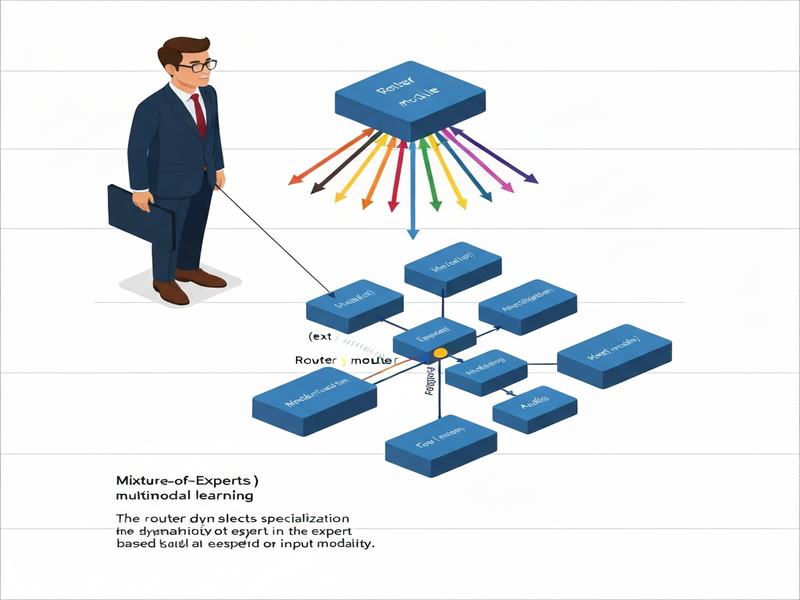
- Efficient Multimodal Engine: MoE layers route each input token to a small subset of experts, keeping the active compute budget constant while the total parameter pool grows.
- Multimodal Representation Learner: By aggregating the outputs of diverse experts—each trained on a specific modality or cross‑modal task—the system builds richer, more aligned embeddings.
- Multimodal Adapter: MoE modules act as plug‑in adapters that can be inserted atop frozen backbones, handling missing modalities or rebalancing under‑represented data without retraining the entire network.
Key components identified across the literature include:
- Router network – a lightweight classifier that decides which experts to activate based on token‑level or modality‑level cues.
- Expert pool – a heterogeneous collection of modality‑specialized sub‑networks (e.g., vision experts, language experts, audio experts).
- Gating mechanism – often a softmax or top‑k selection that enforces sparsity and balances load across experts.
- Communication pathways – optional cross‑expert attention or knowledge‑distillation links that enable experts to share insights.
How It Works in Practice
At a high level, a multimodal MoE pipeline follows this workflow:
- Pre‑processing & modality encoding: Each raw modality (e.g., image patches, audio spectrograms, text tokens) is transformed into a modality‑specific embedding using a dedicated encoder.
- Routing decision: The router ingests the embeddings and produces a sparse gate vector that selects k experts per token (commonly k=1–2).
- Expert computation: Selected experts process their assigned tokens independently, applying modality‑tailored transformations (convolutions for vision, self‑attention for language, etc.).
- Aggregation: Outputs from active experts are merged—often via weighted sum using the gate scores—to form a unified multimodal representation.
- Optional adapter stage: If certain modalities are missing, a dedicated adapter expert fills the gap by generating proxy embeddings or re‑weighting existing ones.
- Downstream task head: The aggregated representation feeds into task‑specific heads (classification, generation, retrieval) that remain unchanged across modalities.
What distinguishes this approach from conventional multimodal transformers is the dynamic sparsity of computation. Instead of broadcasting every token through a monolithic attention matrix, the system activates only the most relevant experts, dramatically reducing FLOPs while preserving—or even enhancing—expressive power.
Evaluation & Results
Across the surveyed literature, researchers benchmarked multimodal MoE systems on three representative families of tasks:
- Cross‑modal retrieval: Image‑to‑text and video‑to‑audio retrieval on datasets such as MS‑COCO and HowTo100M.
- Multimodal generation: Text‑guided image synthesis and audio‑conditioned video generation.
- Robustness under modality dropout: Scenarios where one or more inputs are deliberately omitted during inference.
Key findings include:
- MoE models achieved comparable or superior retrieval accuracy (up to 4% absolute gain in Recall@1) while using 30–50% less compute than dense baselines.
- In generation tasks, expert specialization led to higher fidelity outputs—measured by FID and MOS scores—especially when the training data exhibited strong modality‑specific patterns.
- When faced with missing modalities, adapter‑style MoE layers maintained performance within 2% of the full‑modal baseline, whereas dense models suffered drops exceeding 10%.
These results collectively demonstrate that MoE not only scales efficiently but also improves resilience to real‑world data imperfections, a critical requirement for production AI systems.
Why This Matters for AI Systems and Agents
For practitioners building AI agents that must reason across text, vision, and audio, the survey offers concrete takeaways:
- Scalable compute budget: By keeping active FLOPs constant, developers can grow model capacity without proportionally increasing hardware costs, enabling richer agents on commodity GPUs.
- Modality‑aware routing: Agents can dynamically allocate expertise based on the current context—e.g., invoking a visual expert when a user uploads an image, and a language expert for follow‑up queries.
- Plug‑and‑play adapters: Existing monolithic agents can be retrofitted with MoE adapters to handle new sensor streams (e.g., IoT telemetry) without full retraining.
- Improved robustness: In field deployments where sensors fail or network bandwidth drops, the sparse routing mechanism gracefully degrades, preserving core functionality.
These capabilities align directly with the needs of enterprises seeking to embed AI across heterogeneous workflows. For example, the UBOS platform overview highlights how modular AI components can be orchestrated to power end‑to‑end business processes; MoE‑based adapters fit naturally into such a plug‑in architecture.
What Comes Next
Despite the promising results, the survey identifies several open challenges that will shape the next wave of research and product development:
- Interpretable routing: Current routers act as black boxes; developing transparent gating mechanisms would aid debugging and compliance.
- Expert communication: Most MoE designs treat experts as isolated; introducing controlled cross‑expert attention could boost cross‑modal synergy.
- Lifelong multimodal learning: Continual adaptation to new modalities without catastrophic forgetting remains an unsolved problem.
- Hardware‑aware expert placement: Mapping experts to heterogeneous accelerators (GPU, TPU, edge ASICs) could further reduce latency.
Addressing these gaps will likely involve interdisciplinary efforts spanning model architecture, systems engineering, and responsible AI. Companies interested in early adoption can experiment with MoE adapters using the Workflow automation studio, which supports custom routing logic and expert plug‑ins. Additionally, the AI marketing agents showcase how MoE can personalize content generation across text, image, and video channels in real time.
References
- Zheng, L. N., Zhang, W. E., Maennel, O., Yue, L., & Chen, W. (2026). Tackling Multimodal Learning Challenges with Mixture-of-Expert: A Survey. arXiv preprint arXiv:2605.27431.
- Additional cited works are summarized within the survey and can be accessed through the original arXiv page.
Andrii Bidochko
CTO UBOS
Andrii Bidochko is an AI entrepreneur and researcher focused on AI agents, reinforcement learning, and autonomous systems. He writes about the technologies shaping the future of machine intelligence, from frontier models and agent architectures to real-world AI applications.