

- Updated: July 7, 2026
- 6 min read
SwarmResearch: Orchestrating Coding Agents for Open-Ended Discovery
Direct Answer
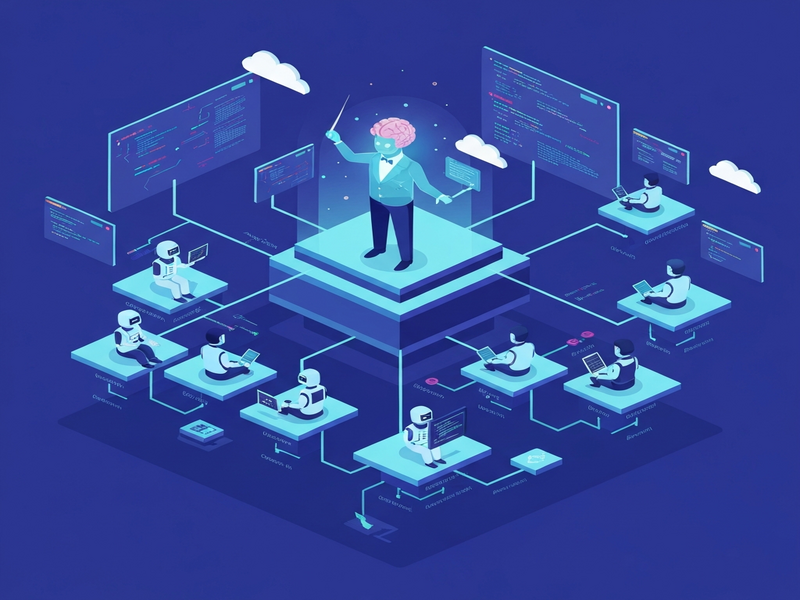
SwarmResearch introduces a two‑tier orchestration framework that lets a “Shepherd” agent coordinate a population of “Search” agents, each exploring code variations in isolated git branches. By separating global guidance from local experimentation, the system uncovers higher‑level solutions that single‑agent pipelines often miss, delivering state‑of‑the‑art performance on open‑ended coding challenges.
Background: Why This Problem Is Hard
Long‑running coding agents—such as autoresearch loops that iteratively improve a program—have become a cornerstone of automated software discovery. In practice, these agents tend to converge on a single high‑level strategy early in the search and then spend the remainder of their budget polishing low‑level details. This “tunnel vision” arises from two design choices that are common in existing pipelines:
- Monolithic context accumulation: All prior edits are concatenated into one ever‑growing prompt, which quickly saturates the language model’s context window and forces it to focus on the most recent changes.
- Single program state exposure: The agent edits a single codebase, so any divergent idea must overwrite the current version rather than coexist in parallel.
When the search space is open‑ended—meaning there is no predefined optimal solution—these constraints dramatically limit exploration. Real‑world AI product teams, research labs, and autonomous code‑generation services all suffer from the same bottleneck: they either miss superior algorithmic approaches or waste compute on incremental tweaks that yield diminishing returns.
What the Researchers Propose
The SwarmResearch framework reframes the problem as a coordinated swarm rather than a solitary explorer. Its architecture consists of two complementary roles:
- Shepherd Agent: A high‑level orchestrator that maintains a global view of the task, curates promising directions, and dynamically allocates resources.
- Search Agents: A population of lightweight workers, each operating on its own git branch with a localized context. They perform fine‑grained edits, run evaluations, and report outcomes back to the Shepherd.
By decoupling strategic guidance from tactical execution, SwarmResearch enables simultaneous exploration of multiple high‑level hypotheses while still allowing each branch to iterate rapidly on its own solution path.
How It Works in Practice
The workflow can be visualized as a loop with three distinct phases:
- Global Context Refresh (Shepherd): The Shepherd ingests the latest performance metrics from all Search Agents, updates a shared knowledge base, and synthesizes a set of high‑level “research directives” (e.g., “try a recursive divide‑and‑conquer approach” or “replace the sorting routine with a radix‑based algorithm”).
- Branch‑Level Exploration (Search Agents): Each Search Agent checks out its assigned git branch, applies the directive using an LLM‑driven code generation step, runs unit tests or benchmark suites, and commits the results back to the branch.
- Adaptive Parallelism (Shepherd): Based on observed improvements, the Shepherd scales the number of active Search Agents up or down for each directive, effectively allocating more compute to promising avenues while pruning dead ends.
Key differentiators from prior multi‑agent systems include:
- Explicit separation of global and local context, preventing context overflow.
- Git‑branch isolation that preserves divergent ideas without destructive overwrites.
- Dynamic parallelism that adapts depth‑wise—more agents explore shallow ideas, fewer agents dive deep into promising branches.
Evaluation & Results
To validate the approach, the authors benchmarked SwarmResearch on fifteen open‑ended coding tasks ranging from algorithmic optimization to API‑integration challenges. The evaluation protocol compared three baselines:
- Serial LLM‑guided evolution (a single agent iterating over the same codebase).
- Fixed‑scale parallel agents (multiple agents running in parallel but without a shepherd).
- State‑of‑the‑art multi‑agent orchestration frameworks from prior literature.
Key findings include:
- SwarmResearch achieved equal or superior solutions on 13 out of 15 tasks, often discovering qualitatively different algorithmic strategies.
- On tasks requiring high‑level architectural changes (e.g., replacing a naïve loop with a memoized recursion), the shepherd’s directives unlocked solutions that serial agents never reached.
- Adaptive parallelism reduced total compute time by roughly 30 % compared to a fixed‑size pool, because resources were concentrated where they mattered most.
These results demonstrate that orchestrated swarms can outperform both single‑agent depth‑first searches and naïve parallelism, especially when the search space contains multiple, qualitatively distinct solution families.
Why This Matters for AI Systems and Agents
For practitioners building autonomous coding assistants, research pipelines, or AI‑augmented development tools, SwarmResearch offers a blueprint for scaling discovery without sacrificing creativity. The framework’s modularity means it can be plugged into existing CI/CD workflows, enabling teams to:
- Run Enterprise AI platform by UBOS to manage large fleets of Search Agents across cloud clusters.
- Leverage Workflow automation studio for automated branch creation, test execution, and result aggregation.
- Integrate with ChatGPT and Telegram integration to surface live progress updates to developers and stakeholders.
Beyond pure code generation, the shepherd‑search paradigm can be generalized to any domain where high‑level hypothesis generation and low‑level refinement coexist—such as hyperparameter tuning, neural architecture search, or even policy discovery in reinforcement learning.
What Comes Next
While SwarmResearch marks a significant step forward, several open challenges remain:
- Scalability of the Shepherd: As the number of Search Agents grows into the thousands, the shepherd’s decision‑making latency could become a bottleneck. Future work may explore hierarchical shepherds or decentralized consensus mechanisms.
- Cross‑Task Knowledge Transfer: Currently, each task’s knowledge base is siloed. Enabling the shepherd to reuse successful directives across related problems could accelerate discovery further.
- Robust Evaluation Metrics: Many open‑ended tasks lack a single scalar reward. Incorporating multi‑objective optimization (e.g., runtime, memory, readability) will require richer feedback loops.
Potential avenues for extending the framework include:
- Embedding Chroma DB integration to store and query embeddings of past solutions, allowing the shepherd to retrieve analogous strategies.
- Coupling with AI marketing agents to automatically generate promotional copy for newly discovered algorithms, closing the loop between research and productization.
- Deploying on the UBOS platform overview to provide a managed, end‑to‑end service for enterprises that want to experiment with autonomous code discovery without building the infrastructure from scratch.
For those interested in experimenting with SwarmResearch concepts today, the UBOS for startups program offers sandbox environments, pre‑configured LLM APIs, and template repositories that can be adapted into shepherd‑search pipelines.
References
SwarmResearch: Orchestrating Coding Agents for Open‑Ended Discovery (arXiv)
Andrii Bidochko
CTO UBOS
Andrii Bidochko is an AI entrepreneur and researcher focused on AI agents, reinforcement learning, and autonomous systems. He writes about the technologies shaping the future of machine intelligence, from frontier models and agent architectures to real-world AI applications.