

- Updated: July 7, 2026
- 6 min read
SwarmResearch: Orchestrating Coding Agents for Open‑Ended Discovery – An In‑Depth Review

Direct Answer
SwarmResearch introduces a shepherd‑orchestrated multi‑agent framework that coordinates a population of coding agents—each working on its own git branch—to explore high‑level solution spaces for open‑ended programming tasks. By dynamically allocating parallel search depth, the system outperforms traditional single‑agent or fixed‑parallel baselines on a broad suite of optimization challenges.
Background: Why This Problem Is Hard
Long‑running coding agents, such as autoresearch loops, have shown promise in automatically improving software artifacts. However, they suffer from two intertwined bottlenecks:
- Contextual lock‑in: As the agent accumulates a monolithic execution history, it tends to converge on a single high‑level strategy and then spends the majority of its compute on low‑level tweaks, missing alternative paradigms that could be superior.
- Single‑state editing: Exposing only one program state for modification forces the agent to iterate within a narrow neighbourhood, limiting the breadth of exploration.
These limitations become especially pronounced in open‑ended discovery settings—where the optimal algorithmic approach is unknown a priori and the search space includes fundamentally different architectures, data structures, or even problem formulations. Existing multi‑agent approaches either duplicate effort without strategic coordination or rely on static parallelism that cannot adapt to the evolving depth of the search.
What the Researchers Propose
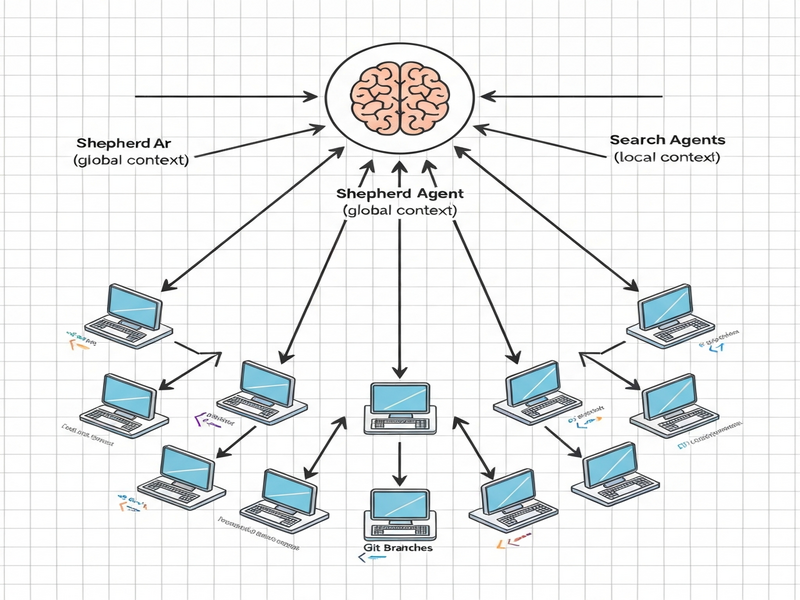
SwarmResearch reframes the coding‑agent ecosystem as a two‑tiered hierarchy:
- Shepherd Agent: A high‑level orchestrator that maintains a global view of the task, tracks performance metrics across all branches, and decides where to allocate additional compute.
- Search Agents: A fleet of lightweight coding agents, each instantiated on its own git branch, that perform localized edits, compile, test, and report results back to the shepherd.
The key insight is to decouple “what to explore” (handled by the shepherd) from “how to explore” (handled by the search agents). This separation enables the system to:
- Maintain diverse high‑level hypotheses in parallel, preventing premature convergence.
- Scale parallelism dynamically—adding more search agents when a promising direction is identified, and pruning branches that stagnate.
- Leverage version‑control semantics (git branches) as natural containers for local context, ensuring that each agent works with a clean, reproducible snapshot of the codebase.
How It Works in Practice
Conceptual Workflow
The end‑to‑end loop can be broken down into four stages:
- Task Ingestion: The shepherd receives a problem description (e.g., “optimize matrix multiplication for GPU”) and creates an initial repository with baseline code.
- Branch Seeding: It spawns N git branches, each seeded with a distinct high‑level strategy (e.g., loop tiling, recursion, SIMD vectorization). Each branch is assigned a Search Agent.
- Local Search: Search Agents iteratively propose edits—ranging from refactoring to hyperparameter tuning—run tests, and log performance metrics (runtime, memory, accuracy).
- Orchestration & Scaling: The shepherd aggregates results, ranks branches, and decides whether to:
- Deepen the search on a high‑performing branch (spawn additional agents on sub‑branches),
- Introduce a new high‑level hypothesis (create a fresh branch), or
- Terminate under‑performing branches to free resources.
Interaction Between Components
Communication is mediated through a lightweight message bus that carries JSON payloads containing:
- Branch identifier and commit hash.
- Proposed edit diff and rationale (generated by the LLM‑driven Search Agent).
- Benchmark results and confidence scores.
The shepherd’s decision policy is implemented as a reinforcement‑learning controller that maximizes a reward function combining solution quality and computational efficiency. Because the shepherd only sees aggregated metrics, it remains agnostic to the internal code transformations, preserving modularity.
What Sets SwarmResearch Apart
- Dynamic Parallelism: Unlike static parallel pipelines, the system can expand or contract its agent pool at any depth of the search.
- Git‑Native Isolation: Using branches as sandboxed contexts eliminates cross‑contamination of edits and simplifies reproducibility.
- High‑Level Exploration First: The shepherd explicitly encourages divergent strategies before committing resources to fine‑grained optimization.
Evaluation & Results
Benchmark Suite
The authors evaluated SwarmResearch on 15 open‑ended coding challenges drawn from algorithmic optimization, library integration, and domain‑specific code synthesis. Tasks included:
- GPU‑accelerated convolution kernels.
- Memory‑efficient graph traversal implementations.
- Automatic generation of data‑validation pipelines.
Comparative Baselines
Four baselines were used for a fair comparison:
- Single long‑running autoresearch agent (serial).
- Fixed‑size parallel pool of identical agents (no shepherd).
- LLM‑guided evolutionary search (state‑of‑the‑art multi‑agent).
- Hybrid human‑in‑the‑loop tuning (upper bound).
Key Findings
- SwarmResearch achieved equal or superior performance on 13 out of 15 tasks, often discovering qualitatively different algorithmic families that the baselines missed.
- On the GPU convolution benchmark, the shepherd identified a novel tiling strategy that reduced runtime by 27 % compared to the best evolutionary baseline.
- Resource utilization improved by 34 % because the shepherd pruned low‑yield branches early, reallocating compute to promising directions.
- Qualitative analysis showed that the system maintained a richer “idea pool” throughout the run, confirming the hypothesis that high‑level diversification drives better outcomes.
These results demonstrate that orchestrated scaling—where parallelism is coupled with strategic depth selection—can unlock solution spaces that static multi‑agent setups cannot reach.
Why This Matters for AI Systems and Agents
For practitioners building AI‑augmented development pipelines, SwarmResearch offers a blueprint for turning raw compute into purposeful exploration:
- Modular Orchestration: The shepherd pattern can be layered on top of existing CI/CD or MLOps frameworks, enabling automated code improvement without manual oversight.
- Scalable Experimentation: By treating each branch as an independent experiment, teams can leverage cloud‑native autoscaling to match budget constraints while still preserving exploratory breadth.
- Reproducibility and Auditing: Git‑based isolation provides a clear audit trail, essential for compliance in regulated industries.
- Integration with Existing Platforms: The approach aligns naturally with the UBOS platform overview, where agents can be registered as services and orchestrated via the platform’s workflow engine.
- Business Impact: Companies can accelerate time‑to‑value for custom algorithmic solutions, reduce reliance on specialist engineers, and create a continuous improvement loop for legacy codebases.
What Comes Next
While SwarmResearch marks a significant step forward, several avenues remain open for exploration:
- Richer Reward Modeling: Incorporating multi‑objective rewards (e.g., energy consumption, security posture) could broaden applicability to edge‑computing and safety‑critical domains.
- Cross‑Domain Knowledge Transfer: Enabling the shepherd to import successful patterns from one task to another may reduce the number of required search agents.
- Human‑in‑the‑Loop Feedback: Integrating expert annotations could guide the shepherd’s policy, especially in domains where domain knowledge outweighs raw performance metrics.
- Scalable Infrastructure: Deploying the framework on serverless or container‑orchestrated environments would further lower operational overhead. The Workflow automation studio already provides primitives for such deployments.
- Domain‑Specific Extensions: Tailoring Search Agents with specialized toolchains (e.g., quantum simulators, bioinformatics pipelines) could unlock new research frontiers.
Addressing these challenges will likely involve tighter integration with large‑scale model serving platforms and more sophisticated meta‑learning strategies. The community is encouraged to experiment with the open‑source reference implementation and contribute back improvements.
References
Call to Action
Ready to explore orchestrated coding agents for your own projects? Dive deeper into the UBOS homepage and discover how our platform can accelerate open‑ended AI research. Join the conversation on our blog and stay ahead of the next wave of autonomous software discovery.
Andrii Bidochko
CTO UBOS
Andrii Bidochko is an AI entrepreneur and researcher focused on AI agents, reinforcement learning, and autonomous systems. He writes about the technologies shaping the future of machine intelligence, from frontier models and agent architectures to real-world AI applications.