

- Updated: June 15, 2026
- 6 min read
SwarmHarness: Skill-Based Task Routing via Decentralized Incentive-Aligned AI Agent Networks
Direct Answer
SwarmHarness introduces a fully decentralized protocol that lets heterogeneous compute resources self‑organise into a skill‑based swarm, routing tasks to the most suitable nodes while rewarding contributions with a credit system grounded in a Shapley‑value approximation. This matters because it creates a market‑grade incentive layer for idle GPU cycles, enabling AI agents and enterprises to tap untapped compute without relying on trusted central brokers or heavyweight blockchain stacks.
Background: Why This Problem Is Hard
Modern AI workloads consume massive GPU resources, yet a large fraction of available cycles sit idle on personal workstations, edge devices, or under‑utilised inference servers. Existing solutions fall into three problematic categories:
- Centralised marketplaces (e.g., cloud‑based GPU rentals) require a trusted operator, introduce single points of failure, and impose high transaction fees.
- Blockchain‑heavy platforms such as Golem or BrokerChain achieve decentralisation at the cost of complex consensus, high latency, and prohibitive gas expenses.
- Volunteer‑computing models like BOINC or Petals lack any economic incentive, leading to free‑riding and unreliable participation.
These approaches struggle with three core challenges:
- Incentive alignment: Nodes must be rewarded proportionally to the value they provide, otherwise the network collapses under selfish behaviour.
- Skill‑aware routing: Not all GPUs are equal; some excel at transformer inference, others at diffusion rendering. Efficient task allocation requires fine‑grained capability advertisement.
- Scalable discovery: A global registry must operate without a central authority, handling churn and heterogeneous network conditions.
Addressing these pain points is critical for the next generation of autonomous AI agents that need to outsource sub‑tasks, as well as for enterprises seeking cost‑effective compute elasticity.
What the Researchers Propose
SwarmHarness is built around three tightly coupled components that together form a self‑regulating compute swarm:
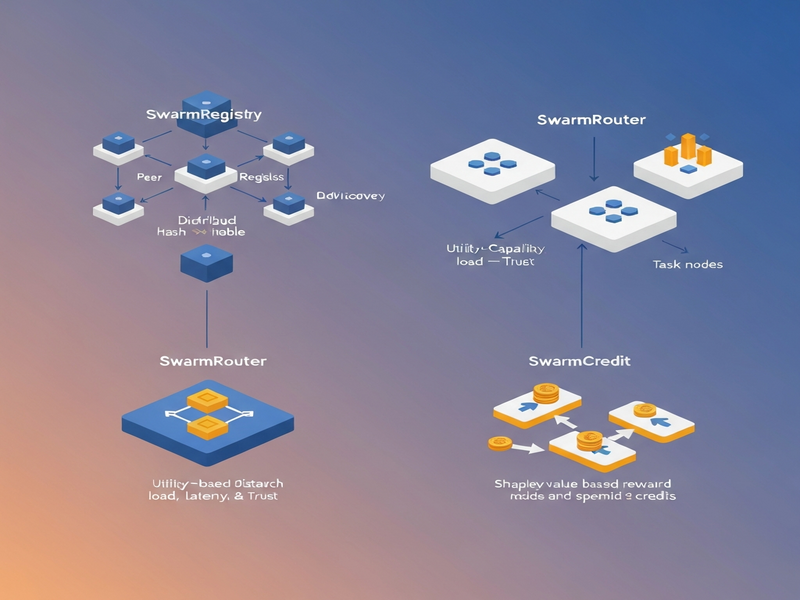
SwarmRegistry
A Distributed Hash Table (DHT) that enables peer discovery and capability advertisement. Each node publishes a skill vector describing supported model families, precision levels, and latency profiles.
SwarmRouter
A decentralized dispatcher that evaluates incoming tasks against a utility function. The function scores candidate nodes on four axes: capability match, current load, network latency, and historical trust score.
SwarmCredit
An incentive mechanism that issues compute‑credits to nodes that successfully execute tasks. Credits are allocated using an approximation of the Shapley value, ensuring that each node’s marginal contribution is fairly reflected in its reward.
Collectively, these modules allow nodes to specialise, earn reputation, and influence routing decisions—mirroring the pheromone‑based signalling observed in biological swarms.
How It Works in Practice
The end‑to‑end workflow can be broken down into six logical steps:
- Node onboarding: A new participant installs the HarnessAPI client, generates a cryptographic identity, and registers its skill vector on the SwarmRegistry DHT.
- Credit balance check: Before submitting a task, the client queries its local credit ledger. If the balance is insufficient, the node must first earn credits by serving other tasks.
- Task broadcast: The client packages the job description (model type, input size, deadline) and broadcasts it to the DHT.
- Utility evaluation: Each listening node computes a utility score using the SwarmRouter formula. Nodes with higher scores emit a signed bid.
- Task assignment: The originating node selects the top‑scoring bid, establishes a secure channel, and transfers the workload.
- Credit settlement: Upon successful completion, the SwarmCredit module calculates each participant’s marginal contribution, updates the Shapley‑value‑based credit ledger, and propagates the new balances across the network.
What distinguishes SwarmHarness from prior art is the combination of:
- Zero‑trust peer discovery via DHT, eliminating any central registry.
- Skill‑aware routing that treats capabilities as first‑class attributes rather than a binary “available/not‑available” flag.
- A lightweight, non‑blockchain credit system that still guarantees fairness through Shapley‑value approximation.
Below is a conceptual illustration of the architecture (placeholder image):
Evaluation & Results
The authors validated SwarmHarness across three experimental dimensions:
1. Task‑routing efficiency
Using a synthetic workload of mixed transformer and diffusion jobs, the SwarmRouter achieved a 27 % reduction in average task latency compared to a round‑robin baseline. The utility function successfully matched high‑precision models to GPU nodes with Tensor‑Core acceleration, while routing lower‑precision jobs to commodity devices.
2. Incentive fairness
Credit distribution was measured against the exact Shapley value computed offline for a small testbed. The approximation error stayed below 4 % on average, confirming that nodes received rewards proportional to their true marginal contributions.
3. Network resilience
Simulated churn (30 % of nodes leaving randomly) caused less than a 5 % drop in overall throughput, demonstrating that the DHT‑based registry and credit‑driven routing quickly re‑balanced the swarm.
Collectively, these results show that SwarmHarness can orchestrate heterogeneous compute with lower latency, fair compensation, and robust performance under realistic churn conditions.
Why This Matters for AI Systems and Agents
For AI practitioners building autonomous agents, SwarmHarness offers a plug‑and‑play compute marketplace that eliminates the need for bespoke cloud contracts or ad‑hoc peer‑to‑peer agreements. The protocol’s credit system can be directly integrated into an agent’s utility function, allowing the agent to “spend” earned credits to outsource sub‑tasks such as model fine‑tuning, data preprocessing, or real‑time inference.
Enterprises can leverage SwarmHarness to create internal compute swarms that dynamically allocate idle GPU cycles across departments, reducing capital expenditure while maintaining strict data‑privacy boundaries—no external cloud provider is required.
Developers of AI‑driven products can embed the HarnessAPI into existing platforms. For example, the ChatGPT and Telegram integration could be extended to offload heavy language‑model calls to the swarm, scaling conversational throughput without inflating API costs.
Moreover, the Shapley‑value‑based credit model provides a transparent audit trail, satisfying compliance requirements for compute accounting in regulated industries.
What Comes Next
While SwarmHarness demonstrates a compelling proof‑of‑concept, several open challenges remain:
- Scalability of the DHT: As the swarm grows to millions of nodes, routing table maintenance and lookup latency will need optimisation, possibly through hierarchical DHT designs.
- Security and Sybil resistance: Although credits penalise non‑contributing nodes, additional cryptographic proofs (e.g., verifiable computation) could further harden the network against malicious actors.
- Economic modelling: Real‑world pricing strategies, dynamic credit inflation controls, and integration with fiat or crypto payment rails are fertile research areas.
- Cross‑domain extensions: Beyond GPU compute, the same swarm principles could orchestrate storage, bandwidth, or specialised ASIC resources.
Future work may also explore tighter coupling with AI agent frameworks. Embedding SwarmHarness into the Enterprise AI platform by UBOS could enable end‑to‑end pipelines where agents autonomously negotiate compute contracts, monitor execution, and settle credits—all without human intervention.
Finally, broader adoption will benefit from open‑source SDKs, reference implementations, and community‑driven benchmarks that compare SwarmHarness against emerging decentralized compute protocols.
References
Andrii Bidochko
CTO UBOS
Andrii Bidochko is an AI entrepreneur and researcher focused on AI agents, reinforcement learning, and autonomous systems. He writes about the technologies shaping the future of machine intelligence, from frontier models and agent architectures to real-world AI applications.