

- Updated: July 16, 2026
- 2 min read
Swapping Faces, Saving Features: A Dual‑Purpose Pipeline for Pedestrian Privacy in ITS
Swapping Faces, Saving Features: A Dual‑Purpose Pipeline for Pedestrian Privacy in ITS
Authors: Roba H. Farouk, Catherine M. Elias
Published: July 11, 2026
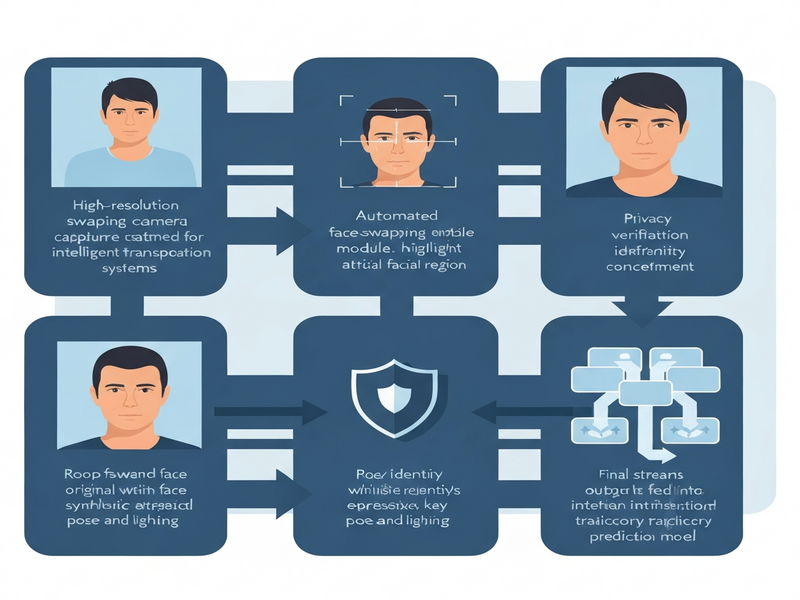
Abstract: Large‑scale, diverse datasets are essential for training AI models that enable real‑time decisions in autonomous vehicles (AVs). Pedestrian intention and trajectory prediction models rely on extensive image collections, yet unrestricted access to these datasets raises serious privacy concerns such as identity theft and tracking. This article presents a five‑stage pipeline that protects pedestrian privacy through face‑swapping while preserving critical facial attributes needed for model training. After evaluating Roop and Ghost‑v2 face‑swapping models, Roop was selected for its superior balance between identity concealment and data usability.
Read more about our privacy‑preserving solutions on the UBOS.Tech Solutions page.
Why Pedestrian Privacy Matters
In intelligent transportation systems (ITS), the collection of pedestrian imagery is indispensable for training perception algorithms. However, exposing raw facial data can lead to privacy violations. Our pipeline addresses this challenge by replacing original faces with synthetic yet attribute‑preserving counterparts, ensuring that the dataset remains valuable for training while safeguarding individual identities.
Pipeline Overview
- Data Ingestion: Collect raw pedestrian video frames from the Egy‑DRiVeS dataset.
- Face Detection: Identify and locate faces using a high‑accuracy detector.
- Attribute Extraction: Capture essential facial attributes (e.g., pose, expression, lighting).
- Face Swapping: Apply the Roop model to replace detected faces with synthetic identities while preserving extracted attributes.
- Quality Assurance: Validate that swapped faces retain usability for downstream tasks such as intention prediction.
Model Comparison: Roop vs. Ghost‑v2
Both Roop and Ghost‑v2 were benchmarked on speed, realism, and attribute retention. Roop consistently outperformed Ghost‑v2, delivering higher fidelity swaps with minimal degradation of pose and illumination, making it the preferred choice for the pipeline.
Impact on Model Training
Experiments demonstrate that models trained on the privacy‑preserved dataset achieve comparable performance to those trained on original data, confirming that essential visual cues remain intact after face swapping.
Future Work
We plan to extend the pipeline to support additional privacy techniques such as background blurring and gait anonymization, further enhancing dataset safety for public release.
For detailed implementation code and dataset access, visit our UBOS.Tech Resources section.
Andrii Bidochko
CTO UBOS
Andrii Bidochko is an AI entrepreneur and researcher focused on AI agents, reinforcement learning, and autonomous systems. He writes about the technologies shaping the future of machine intelligence, from frontier models and agent architectures to real-world AI applications.