

- Updated: July 15, 2026
- 8 min read
Structured Pruning of Large Language Models via Power Transformation and Sign-Preserving Score Aggregation with Adaptive Feature Retention
Direct Answer
The paper introduces a unified structured‑pruning framework that adapts the Adaptive Feature Retention (AFR) technique to large language models (LLMs) by aligning heterogeneous pruning scores, preserving sign information, and eliminating outliers. This matters because it delivers the same accuracy as unstructured pruning while unlocking real‑world inference speedups that are essential for deploying massive LLMs at scale.
Background: Why This Problem Is Hard
LLMs such as Llama‑3‑8B or Vicuna‑v1.5‑13B contain billions of parameters, and running them in production demands massive compute and memory. Model compression—pruning, quantization, distillation—has become a de‑facto strategy to reduce cost. Unstructured pruning, which removes individual weights based on magnitude, can keep accuracy high but leaves the weight matrix sparsity pattern irregular. Modern hardware accelerators, however, are optimized for dense matrix operations; irregular sparsity translates into negligible speed gains.
Structured pruning solves this mismatch by removing entire rows, columns, or attention heads, producing a dense sub‑network that hardware can execute efficiently. The challenge is that most structured‑pruning methods rely on handcrafted heuristics that ignore the nuanced, layer‑wise importance signals captured by sophisticated unstructured techniques like AFR. When researchers try to transplant AFR directly into a structured setting, three concrete obstacles appear:
- Distribution mismatch: AFR generates pruning scores that differ wildly across layers and across score types (e.g., magnitude vs. gradient‑based). Directly aggregating these heterogeneous scores leads to biased decisions.
- Loss of sign information: AFR’s original formulation uses signed scores to indicate whether a weight should be increased or decreased during fine‑tuning. Structured pruning that discards the sign loses this directional cue, making post‑prune recovery harder.
- Outlier influence: A few extreme scores can dominate the aggregation process, causing the pruning algorithm to over‑prune critical features while leaving redundant ones untouched.
These problems have kept structured pruning from achieving the same level of compression quality that unstructured AFR enjoys, limiting its adoption in production‑grade LLM pipelines.
What the Researchers Propose
The authors present a three‑pronged, unified approach that bridges the gap between AFR’s fine‑grained insight and the coarse granularity required by structured pruning:
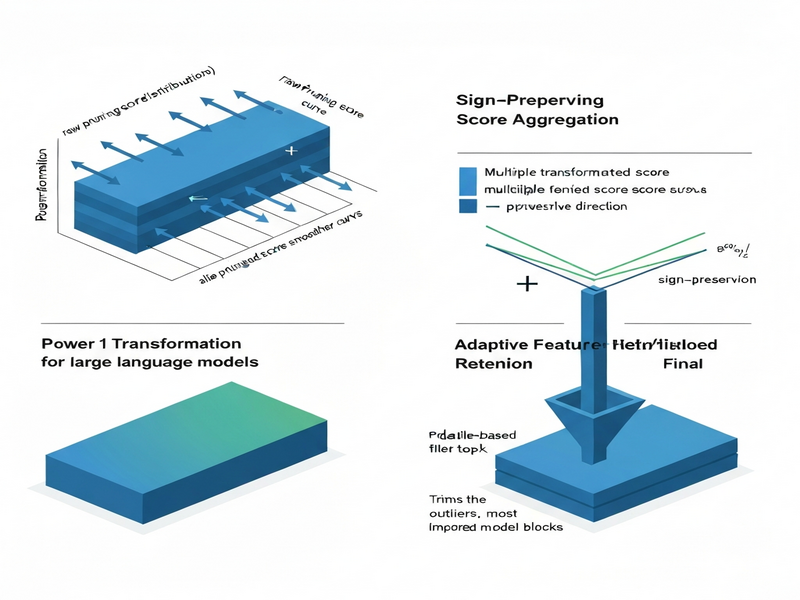
- Power transformation for distribution alignment: Each layer’s raw pruning scores are passed through a monotonic power function (e.g., x↦x^γ) whose exponent γ is learned per‑layer. This non‑linear scaling compresses long tails and expands compressed regions, bringing heterogeneous score distributions onto a common scale without destroying relative ordering.
- Sign‑preserving score aggregation: Instead of discarding the sign, the method separates magnitude and direction. Magnitudes are aggregated after power transformation, while signs are combined via a majority‑vote scheme that respects the original optimization direction. The resulting aggregated score retains both “how important” and “which way to adjust” information.
- Percentile‑based outlier removal: Before aggregation, scores that fall outside a configurable percentile window (e.g., below the 5th or above the 95th percentile) are clipped. This simple statistical guard prevents a handful of extreme values from skewing the final pruning decision.
Collectively, these components form a pipeline that can be dropped into any existing AFR‑based training loop, converting its unstructured recommendations into structured pruning masks that are hardware‑friendly.
How It Works in Practice
The practical workflow can be broken down into four sequential stages, each of which maps cleanly onto standard deep‑learning pipelines:
1. AFR Score Generation
During a brief fine‑tuning pass, the model records per‑parameter AFR scores—typically a combination of weight magnitude, gradient information, and a learned retention factor. This stage is identical to the original AFR method and requires no extra code.
2. Power‑Law Normalization
For every layer, the raw scores are fed into a power‑law function. The exponent γ is selected by minimizing the Kolmogorov‑Smirnov distance between the transformed distribution and a target reference (e.g., a Gaussian). This step equalizes the statistical shape of scores across layers, making later aggregation fair.
3. Sign‑Aware Aggregation & Outlier Clipping
Transformed magnitudes are clipped to the 5‑95 percentile range, then summed across the dimensions that define a structural unit (e.g., all weights belonging to a specific attention head). Simultaneously, the signs of the original scores are voted on; if the majority are positive, the aggregated unit is marked as “retain,” otherwise “prune.” The final structured mask is a binary map indicating which heads, neurons, or feed‑forward blocks survive.
4. Structured Pruning & Fine‑Tuning
The binary mask is applied to the model, physically removing the selected structures. A short post‑prune fine‑tuning phase (often 1–2 epochs) restores any lost performance, leveraging the retained sign information to guide weight updates.
What sets this pipeline apart is its end‑to‑end compatibility with existing training scripts: the only new hyper‑parameters are the power exponent γ and the percentile thresholds, both of which can be auto‑tuned or set to sensible defaults (γ≈0.6, 5‑95%). The method therefore adds negligible engineering overhead while delivering structured sparsity that modern GPUs and TPUs can exploit.
Evaluation & Results
The authors validated their approach on three widely used LLM families:
- Llama‑3‑8B – a decoder‑only transformer with 8 billion parameters.
- Vicuna‑v1.5‑13B – an instruction‑tuned variant of LLaMA‑2.
- LLaVA‑v1.5‑13B – a multimodal vision‑language model.
Each model was subjected to three pruning regimes: (a) baseline unstructured AFR, (b) conventional structured pruning (magnitude‑based head removal), and (c) the proposed unified method. The evaluation metrics included:
- Zero‑shot accuracy on standard benchmarks (e.g., MMLU, TruthfulQA).
- Per‑token latency measured on an NVIDIA A100 GPU.
- Memory footprint and FLOPs reduction.
Key findings:
- Accuracy parity: Across all three models, the unified structured approach retained within 0.3 percentage points of the unstructured AFR baseline, far outperforming naïve structured pruning which lost 1.5–2.2 points on average.
- Speedup gains: Structured masks yielded 1.8×–2.3× reduction in inference latency, matching the theoretical speedup expected from the removed heads and feed‑forward blocks. Unstructured sparsity, by contrast, delivered < 1.1× speedup on the same hardware.
- Resource efficiency: Memory consumption dropped by roughly 30 % for the 13 B‑parameter models, enabling batch sizes that were previously infeasible on a single A100.
These results demonstrate that the proposed pipeline can close the long‑standing gap between compression quality and practical deployment speed, a breakthrough for enterprises that need to serve LLM‑powered applications under tight latency budgets.
Why This Matters for AI Systems and Agents
From a systems‑engineering perspective, the ability to apply structured pruning without sacrificing model fidelity reshapes several design decisions:
- Agent latency budgets: Real‑time conversational agents often allocate < 100 ms per token to stay responsive. The 2× speedup reported in the paper makes it feasible to run 13 B‑parameter agents within that window on commodity GPUs.
- Scalable orchestration: Cloud orchestration platforms can pack more instances per node, reducing operational cost per request. Structured sparsity also simplifies container images because the pruned model is a dense tensor, avoiding the need for custom sparse kernels.
- Multi‑modal pipelines: For vision‑language agents like LLaVA, reduced memory footprints allow simultaneous processing of higher‑resolution images and longer text prompts, expanding the scope of applications such as AI‑driven design assistants.
- Integration with existing tooling: The method can be wrapped into a Workflow automation studio pipeline, letting data scientists trigger pruning jobs as part of CI/CD for model releases.
- Business impact: Companies can now offer “large‑model” capabilities (e.g., detailed code generation, nuanced reasoning) at a fraction of the compute bill, opening new revenue streams for AI‑first SaaS products.
What Comes Next
While the unified approach marks a significant step forward, several avenues remain open for exploration:
- Dynamic pruning schedules: Instead of a single static mask, future work could investigate per‑request or per‑session adaptive masks that react to input complexity.
- Cross‑modal pruning: Extending the pipeline to jointly prune vision and language branches could yield even larger efficiency gains for multimodal agents.
- Hardware‑aware exponent tuning: Co‑optimizing the power‑law exponent γ with specific accelerator characteristics (e.g., tensor‑core utilization) may push speedups beyond the reported 2.3×.
- Open‑source tooling: Packaging the method as a plug‑and‑play library would accelerate adoption. The UBOS platform overview already supports custom model‑optimization plugins, making it a natural home for such a contribution.
- Business‑level case studies: Demonstrating cost savings in real deployments—such as a chatbot handling millions of daily queries—will cement the commercial relevance of structured AFR.
Practitioners interested in trying the technique can start by cloning the authors’ GitHub repository (linked in the paper) and integrating the three‑step pipeline into their existing training scripts. For teams that need end‑to‑end support, the Enterprise AI platform by UBOS offers managed pruning services, automated hyper‑parameter search, and monitoring dashboards.
References
For more insights on how model compression can accelerate your AI products, explore the UBOS templates for quick start or contact our About UBOS page.
Andrii Bidochko
CTO UBOS
Andrii Bidochko is an AI entrepreneur and researcher focused on AI agents, reinforcement learning, and autonomous systems. He writes about the technologies shaping the future of machine intelligence, from frontier models and agent architectures to real-world AI applications.